Data Mesh Architecture Explained
The advent of the data mesh has changed the way organizations manage and utilize data. It’s not expected to go away anytime soon.
Data mesh, in short, is a popular approach to data management in the enterprise. Its primary goal is to empower teams, especially cross-functional ones.
In this article, we'll delve into what data mesh is and explore its key principles. We'll also discuss some benefits of implementing this modern data mesh approach in your organization. Additionally, we will provide insights on how to implement it successfully.
Let's have a closer look.
What is data mesh?
Data Mesh is a set of principles with a modern decentralized approach to data architecture and data management. The aim of data mesh is to empower cross-functional teams within an organization.
Unlike traditional centralized data architectures, which rely on a single team managing all aspects of the data ecosystem, a data mesh distributes the responsibility for data across different product teams. Each team takes ownership of their own domain-specific data products and manages them independently using mesh principles. This distributed approach allows for greater scalability, flexibility, and agility in addressing evolving business needs.
(Despite the names, data mesh it not to be confused with data fabric, which is an infrastructure-level layer of software that enables data to move between different systems.)
Key principles of data mesh
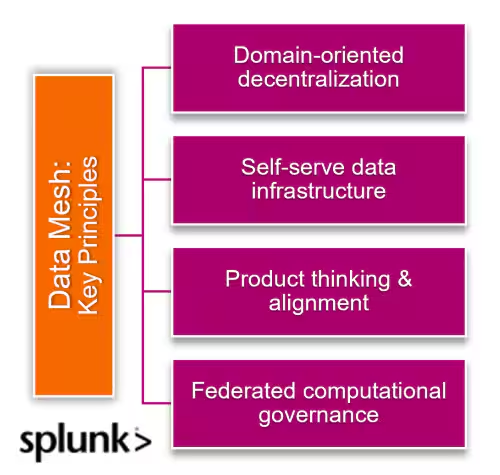
To help you better understand the several aspects of data mesh, let's explore some key principles.
Domain-oriented decentralization
Firstly, a data mesh is based on the concept of domain-oriented decentralization. It allows each product team to take ownership of its own data products and manage them independently with high autonomy and low coordination.
This approach allows product teams to focus on their core competency, quickly develop new features and services, and evolve their data stack in line with changing business needs. Here are some examples:
- A marketing team is responsible for developing and managing customer data products.
- An engineering team is responsible for developing and managing product data products.
- A finance team is responsible for developing and managing financial data products.
Self-serve data infrastructure
Next, having a dash mesh also means more autonomy is placed in the hands of different teams.
By promoting autonomy and reducing dependencies on centralized teams, organizations can empower cross-functional teams to have more control over their own data needs. This approach allows for faster decision-making, increased agility, and improved collaboration across the organization.
Product thinking & alignment
In a data mesh architecture, you'll also need to think of your data as a product. Treating data as a product involves:
- Assigning clear ownership.
- Defining its value proposition.
- Creating a roadmap for its development.
This approach ensures that data products are treated with the same level of care and attention as any other tangible product in an organization.
Continuous improvement is achieved through feedback loops that allow teams to iterate on their data products based on user feedback and changing business needs. By staying responsive to feedback, teams can ensure that their data products remain relevant, valuable, and effective over time.
Federated computational governance
In each implementation of an effective data mesh architecture, an organization would need federated computational governance. Federated computational governance is a set of protocols and procedures to ensure data security, integrity, compliance, and privacy.
Distributing governance responsibilities across cross-functional teams helps to ensure that decision-making is inclusive and reflects diverse perspectives. This approach allows for a more agile and responsive governance framework, enabling faster problem-solving and reducing bottlenecks in the decision-making process.
Some ways to ensure effective federated computational governance include:
- Establishing clear roles and responsibilities.
- Setting up a feedback loop process to ensure that decisions are aligned with the organization's goals.
- Developing data policies and procedures to comply with regulations.
- Implementing security measures such as encryption, identity management, and access control.
(Know the differences between data governance & data management.)
Benefits of data mesh
Now that you understand the key principles of a data mesh, let's look at some of the main benefits.
Empowering cross-functional teams
Clear ownership and accountability for data domains ensures that each team is responsible for the quality and accuracy of their own data, fostering a sense of ownership and pride. With shared understanding and collaboration across teams, knowledge can be freely exchanged, leading to more comprehensive insights and solutions.
Decentralized data management also enables faster decision-making by empowering teams to access and analyze relevant data directly.
Improved data quality & availability
A data mesh also enables organizations to increase the quality and availability of data.
Through a decentralized approach, each product team is responsible for ensuring that their own data sets are accurate and up to date. This reduces redundancy in the system and minimizes the risk of errors and inconsistencies in the data.
Here are some practices that can help in managing data quality in data mesh:
- Regularly reviewing data sources to ensure accuracy.
- Establishing quality assurance (QA) processes and checks.
- Creating automated alerts for outlier values.
Data validation checks like these at the source ensure accurate and reliable data. This helps improve overall data quality and eliminates the need for time-consuming manual error detection.
Consistent data standards across different teams and systems also enhance collaboration and enable seamless integration of datasets. When everyone follows the same set of standards, it becomes easier to share and analyze data across various departments. This consistency eliminates confusion, reduces errors caused by incompatible formats, and improves overall efficiency.
Increased innovation & agility
Data mesh enables teams to quickly experiment with new ideas using self-serve analytics tools is a key aspect of increased innovation and agility in organizations. Here are some ways data mesh will boost innovation and agility:
- The ability for quick experimentation using self-serve analytics tools
- Fast iteration cycles with reduced reliance on centralized pipelines
- Encouragement of creativity through diverse perspectives on data usage
These teams can then access and analyze data on their own, test hypotheses, iterate on solutions, and make informed decisions more rapidly.
Fast iteration cycles due to reduced reliance on centralized data pipelines allow teams to move swiftly from idea generation to implementation. Encouragement of creativity by enabling diverse perspectives on data usage drives innovation forward. When different team members have access to relevant data sets and are empowered to explore various angles, novel insights are discovered that may not have been possible otherwise.
Reduced bottlenecks & dependencies
A data mesh architecture enables faster insights! By parallel processing distributed datasets, teams can uncover valuable information more quickly and efficiently. Redundant storage eliminates single points of failure, ensuring that data is protected and accessible at all times.
Furthermore, changes or disruptions in one team's infrastructure have minimal impact on the operations of others, reducing dependencies and bottlenecks within the organization.
The introduction of a data mesh would, therefore, boost efficiencies.
How to implement data mesh in your organization
Implementing data mesh can help an organization streamline data operations, access valuable insights faster, and foster cross-functional collaboration. However, putting a strategic plan in place ensures a smooth transition.
Here are some steps organizations can take when implementing a data mesh:
1. Define your goals & objectives
The first step in implementing data mesh is to define your goals and objectives. Creating an actionable roadmap with measurable success criteria will help ensure that data mesh initiatives are in line with organizational objectives.
It also helps to identify any potential roadblocks or challenges, allowing teams to plan ahead and take proactive measures.
2. Identify domain-driven teams
Analyzing existing team structures is the next step in identifying domain-driven teams. This helps you to be aware of your current organization's composition, strengths, and weaknesses and assign them according to their domain expertise.
Mapping business functions to data domains allows us to understand which teams are responsible for specific data sets and processes. This mapping helps ensure that each team clearly understands their role and responsibilities within the larger ecosystem of distributed data management.
3. Establish data product ownership
Defining ownership roles and responsibilities is crucial in establishing data product ownership. Teams can effectively manage and govern their data products by clearly outlining who is responsible for each data domain.
Assigning product owners to oversee specific domains ensures a focused approach to decision-making and accountability. This clarity in roles promotes efficiency and empowers cross-functional teams to take ownership of their respective areas within the data mesh framework.
4. Build self-serve data infrastructure
Working towards a self-serve data culture involves building infrastructure that encourages it too. To empower cross-functional teams with distributed data management, organizations must focus on:
- Designing scalable data architectures that can handle large volumes of diverse datasets while ensuring efficient processing and storage.
- Implementing effective data access patterns and APIs to enable seamless retrieval and manipulation of the required information.
- Enabling self-service provisioning of resources to allow teams to independently obtain the necessary computing power, storage capacity, and tools for their specific needs.
These efforts not only enhance productivity but also foster a collaborative environment where teams can leverage the power of data without unnecessary dependencies.
5. Implement federated computational governance
Establishing data sharing and collaboration policies is also crucial in implementing federated computational governance.
With clearly defined guidelines and procedures, teams can efficiently exchange data and work collaboratively across domains. This ensures that the right information reaches the right people, promoting effective decision-making and innovation.
Fostering a culture of transparency, trust, and accountability is essential for successful implementation of federated computational governance. Here are some examples:
- Creating open forums for teams to discuss data-related challenges and share best practices.
- Encouraging collaboration among different groups within an organization by promoting cross-functional initiatives such as hackathons or workshops.
- Establishing data management standards across the board, from coding to documentation and version control.
Final thoughts
To wrap up, data mesh is a valuable approach for organizations looking to improve their data operations, access insights faster, and promote collaboration. This modern approach to data architecture provides benefits such as an empowered team, better data quality, faster innovation, and fewer bottlenecks.
If your organization is looking to transition to data mesh, make sure you define your goals and objectives first, identify domain-driven teams, establish product ownership roles, build a self-serve data infrastructure, and implement federated computational governance.
FAQs about Data Mesh Architecture
Related Articles

How to Use LLMs for Log File Analysis: Examples, Workflows, and Best Practices

Beyond Deepfakes: Why Digital Provenance is Critical Now

The Best IT/Tech Conferences & Events of 2026

The Best Artificial Intelligence Conferences & Events of 2026

The Best Blockchain & Crypto Conferences in 2026

Log Analytics: How To Turn Log Data into Actionable Insights

The Best Security Conferences & Events 2026

Top Ransomware Attack Types in 2026 and How to Defend