What Is Data Analytics? The 4 Analytics Types You Need To Know
Data analytics is the discovery, management and communication of meaningful insights from historical information to drive business processes and improve decision making. The process involves:
- Acquiring or collecting data from multiple sources.
- Managing the data to transform information into consumable formats
- Using analytics tools to extract meaningful patterns from data.
So, let's take a look at data analytics today, specifically the 4 types you need and what they'll tell you about your organization.
Data analytics vs. business analytics
Data analytics is also interchangeably referred to as business analytics or business process analytics:
A data analyst tends to work closely with the technology aspect: collecting, transforming, governing, securing and consuming data using tools that transform information into applicable knowledge. Data analysts enable the technology capability and processes that can be used to solve a variety of business problems.
A business analyst follows a similar route to drive strategic business decisions as their tasks are primarily driven by the need to solve well-defined business use cases.
(Know the difference between data analytics & data science.)
Adopting data analytics: 4 analytics types for your organization
In this blog, we will review four types of Data Analytics that your organization can adopt today:
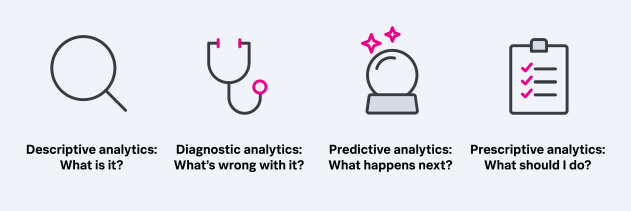
Descriptive analytics
What happened?
Descriptive analytics is the simple form of analytics that answers the primary questions based on the available information. Here, descriptive analytics are able to:
- Tell you what is going on currently and recently.
- Uncover patterns based on current and historical information.
This knowledge can help uncover the strengths and weaknesses of your operational processes and business decisions as they reflect in terms of KPI and metrics performance. It can be used to understand how these trends change between the past. It also forms a basis to other forms of analytics such as predictive and prescriptive analytics that forecast future trends or provide some actionable advice.
Examples of descriptive analytics include financial statement analysis:
- Which product has the largest customer acquisition cost?
- Which product is most in demand?
- How much is the company spending on product advertisement for the most popular products as compared to least popular products?
Diagnostic analytics
Why did this happen?
Diagnostic Analytics refers to the practice of discovering context and root cause underlying a trend, pattern or insight in data. It helps understand correlations and relationships between phenomena that can be described by these trends — but require further analysis to identify a true reasoning. Data analysts take several approaches for diagnostic analytics:
- Testing hypotheses.
- Identifying metrics that appear to correlate.
- Finding if a correlation is attributable to causation.
This can be achieved by statistical analysis ranging from standard linear regression to advanced machine learning algorithm implementations. Once the related factors are identified, they are further analyzed in isolation.
Examples of diagnostic analytics include the analysis of shopping trends during peak season to answer questions such as:
- Why do a majority of customers purchase product A and product B together?
- Why do customers buy product C at the last minute?
By answering these questions, ecommerce companies can better manage pricing models and supply chains to boost revenue and optimize operational expenses.
Predictive analytics
When will it happen?
Predictive analytics uses historical and present information to uncover insights about the future. It helps identify probable future outcomes. As such, data analysts view the problem in two dimensions:
- Discovering what is about to happen.
- Determining when it might happen.
To answer these questions, analytics tools typically use advanced statistical methods including machine learning algorithms that need to train on large volumes of data to uncover future insights with acceptable accuracy. These models can be used to predict events expected in the immediate future:
- An anomalous network traffic behavior suggesting an imminent network intrusion by an unauthorized authority.
- Forecasts about the distant future. How much additional cloud resources are required to accommodate the increasing network traffic demand one year from now, given the recent growth in user base?
Prescriptive analytics
What to do next?
Predictive analytics goes beyond basic data analysis — it helps guide strategic business decisions for the future. Once you’ve identified probable future scenarios, you can use prescriptive analytics to evaluate the choices that can help realize strategic business goals for the organization.
Foe example, an ecommerce company can use prescriptive analytics to drive the recommendations engine on their platform that allows…
- Customers to make better purchase decisions.
- The business to optimize revenue opportunities.
This is different from traditional rules-based recommendations or A/B testing that follow a fixed and predefined workflow to compare known scenarios. Instead, the advanced algorithms first identify probable future scenarios and uncover the consequences that occur iteratively — each iteration opens a myriad of possibilities and future scenarios.
This enables you to discover and map an optimal path from the current state to a desired future state, all with actions uncovered by predictive analytics.
(See how predictive & prescriptive analytics can work together.)
Scaling data is key to analytics success
To make the most of your analytics efforts, it is important to establish a scalable data platform – built using data lake or data lakehouse technologies that simplifies the data acquisition process. Once a foundation of trust is established by adopting data management and governance protocols that align with the applicable compliance regulations, you can extend the data pipeline by integrating third-party analytics tools.
Once you’re established, you can start to use and experiment with a variety of data analysis techniques.
FAQs about
Data Analytics Guide
Related Articles
How to Use LLMs for Log File Analysis: Examples, Workflows, and Best Practices

Beyond Deepfakes: Why Digital Provenance is Critical Now

The Best IT/Tech Conferences & Events of 2026

The Best Artificial Intelligence Conferences & Events of 2026

The Best Blockchain & Crypto Conferences in 2026

Log Analytics: How To Turn Log Data into Actionable Insights

The Best Security Conferences & Events 2026

Top Ransomware Attack Types in 2026 and How to Defend