Continuous Testing: The Ultimate Guide
Learn Kayly LangeIn recent history, software has been the critical edge businesses leverage over their competitors. Because of the key role it plays for organizations, organizations have pushed to deliver more innovative, high-quality software with faster release timelines.
Software teams turn to lean approaches to meet these pressing deadlines as demands increase each year. From Agile to Continuous Delivery to DevOps, teams speed up the software development lifecycle (SDLC) with proven processes. However, organizations often fail to reap the expected benefits from shortened SDLC because of inferior quality.
Continuous testing has emerged as a critical strategy to counteract the challenges of maintaining high quality amidst accelerated development cycles.
Continuous testing is an approach that not only identifies defects early on but also fosters a culture of quality and collaboration, which is essential for meeting today’s software demands. By adopting this approach, teams can achieve the delicate balance of speed and quality, enabling them to deliver innovative, high-quality software that provides a competitive edge.
As we delve deeper into the benefits, fundamentals, and implementation steps of Continuous Testing, it becomes clear that this method is not just an option but a necessity for teams aiming to thrive in the fast-paced world of software development.
What is Continuous Testing?
Continuous Testing (CT) is a process that continuously checks software quality during the software development cycle (SDLC). It is like a constant health check-up for programs as they are created. Continuous testing finds and fixes problems early, ensuring the software is always ready to go and works well without big issues.
With continuous testing, developers catch mistakes quickly and early, ensuring a high-quality final product that can be delivered to users without delays.
(Related reading: software testing explained & the software engineer role.)
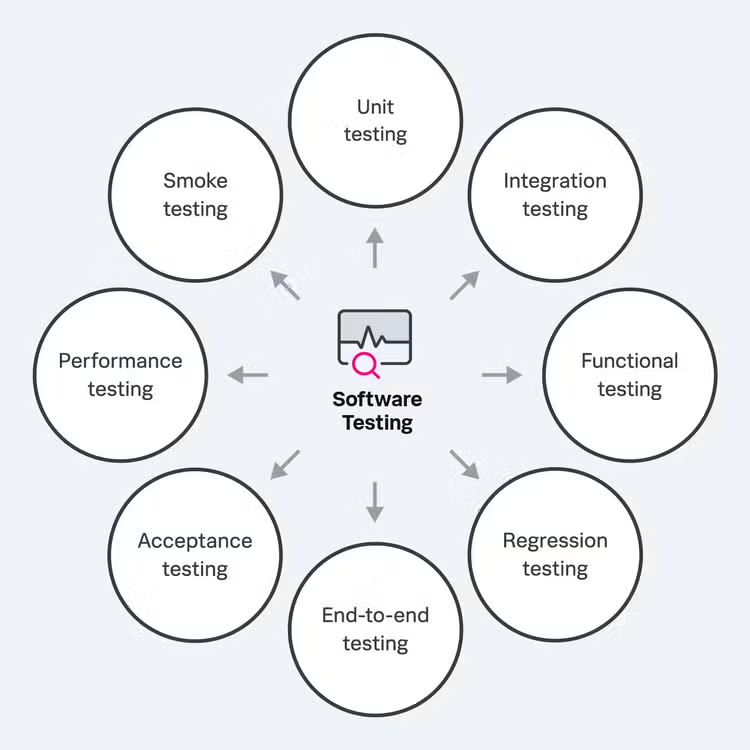
Key benefits
Continuous testing offers many compelling benefits, making it an essential process for teams that want to enhance their software development and delivery processes.
- Faster identification & bug resolution. CT allows early detections of defects. Identifying bugs as soon as they are introduced makes fixing them easier and less costly, leading to higher-quality software.
- Enhanced quality assurance (QA). There is a constant focus on quality because tests are run continuously. It ensures that software meets the required standards at every stage of development. This ongoing evaluation helps in maintaining a consistent quality level.
- Reduced time to market. CT significantly reduces the time needed for manual testing by automating and integrating it into the development process. This acceleration allows teams to release new features and updates faster.
- Increased release confidence. Continuous feedback from the testing process enables developers to make informed decisions about the software's readiness for release. This constant validation builds confidence in the application's stability and performance, reducing the fear of post-release bugs.
- Improved customer satisfaction. The ultimate goal of adopting CT is to deliver better products to the end user. Organizations significantly enhance the user experience and satisfaction by ensuring the software is thoroughly tested and free from critical issues.
- Supports agile & DevOps Practices. CT fits perfectly with Agile and DevOps methodologies, emphasizing continuous improvement, flexibility, and speed. It supports these practices by enabling faster feedback loops and more efficient collaboration among development, testing, and operations teams.
Adopting CT enables DevOps teams to achieve their goals of rapid, reliable, and frequent deployments. It not only enhances the efficiency and quality of software development but also aligns with the broader objective of delivering superior value to customers in a competitive market.
Fundamentals of Continuous Testing
Continuous Testing has foundational practices and principles that ensure its effectiveness within software development and delivery processes. The most critical ones include:
Automation of testing processes
Automation transforms repetitive and time-consuming tasks into quick, consistent actions. This automation significantly speeds up the testing cycle, increases test coverage, and reduces the chances of human error, enabling more efficient issue identification and resolution.
(Related reading: automation vs. orchestration & RPA: robotic process automation.)
Integration with CI/CD
Seamless integration of testing into the Continuous Integration/Continuous Deployment (CI/CD) pipeline ensures that every code commit triggers an automatic build, test, and preparation for deployment processes. This approach eliminates testing as a bottleneck, fostering a more streamlined path to delivering high-quality software rapidly and reliably.
Comprehensive test coverage
Achieving comprehensive test coverage means that the testing efforts span across functionality, performance, security, and usability and are conducted across different devices and environments.
This thoroughness ensures that all aspects of the application work as expected, meeting all requirements and user expectations, thus safeguarding the quality of the final product.
Shift-left approach
Adopting a shift-left approach involves moving testing earlier in the SDLC, including during the requirement and design phases. This early testing helps identify and address defects when they are less costly to fix, significantly enhancing the development process's efficiency and effectiveness.
Continuous feedback loops
CT is characterized by its ability to provide immediate feedback to developers, testers, and stakeholders about the application's quality and readiness. This prompt feedback:
- Facilitates quick corrective actions.
- Enhances team members' collaboration.
- Improves the product’s quality.
Test environment & data management
Ensuring that the test environments are stable, scalable, and reflective of production scenarios, along with managing test data efficiently, is essential for conducting meaningful and accurate tests.
Proper management of these elements ensures that the testing results are reliable and accurately predict the software’s performance in real-world conditions.
Scalability of testing efforts
The scalability of testing efforts is vital to adapt to the varying complexity of the application and its development stages. Scaling testing up or down ensures that resources are used effectively and testing remains efficient without becoming a bottleneck in the software delivery process.
Continuous learning & improvement
Continuous learning and improvement are at the heart of CT. Leveraging insights and data from testing allows teams to refine their testing strategies, tools, and practices constantly.
This commitment to continuous improvement helps teams stay adaptable to changing requirements and technologies, ensuring the long-term effectiveness of their testing efforts.
Continuous Testing: An 8-step approach
Implementing CT involves a series of steps that integrate testing seamlessly into the software development and delivery pipeline. Here’s a structured approach to perform Continuous Testing effectively:
Step 1. Plan & define objectives
The journey to Continuous Testing begins with setting clear goals and objectives. It’s crucial to understand what you aim to achieve, whether it’s:
- Enhancing software quality.
- Accelerating release cycles.
- Reducing the number of defects.
Defining the scope of testing and deciding on the types of tests to be conducted (like unit, integration, or system tests) is an essential first step. This planning phase lays the foundation for a structured testing strategy that aligns with your development goals.
Step 2. Choose tools & technologies
The appropriate tools and technologies are crucial in establishing a Continuous Testing environment. Your tools should support automated testing and seamlessly integrate with your development and deployment workflows.
Compatibility with your existing technology stack is essential to facilitate a smooth integration into your CI/CD pipeline, ensuring that the testing process enhances rather than hinders your development efforts.
Step 3. Automate testing processes
You can efficiently cover repetitive tasks such as regression testing by converting manual tests into automated ones.
Developing test scripts that can be executed automatically enables the team to perform a wide range of tests without manual intervention, significantly speeding up the testing process and reducing the likelihood of human error.
Step 4. Integrate with CI/CD pipeline
Integrating testing into the CI/CD pipeline is precisely what makes testing continuous. This integration means configuring your pipeline to automatically trigger tests at critical development stages, such as after every commit or build and before deployment.
Setting up automated feedback loops ensures that developers and testers are immediately informed of the test results, allowing for quick identification and resolution of issues.
(Related reading: DevOps release management.)
Step 5. Maintain & update test cases
CT requires ongoing maintenance and updating test cases to keep pace with the application’s evolution. Regularly reviewing and refining test cases ensures they remain relevant and encompass new features and changes.
Effective test data management is also vital, ensuring that tests are meaningful and reflect real-world scenarios.
(Related reading: how data management works.)
Step 6. Monitor & measure performance
Implementing monitoring tools allows for the continuous assessment of the application’s performance and availability in production.
Collecting and analyzing key performance indicators (KPIs) such as test pass rates, defect resolution times, and frequency of releases provides valuable insights into your CT strategy's effectiveness and highlights improvement areas.
(Related reading: DevOps monitoring & SRE metrics for monitoring.)
Step 7. Analyze results & refine processes
Regular analysis of test outcomes is essential to:
- Identify patterns.
- Recurring issues.
- Improvement opportunities.
This step involves using the insights gained from testing to refine and optimize your testing strategy and processes, ensuring they remain effective and aligned with your development objectives.
Step 8. Foster a culture of quality & collaboration
The last step is establishing a culture of quality and collaboration. It is fundamental to the success of CT.
- Encouraging involvement from all team members in the testing process and fostering shared responsibility for quality helps to break down silos between developers, testers, and operations teams.
- Promoting knowledge sharing and best practices across the team enhances the overall efficiency and effectiveness of the testing process.
By meticulously implementing each of these steps, organizations can fully realize the benefits of Continuous Testing, achieving faster delivery times, higher software quality, and a more streamlined development lifecycle.
Ensuring software excellence at speed
Continuous Testing is a pivotal element in the modern software development landscape, particularly within Agile and DevOps practices. By integrating CR into the development and delivery pipelines, organizations enhance their software products' quality, reliability, and speed. This approach not only streamlines the detection and resolution of issues but also fosters a culture of continuous improvement and collaboration across teams.
As businesses continue to navigate the complexities of digital transformation, embracing CT will be crucial in maintaining competitive advantage, ensuring customer satisfaction, and driving innovation in an ever-evolving technological landscape.
FAQs
Related Articles

What Is ITOps? IT Operations Defined

Code Refactoring Explained