A Guide to Bots: Good vs. Bad Bots, Common Types, and Online Safety in 2026
Learn Laiba Siddiqui , Samantha DunnKey Takeaways
- Bots account for nearly half of online traffic — some are helpful, others are harmful.
- Knowing different bot types helps you identify risks and protect your data.
- Use tools like CAPTCHAs, firewalls, and software updates to defend against bad bots.
When you communicate with someone online, have you ever thought whether it’s a real person or a bot? One second, you're chatting or scrolling. Next, you're thinking if there's even a human on the other side. But why is that so?
That’s because bots have slipped so seamlessly into our digital lives that we often don’t realize we’re interacting with them. In fact, in 2024, bots were responsible for nearly 50% of all internet traffic. That means every other online interaction could be automated.
Some bots are helpful and make our lives easier, while others can be disruptive — or even malicious.
In this guide, we’ll break down what bots are, the different types you’ll encounter, how they affect your online experiences, and what you can do to protect yourself and your business.
What is a bot?
A bot (short for "robot") is a software application that performs automated tasks over the internet, often at a speed and scale far beyond human capability. Bots can be programmed to chat with users, search and index web content, collect and analyze data, or even mimic human behaviors in online environments. They power everything from search engines and customer service chats to social media automation and e-commerce recommendations.
While many bots are designed to make digital experiences smoother and more efficient, others can be used for less benign purposes, such as spreading spam or attempting to breach accounts.
Today, bots are woven so seamlessly into our digital lives that we often interact with them without even realizing it, making them a fundamental part of how the modern internet operates.
Good bots vs. bad bots
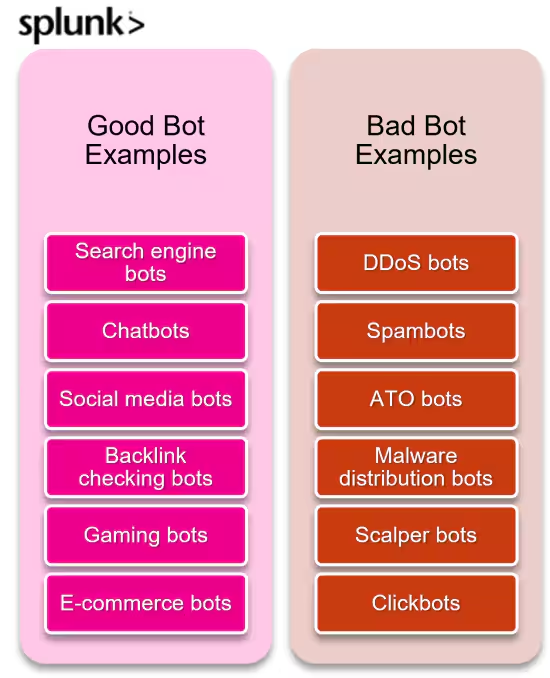
Bots come in many forms, but they generally fall into two categories: good bots and bad bots. The difference lies in their purpose and the impact they have on users and businesses.
Good bots
Good bots are designed to provide value, streamline processes, and enhance digital experiences. They operate within ethical boundaries and typically follow rules set by website owners.
Common examples of good bots include:
- Search engine bots: These are the backbone of modern internet search. Bots like Googlebot, Bingbot, and Amazonbot systematically scan websites, index new content, and ensure you get relevant search results in seconds.
- Customer service chatbots: Found on e-commerce, banking, and support websites, these bots assist users by answering common questions, guiding them through processes, or helping with transactions. For example, they can tell you about return policies, help track orders, or resolve simple issues without human intervention.
- Monitoring and analytics bots: These bots monitor website uptime, track performance metrics, and provide insights that help site owners improve their services.
- Content aggregator bots: Some bots help gather news, job postings, or social media updates from various sources and present them in a single, easy-to-read format.
Good bots are essential to how the internet functions today. Without them, finding information, getting help, or monitoring services would be far more difficult and time-consuming.
Bad bots
Bad bots, on the other hand, are programmed to exploit systems, deceive users, or disrupt online activities for personal or financial gain. They often operate without permission and can cause significant harm to individuals and organizations.
Common examples of bad bots include:
- Spam bots: These bots flood forums, comment sections, and inboxes with irrelevant or malicious messages, advertisements, or phishing links. Their goal is to trick users or drive traffic to shady websites.
- Scalper and sneaker bots: These bots scoop up limited-edition products or concert tickets the instant they go on sale, leaving real customers empty-handed and driving up resale prices.
- Fake social media bots: Used to artificially inflate followers, likes, or engagement, these bots can distort perceptions of popularity and trust. They also spread misinformation or amplify spam.
- Credential stuffing bots: These bots use stolen usernames and passwords to attempt unauthorized logins across various sites, leading to potential data breaches and financial losses.
- Web scraping bots: While some scraping is legitimate, malicious scrapers steal proprietary content or pricing information in violation of site policies.
Bad bots can damage your brand’s reputation, compromise data security, disrupt business operations, and negatively impact the user experience. Their actions can result in lost revenue, increased costs, and eroded trust.
Common types of bots
Let’s explore the most common bots shaping your digital world.
Chatbots
Chatbots are the digital assistants you encounter on websites, ready to answer FAQs or guide you through the shopping process.
Types of Chatbots:
- Rule-based chatbots follow set instructions. Ask a specific question (“What are your store hours?”), and they’ll give you a canned response. They can get confused by off-script requests.
- AI-powered chatbots use machine learning to respond more naturally. Tools like ChatGPT can help with writing, solving math problems, or offering recommendations.
Rule-based chatbots
Rule-based chatbots follow a fixed set of instructions (like a decision tree). If you ask a specific question, such as “What are your store hours?”, they recognize the keyword and immediately reply with today’s open and close times.
However, if you deviate from the script and ask a follow-up question or phrase things differently, they may become confused or stop responding.
HelloFresh uses a rule-based system that answers questions related to the jobs they offer. It works well as long as you stick to expected questions, but if you ask something outside its script, it may not reply correctly. When I asked about jobs, it responded accurately. But when I asked, “Tell me a joke,” it didn’t understand what I was trying to ask.
AI-powered chatbots
AI-powered chatbots use machine learning to understand and respond more naturally. They learn from conversations and feel more like talking to a real person.
ChatGPT is the best example. It tells you almost everything you need to know, whether you require help with writing an email, solving a math problem, or planning a vacation.
Web crawlers
Also known as spiders or search engine bots, web crawlers are the technology that powers search engines like Google. These bots systematically scan websites, read their content, and index the information so it can appear in search results. Without web crawlers, search engines wouldn’t be able to deliver relevant results or help you find what you’re looking for online.
Common examples include Googlebot, Bingbot, and Amazonbot — bots that can read, categorize, and connect vast amounts of content in just milliseconds. If you own a website, you can control what these bots access by setting rules in a file called`robots.txt`, specifying which pages they are allowed — or not allowed — to crawl.
Social media bots
These bots automate tasks like scheduling posts or replying to DMs. Some are helpful, while others are not.
These bots automate social media tasks — some for good, others for ill.
- Helpful bots schedule posts or auto-reply to messages.
- Malicious bots inflate followers, likes, or spam users.
In 2024, 55.6% of Instagram's big influencers with over a million followers were found to use fake methods to boost their engagement.
But how can you tell if someone’s followers are real or fake? One way is to look at their engagement. If they have thousands of followers but barely any likes or comments, that’s a red flag. If you're thinking, how many influencers or celebrities have bought followers or likes? It’s hard to know for sure, but it happens more often than we think.
Gaming bots
If you’re a gamer, you’ve probably encountered gaming bots before. Many games include bots to assist new players or fill empty slots in matches — these are considered helpful, or “good,” bots.
However, not all gaming bots are beneficial. In fact, in 2022, 58.7% of traffic to gaming websites came from malicious bots. These bad bots are often used to cheat, giving players unfair advantages like auto-aiming (which allows for perfect accuracy) or automated resource farming (repeatedly performing tasks to gain in-game rewards).
To combat these negative impacts, game developers employ tools such as behavior tracking, CAPTCHA tests, and even hardware bans to detect and block bots. For example, RuneScape, a popular online role-playing game, introduced a text-based CAPTCHA during extended play sessions, requiring players to type a word to verify they were human before continuing.
E-commerce bots
E-commerce bots are a type of chatbot designed to enhance your online shopping experience. They can answer customer questions, help you find products, compare prices, and even notify you when an item is back in stock or when prices drop.
For example, when searching for "cheek tints" on Sephora you might notice that, after selecting a product, the site displays a comparison of similar items — showing pricing, ratings, and key features. This makes it much easier for shoppers to make informed decisions without having to browse through endless options.
However, not all e-commerce bots are helpful. Some are created to exploit the system. If you’ve ever tried to buy concert tickets or a limited-edition product only to find it sold out within seconds, you’ve likely been outpaced by scalper bots. These bots can purchase high-demand items far faster than any human, snapping them up instantly so they can be resold at inflated prices.
This practice not only frustrates genuine shoppers who want a fair chance to buy something but also creates challenges for businesses trying to keep their product launches equitable. In short, while some bots make shopping more convenient, others make it less fair for everyone.
Malicious bots
While some bots are helpful, others are designed to cause harm. Malicious bots exploit vulnerabilities, steal data, and disrupt online experiences.
Let’s take a closer look at some of the most common types and how they operate:
Spambots
Spambots scour websites to collect email addresses or phone numbers, which they then use to send out spam messages.
For example, you may receive a message from a number claiming you’ve been offered a high-paying job — even though you never applied. If the message tries to redirect you to a suspicious number or website, that’s a strong sign it’s a spambot. These messages are crafted to trick you into responding or clicking a link, often with the intent to steal your personal information.
Malicious chatterbots
These bots appear in website chats or on social media, posing as real people. They’re programmed to sound convincing, but their goal is to lure you into sharing sensitive information.
For instance, you might get a message promising access to an account loaded with funds, complete with a username, password, and a link to a seemingly legitimate site. Clicking the link can lead to phishing scams, where your data is stolen or malware is secretly installed on your device.
Click bots
Click bots are used to generate fake ad clicks or page views, artificially inflating traffic numbers and ad revenue. Some companies may unknowingly purchase such services, thinking they’re getting genuine traffic.
Click bots simulate thousands of visits, manipulating metrics and budgets without any real engagement.
Botnets
A botnet is a network of compromised devices working together under a single command. In coordinated attacks — such as Distributed Denial of Service (DDoS) — botnets can flood a website with fake traffic, overwhelming servers and causing sites to crash or become unusable. For example, in May 2025, Cloudflare blocked a record-breaking DDoS attack where hackers unleashed 7.3 Tbps of junk traffic on a single IP address in less than a minute.
Credential stuffing
Credential stuffing bots leverage stolen usernames and passwords from previous data breaches, attempting to log into accounts across different websites. If you’ve reused a password from a compromised app — for example, your old fitness tracker — a bot could use it to access your email or financial accounts.
The financial impact of credential stuffing can be significant, with losses ranging from hundreds of thousands to tend of millions of dollars each year.
How to know if you’re interacting with a bot
Even when bots attempt to mimic human behavior, they often fail. So here are a few red flags that you should always watch out for to differentiate between a human visitor and a bot:
- Speed: Bots fill forms and click buttons much faster than humans.
- Repetition: The same action is performed repeatedly.
- 24/7 activity: Consistent, round-the-clock behavior from a single user.
- No human-like pauses: Bots don’t move a mouse around or make mistakes like real users.
Protecting yourself and your business from bad bots
Let’s see a few measures that you can implement to protect your website or system from bad bots:
1. Use CAPTCHA
CAPTCHAs are those familiar tests that ask you to identify images, click on certain objects, or type distorted text. Their purpose is to distinguish between real human users and automated bots, which typically struggle to solve these challenges. Tools like Google reCAPTCHA can be easily integrated into websites to block the majority of automated attacks while keeping the user experience smooth for genuine visitors.
2. Deploy anti-bot tools
Anti-bot solutions leverage machine learning and digital fingerprinting to identify and block suspicious activity. For example, if someone is rapidly attempting hundreds of password guesses in a matter of seconds, an anti-bot tool will recognize this as bot behavior and block the attack before any damage is done.
3. Set up honeypots
A honeypot is a fake environment — such as a dummy login page or fabricated database — designed to attract and trap malicious bots. Security teams can use honeypots to study bot tactics in real time, analyze their behavior, and develop stronger defenses. For example, a hidden form field on your site, invisible to human visitors but detectable by bots, can help you identify and block suspicious activity before it reaches your core systems.
4. Use a Web Application Firewall
A WAF acts as a protective barrier, monitoring all incoming website traffic for suspicious patterns. If the WAF detects behavior typical of bots — such as repeated rapid requests — it can automatically block the traffic, much like a security guard turning away unauthorized visitors at the door.
(Read all about the different types of firewalls.)
5. Monitor your logs
Regularly analyzing access logs and network logs can reveal telltale signs of bot attacks, such as spikes in traffic, repeated failed login attempts, or activity from unusual IP addresses. By analyzing these logs, you can quickly identify potential threats and respond before they cause harm.
(Related reading: log analytics.)
6. Train your users
Educating your staff and users is a crucial defense against bad bots. Many attacks begin with subtle signs, like odd login attempts or suspicious messages. By training your team to recognize these red flags, you empower them to act quickly and prevent small issues from escalating into major problems. Even basic awareness can make a significant difference in your organization’s overall security.
(Understanding malicious bots is key in bolstering your cyber threat intelligence.)
7. Keep your software updated
Outdated software is a prime target for bots searching for vulnerabilities to exploit. When a security flaw is discovered, attackers move quickly to take advantage of unpatched systems. That’s why it’s vital to promptly install the latest security updates and patches for all your software and platforms — closing the door before bots can get in.
Building for a bot-powered world
Bots are now part of everyday digital life—sometimes helpful, sometimes harmful. For businesses and website owners, it’s essential to:
- Audit your security setup.
- Implement basic protections (CAPTCHA, WAF, anti-bot tools).
- Regularly review logs and keep software up to date.
- Train your team to spot suspicious activity.
Even small steps — like setting up a honeypot or adding CAPTCHA — can make a big difference in protecting your business from bot-driven disruptions.
Related Articles

Monitoring Windows Infrastructure: Tools, Apps, Metrics & Best Practices

Network and Application Performance Monitoring: Why You Need Both