Technology Modernization Fund: An Opportunity to Upgrade Legacy Capabilities

T he Technology Modernization Fund, or “TMF,” was created as part of the Modernizing Government Technology Act of 2017. At its core, the TMF is a government-wide technology refresh fund where any federal agency can seek funding for efforts associated with finding IT efficiencies. If funding is received, that agency has up to five years to repay the amount received back to the fund, which can include any efficiencies achieved. Historically, the TMF has seen minimal funding and use. Despite being in place for nearly four years, there have only been eleven projects awarded. Notably, none of these projects have been at the Department of Defense, the largest spender in federal IT.
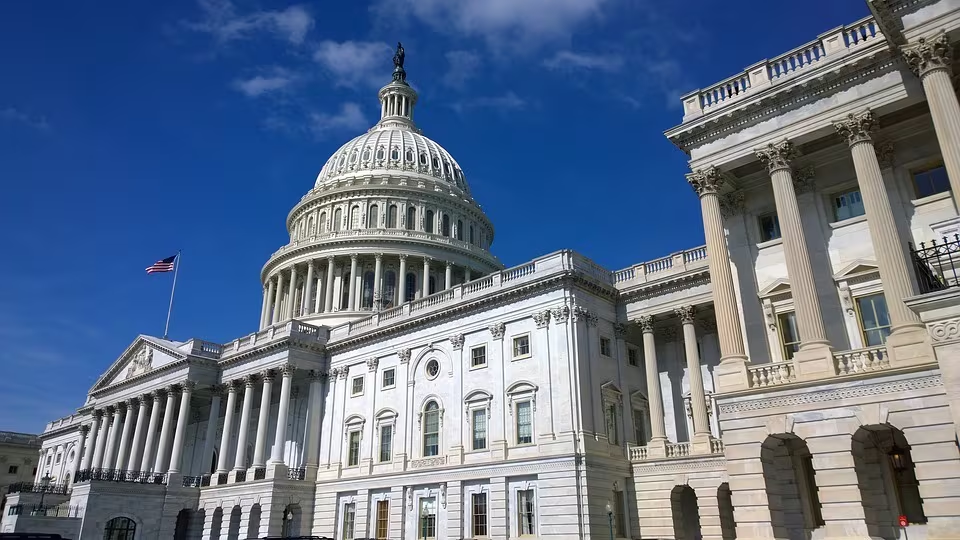
The TMF has been in the news recently due to it receiving a $1 billion investment as part of the American Rescue Plan Act which was signed into law by President Biden in March 2021. This is a substantial amount when compared with the $175 million total investment that the fund had previously received over its lifetime. This is a clear indication of the importance both the Biden Administration and Congress has placed in modernizing federal IT.

There is a Technology Modernization Board made up of multiple senior IT officials from across the federal government that is charged with oversight and implementation of the Fund. Funded projects focus on a variety of areas - from cybersecurity and operations of a Department or Agency, to enhanced delivery of services or implementation of an existing IT modernization strategy. In order to receive funding, Departments and Agencies must apply through a two-step process. First, an Initial Project Proposal must be submitted to the Office of Management and Budget (OMB). This brief form requires input on how a proposed project fulfills an Agency’s mission, the details of the problem(s) to be solved, a cost estimate and key metrics for success. Second, if the Initial Project Proposal is accepted, a Full Project Proposal is presented to the Board which contains a comprehensive funding plan and schedule, specific milestones to measure implementation progress, and a detailed description of the project to be funded.
Despite the relatively straight-forward application process, fewer restrictions should be eased-in in order for Departments and Agencies to take full advantage of the TMF. Perhaps the greatest impediment to full Fund implementation centers on the TMF repayment requirements. Shortly after the American Rescue Plan was signed into law, an industry association letter led by the Alliance for Digital Innovation (ADI) (of which Splunk is a member) was sent to the federal Chief Information Officer, OMB, and General Services Administration, highlighting this and other changes to TMF requirements that could increase its use. The ADI-led letter goes on to note key areas of investment that are proper for TMF utilization: federal operations, citizen services, and perhaps most critically in the current environment—remote work, cybersecurity, and secure cloud adoption.

With the addition of $1 billion for the TMF and the recent announcement that the Administration will be requesting $500 million for the TMF in Fiscal Year 2022, now is the time for Departments and Agencies to seriously consider applying for this funding. With remote work here to stay, a shift to cloud underway, and the ever-present cyber threat, we can expect to see additional focus on the TMF.

Related Articles

How Splunk is Helping Shape the Future of Higher Education IT by Tackling EDUCAUSE 2026 Top Issues

Industries
3 Minute Read

How Splunk is Helping Shape the Future of Higher Education IT by Tackling EDUCAUSE 2026 Top Issues

Dive into how Splunk aligns with key priorities highlighted at EDUCAUSE 2025.
Enhancing Government Resilience: How AI and Automation Empower Public Sector Missions

Industries
3 Minute Read

Enhancing Government Resilience: How AI and Automation Empower Public Sector Missions

Splunk helps government agencies boost security and efficiency with powerful, mission-ready AI and automation.
Solving Manual Mayhem in Telecom with Agentic AI

Industries
3 Minute Read

Solving Manual Mayhem in Telecom with Agentic AI

Agentic AI cuts downtime, improves security, and boosts customer experience, and with unified data from Splunk and Cisco, teams can build more resilient operations.
Upgrading to Splunk Enterprise 10.0 and Splunk Cloud Platform 10.0: Key Resources for Public Sector Customers

Industries
2 Minute Read

Upgrading to Splunk Enterprise 10.0 and Splunk Cloud Platform 10.0: Key Resources for Public Sector Customers

Splunk Enterprise 10.0 and Splunk Cloud Platform 10.0 deliver the most secure, stable, and modernized platform for a digitally resilient and compliance-ready future.
Building the Next Generation of Defenders: From the Classroom to the SOC of the Future

Industries
3 Minute Read

Building the Next Generation of Defenders: From the Classroom to the SOC of the Future

Resilience in the AI era doesn’t just happen – it's built one student, one SOC, and one organisation at a time.
Analytics That Work: 3 Approaches for the Future of Contact Centers

Industries
3 Minute Read

Analytics That Work: 3 Approaches for the Future of Contact Centers

Splunker Khalid Ali explains how unified, real-time intelligence connects data, empowers agents, and builds lasting customer loyalty.
Observability + Security: Real-Time Digital Resilience for SLED

Industries
1 Minute Read

Observability + Security: Real-Time Digital Resilience for SLED

Cisco and Splunk are helping public sector organizations build digital resilience.
Digital Resilience for State and Local Governments (Part Two)

Industries
3 Minute Read

Digital Resilience for State and Local Governments (Part Two)

Discover how collaboration—powered by shared data platforms like Splunk—can enhance incident response and overall digital resilience.
Reflections from SIBOS 2025: How will advances in technology (and especially AI) change the financial services industry over the next 5 years?
Industries
2 Minute Read

Reflections from SIBOS 2025: How will advances in technology (and especially AI) change the financial services industry over the next 5 years?

Discover key insights from SIBOS 2025 on how AI, collaboration, and data will reshape financial services over the next 5 years—prepare for rapid change and exciting opportunities ahead.