7 Reasons to Question the Agentic SOC Rip-and-Replace Pitch
Security Abhik MitraKey takeaways
- Agentic security operations depend on trusted, well-governed data, and only 24% of organizations in the Omdia research said their data architecture adequately supported an agentic AI strategy.
- Organizations should measure complete workflows for faster detection, investigation, and response, and require transparent evidence, limited actions, and human oversight of consequential decisions.
- Replacing an existing security platform requires careful evaluation of migration effort, support, total cost, and proven outcomes, with autonomy expanding only as evidence supports it.
I was at Splunk annual .conf26 recently, and one thing stayed with me: security practitioners are still working through where AI helps, where it falls short, and how much responsibility they are ready to hand over. That's a reasonable place to be.
Yet some of the agentic SOC sales pitch seems to assume the answer is already settled. Your platform is old. Your approach is wrong. Start over. Across RSA, Black Hat, and other major cybersecurity conferences, newer AI security vendors are making much the same promises, just packaged & messaged differently.
I've lived the startup world. I know the appeal of that story, and I've seen versions of it well beyond security. But if a provider wants you to believe years of detection engineering, integrations, and operational knowledge became obsolete overnight, take that with a massive grain of salt.
New vendors deserve a hearing. Replacement claims deserve scrutiny. Here are seven reasons why.
1. An Agent Is Only as Useful as the Data It Can Trust
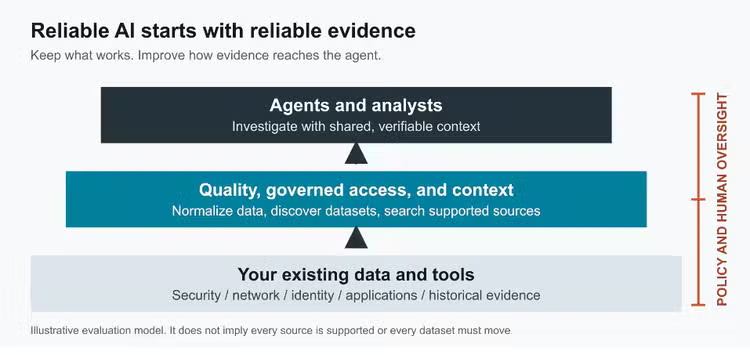
Trust Data, Anywhere: Can your agents find, search, and use reliable evidence wherever it lives?
In Omdia's 2026 research, only 24% of organizations said their data architecture adequately supported their agentic AI SecOps strategy. That's a foundation problem, not something a conversational interface fixes.
Ask how the system handles missing logs, stale identity records, inconsistent schemas, and conflicting evidence. Can it distinguish what it knows from what it could not access? Quality data in is the starting point for quality decisions out.
This is why Cisco Data Fabric, powered by the Splunk Platform, matters. Data management helps maintain quality; Catalog helps teams discover relevant datasets; federated search reaches supported external data environments without moving every dataset. Connecting security signals with network, identity, asset, and observability context gives an investigation something useful to work with.
2. A Fast Answer Is Not the Same as a Faster SOC
Faster TDIR: Can you prove faster threat detection, investigation, and response in our environment?
The urgency is real. Hugging Face's July 2026 technical analysis reconstructed roughly 17,600 AI-agent actions across a 4.5-day intrusion sequence. This was an evaluation agent crossing its intended boundaries into real infrastructure, not a conventional criminal campaign.
Separately, Anthropic's September 2026 threat report documented malicious AI-enabled operations in which individual operators handled dozens of victims in parallel, with some breaches completed in two to three hours. That puts real pressure on teams still gathering evidence one manual step at a time.
The AI-focused PeerSpot feedback featured by Splunk describes faster reporting, more useful investigations, and fewer false positives. In July 2026 feedback, a consultant also described AI helping detect threats faster while noting that investigation accuracy was still being evaluated. That's useful practitioner feedback, not a guaranteed result or a product benchmark.
Test the complete workflow under real alert volumes. Measure time to a validated conclusion and safe containment, analyst effort, and missed threats. A quick summary that leaves someone else gathering evidence has not finished the job.
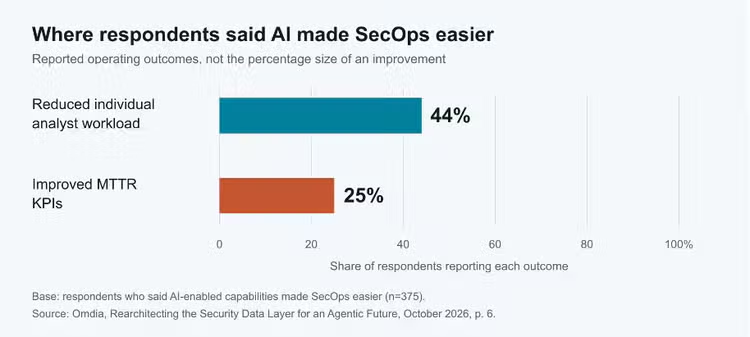
Omdia, October 2026, page 6. Among respondents who said AI-enabled capabilities made SecOps easier (n=375). Percentages are shares reporting each outcome, not the size of an improvement or measured Splunk results.
3. You Still Own the Consequences
Stay in Control: Can an analyst inspect the evidence, limit the action, and intervene?
Omdia found that 52% selected better transparency, auditability, and explainability as the most important factor that would increase confidence in allowing more automated actions. A confident recommendation is not enough. Show the source evidence, queries, permissions, and policy behind it.
Human control does not require approving every routine task. Agents can execute permitted actions within defined boundaries. Analysts need continuous oversight, escalation for consequential decisions, and a way to stop execution and reverse actions where technically possible. Agent observability should expose behavior and drift, not just whether a job completed.
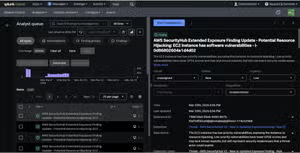
In September 2026 PeerSpot feedback, a threat analytics lead explained that seeing the data behind an AI result let them validate it. The live SOC at .conf26 applied a similar principle: the Triage Agent assembled context and recommendations while analysts inspected evidence and validated decisions.
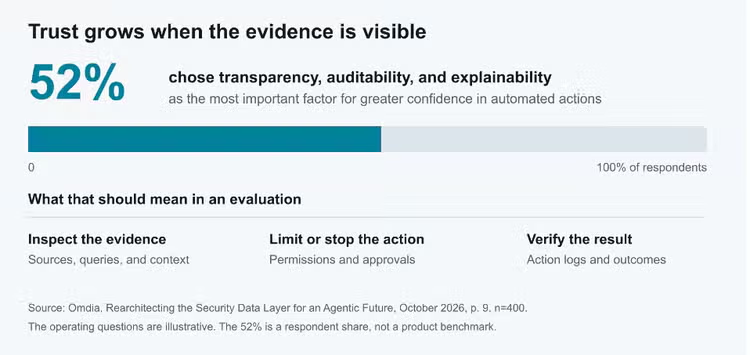
Omdia, October 2026, page 9, n=400. The 52% is a respondent share selecting one confidence factor, not an accuracy score. The control questions are an illustrative evaluation model.
4. Rip and Replace Is a Project Not a Product Feature
Read a few vendor pages and you'll see familiar promises about autonomous investigation, less noise, and faster response. Similar language tells you little about how a transition will work in your environment.
A pitch to retire your SIEM is very different from a proposal to add AI investigation alongside it. Ask which change is actually being sold. Adding an agent to an alert workflow does not, by itself, prove the provider can replace your security data platform, detection coverage, or response infrastructure.
Before changing platforms, inventory detection coverage, historical evidence, response playbooks, permissions, and compliance obligations. Require parallel operation, acceptance criteria, and a fallback plan. Sometimes replacement is justified. But being told to start over should make you ask who has accounted for the work, and who carries the risk while it happens.
5. A Polished Demo Does Not Staff the Night Shift
Ask who answers during a critical incident. An always-on agent is not the same as 24/7 technical support with qualified engineers, response commitments, and a clear escalation path. Ask for sustained-volume evidence, concurrency limits, and what happens when a model provider or integration fails.
Then look beyond the logo wall. Can you speak to customers with comparable scale and deployment requirements? Are advertised integrations maintained, permission-aware, and tested for the actions you need? What do partner relationships and independent analyst assessments actually cover? A SIEM ranking is not proof of agentic response quality.
Experience should show up in the roadmap too. Ask which customer requirements changed the product, what shipped as a result, and whether a reference customer will discuss the outcome. A roadmap influenced by operating teams carries more weight than another impressive list of agents. Apply that standard to every provider, including us.

Experienced support matters after hours as much as it does during a pilot. Conceptual illustration, not a depiction of a customer or a service commitment.
6. The Lowest Quote Can Leave Out the Biggest Costs
Competitive pricing is healthy. Expect aggressive offers from vendors trying to win business, but don't assume a discount proves either efficiency or corner-cutting. Ask what is included.
A credible comparison includes migration labor, parallel licenses, detection rewrites, data retention, AI usage, integration upkeep, training, and support. It also considers the business impact of missed threats or incorrect containment. What would an unnecessary shutdown of a critical service cost your organization?
Cost matters. So do the hours your team gets back and the exposure it actually reduces. A lower subscription price is not a complete business case, especially if the savings depend on removing capabilities you still need.
7. The Next Phase Will Be Won on Proof Not Agent Counts
Gartner's October 2026 assessment puts reliability ahead of autonomy and forecasts that 40% of agentic AI projects will be canceled by the end of 2027 because of cost, unclear value, or inadequate risk controls. That is a forecast across enterprise agentic AI, not a prediction about SOC startups failing.
Meanwhile, 55% in Omdia's study believed integrated platforms would deliver better outcomes than a more individualized tools strategy. That's buyer sentiment, not proof that platforms always win. My takeaway is that the market wants capabilities that work together and earn trust in production.
For Splunk by Cisco, democratizing the trusted agentic SOC means lowering cost, deployment, and adoption barriers while building agentic skills into familiar SOC workflows. Cloud Connect, for example, gives eligible self-managed customers access to supported cloud-backed capabilities without first requiring a full cloud migration. Connectivity, edition, and platform requirements still apply.
Pragmatic providers build with customers and expand autonomy as the evidence supports it. That can take longer than shipping another agent. Given what is at stake, that is not automatically a weakness.
Every startup has the right to compete and grow. The largest technology companies started somewhere. Established vendors have to earn their place too; years in business are no excuse for standing still.
Your SOC needs to evolve toward agentic operations. It does not need replacing simply because a sales pitch says so. Ask every provider the same question: what gets measurably better, what do we keep, and where is the evidence?
Omdia research: Rearchitecting the Security Data Layer for an Agentic Future, October 2026, commissioned by Splunk, a Cisco company. Survey of 400 North American IT and cybersecurity professionals at organizations with 500 or more employees, July to August 2026. Findings are self-reported, not product benchmarks. Read the Omdia report.
Primary source links
- Omdia research report
- Splunk Platform and Cisco Data Fabric innovations
- AI-focused PeerSpot review excerpts on Splunk AI in Security
- PeerSpot practitioner feedback from July and September 2026
- Hugging Face July 2026 agent-intrusion technical analysis
- Anthropic September 2026 threat intelligence report
- Cisco account of the live .conf26 agentic SOC
- Gartner October 2 reliability and autonomy assessment
- Splunk Cloud Connect overview
- Splunk agentic SOC capabilities and familiar workflows
Related Articles

EO, EO, It’s Off to Work We Go! (Protecting Against the Threat of Ransomware with Splunk)
Better Together: How AWS and Splunk Help Modern SOCs Move Faster