Entity Profile: Identify Contextual Risk Affecting Entities
Security Milena ChenEnterprise Security 8.8 adds Entity Profile in Exposure Analytics, to proactively identify contextual risk across assets and users based on their discovered context and exposure . This feature builds upon Entity discovery and Entity posture to prioritize exposure remediation, add additional context during investigations and elevate the risk of associated findings.
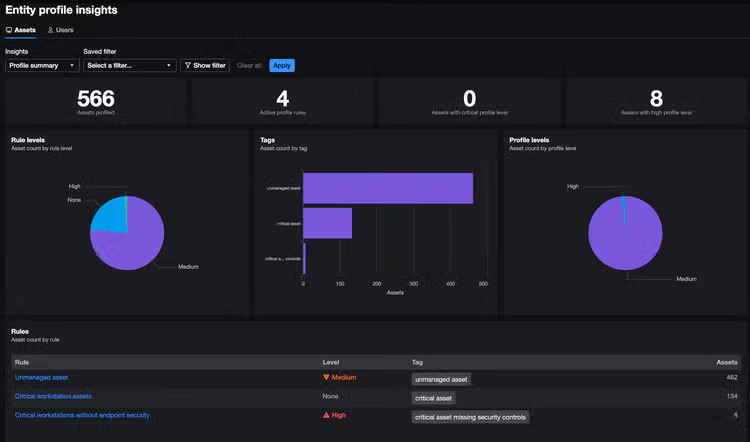
Entity Profile rules can be created to assign a profile level, one or more profile tags, or both to an asset or user. Each rule can use logic based on one or more entity posture metric gaps or saved entity discovery filters. When multiple rules are triggered for an entity, its profile level is the highest level assigned by those rules, and its profile tags are the combined tags from all triggered rules.
Examples of entity profile rules might include:
- Internet-facing assets that have never been vulnerability scanned
- Executive workstations without laptop encryption
- Critical servers with security control gaps
Entity Profile levels and tags update dynamically based on the rules an entity matches. For example, an executive asset might be assigned to a “Critical” profile level when it matches a rule that identifies an endpoint security gap. If the gap is remediated, the asset might no longer match the rule, and its profile level might change or be removed.
Prioritize Security Control Gap Remediation
Entity profile can be used to help address and prioritize remediation of security gaps for the entities that are most important. For example, an entity posture metric may identify 10,000 endpoint security gaps, and a profile rule then helps to add context to identify the highest priority gaps that need to be addressed first.
Bring Additional Context to Agentic SOC Operations
Not every finding carries the same risk. A security control gap on a test machine isn’t the same as a gap on a server that runs a critical business service. Entity Profile helps the SOC tell the difference.
The Entity analysis view now brings Entity Profile and Entity Posture together, with a new Exposures tab for even more insights. When analysts investigate a finding or detection, they can immediately see how important the affected entity is and which security gaps it has all from a single view.
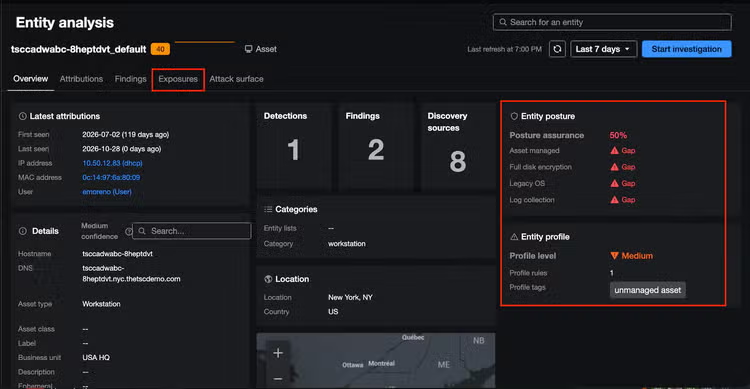
Entity Profile can also raise a finding’s risk score through risk factors, based on the profile level of its associated entity. That contextual risk flows into the overall Entity Risk Score (ERS). As a result, a finding on a critical server with higher contextual risk rises to the top of the queue, and a similar finding on a low-value system does not.
This gives analysts and AI-assisted workflows the context to focus on the entities that matter most, and to act with confidence.
Entity Profile is part of a broader set of proactive capabilities in Splunk Enterprise Security 8.8. Once contextual risk is clear, Entity Actions connect exposure insights to remediation. The next blog in this series covers Entity Actions.
Related Articles

Black Hat USA 2026: Proving the Splunk ES Foundation for the Agentic SOC

Splunk Security Content for Threat Detection & Response: March Recap