Strengthen SOC Defenses with Native UEBA in Splunk Enterprise Security
At .conf25, we announced how Splunk Enterprise Security (ES) has transformed to today’s AI-powered SecOps platform—unifying industry-leading technologies across SIEM, SOAR, User and Entity Behavior Analytics (UEBA), threat intelligence, and detection engineering with purpose-built AI across the entire Threat Detection, Investigation, and Response (TDIR) workflow—empowering Security Operations Centers (SOCs) to end analyst fatigue, deliver faster security outcomes, reduce risk, and build resilience for the agentic-AI era.
In today’s complex cybersecurity landscape, SOCs face an ever-expanding attack surface, sophisticated insider threats, and advanced unknown attacks that traditional security tools struggle to detect. Insider threats—whether malicious, accidental, or due to compromised credentials—pose a growing risk across hybrid, cloud, and on-premises environments. The vast volume of behavioral data overwhelms legacy tools, generating excessive false positives and leaving critical threats undetected, oftentimes creating alert fatigue and thinned bandwidth for security professionals.
Our enhanced UEBA capability, now natively available in ES, empowers SOCs to transition from reactive, fragmented workflows to a proactive, behavior-driven security posture. By continuously baselining and analyzing user, device, and entity behaviors, UEBA detects subtle deviations that signal insider threats and advanced attacks. Its machine learning models adapt dynamically, uncovering hidden risks and reducing alert fatigue. This user-centric approach provides SOC teams with contextual intelligence and situational awareness to prioritize and respond effectively, strengthening the entire TDIR.
Unifying the TDIR Framework with UEBA
Enterprise Security’s UEBA capability helps to complete a holistic TDIR approach, enabling security teams to shift from reactive, incident-driven workflows to proactive, behavior-focused operations. By analyzing and baselining the regular activity of users, devices, and entities, UEBA identifies deviations that signal potential threats. Unlike traditional correlation rules, UEBA’s machine learning models continuously learn and adapt, uncovering hidden threats that would otherwise go unnoticed. This capability allows SOCs to detect known, unknown, and hidden threats across the enterprise, reducing alert fatigue and empowering analysts with actionable insights.
At its core, our UEBA capability uses key functionality to achieve this:
- Behavioral Baseline and Anomaly Detection: Our UEBA capability continuously models normal behavior for users and entities across the enterprise, detecting deviations that may indicate compromise or misuse.
- Machine Learning-Driven Insights: UEBA utilizes unsupervised machine learning, it identifies subtle and complex threat patterns that traditional signature-based tools miss.
- Entity Risk Scoring: A cornerstone of our UEBA capability, the Entity Risk Scoring (ERS) system aggregates multiple risk signals into a dynamic, cumulative risk score for each user or entity, enabling precise prioritization of investigations and response efforts. It helps the SOC teams to monitor abnormal behaviors to determine investigation and potential remediation.
- Multi-Entity Correlation: UEBA correlates activities across users, endpoints, cloud applications, and devices to uncover sophisticated attack chains such as lateral movement and data exfiltration.
- MITRE ATT&CK Heatmap: Provides a visualization of at-risk users and/or entities mapped to the ATT&CK framework.
- Contextual Intelligence and Peer Group Analysis: UEBA provides rich context and comparisons to peer behavior, accelerating threat investigation and reducing analyst fatigue.
- Open Investigations Quickly in ES: When deviations are realized, SOC teams are now able to detect elevated risks and expediently open cases within ES.
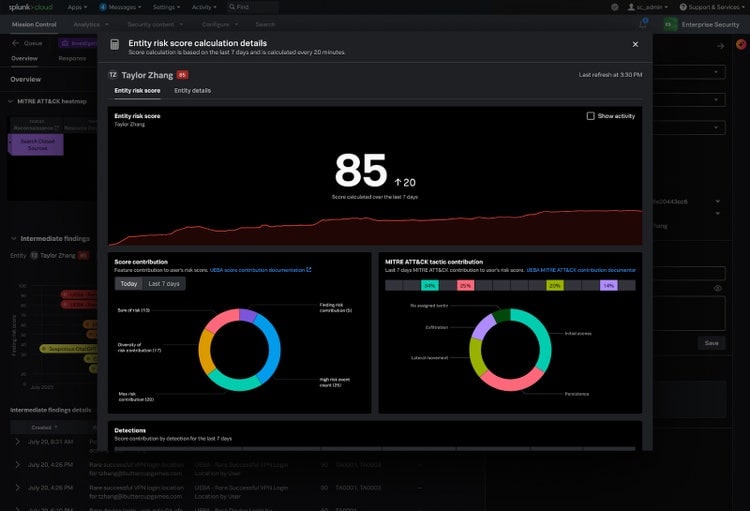
Entity Risk Score
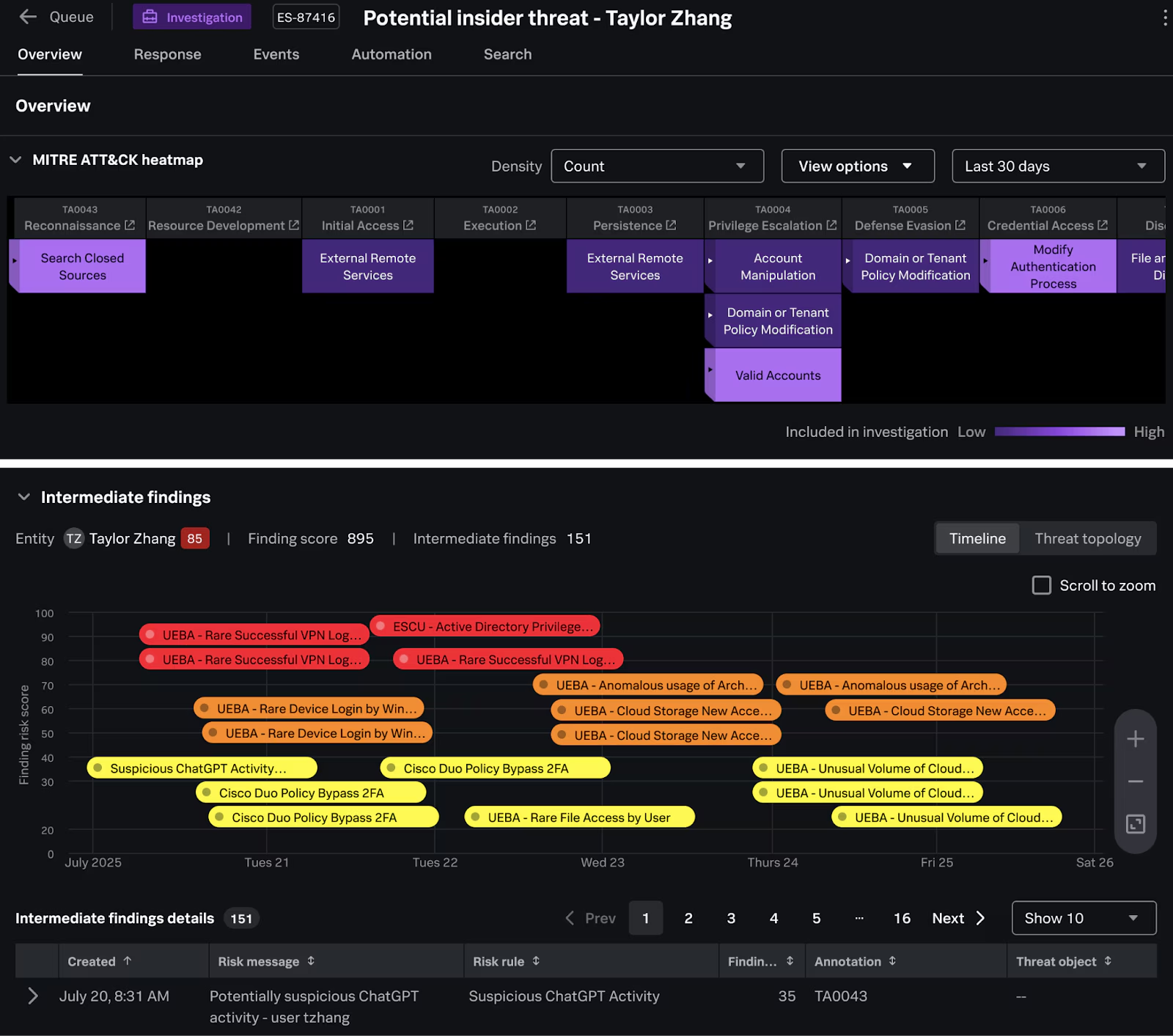
MITRE ATT&CK Heatmap in UEBA
Tackling Insider Threats Head-On
Our UEBA capability is designed to excel at challenges most SOCs struggle with:
- Insider Threats: Identifies malicious or accidental misuse of privileges, compromised accounts, and anomalous insider activities.
- Advanced and Unknown Threats: Detects sophisticated attack techniques and unknown threats by correlating anomalies across multiple data sources.
- Compromised Machines and Lateral Movement: Flags suspicious endpoint behavior and unauthorized access expansion within the network.
Customers previewing ES Premier and exploring UEBA have already uncovered real insider threats and avoided being compromised:
- Identifying revoked users attempting to infiltrate access points—both physically and digitally—aimed at regaining control of sensitive data.
- An insider bad actor attempting to exfiltrate company data without permission.
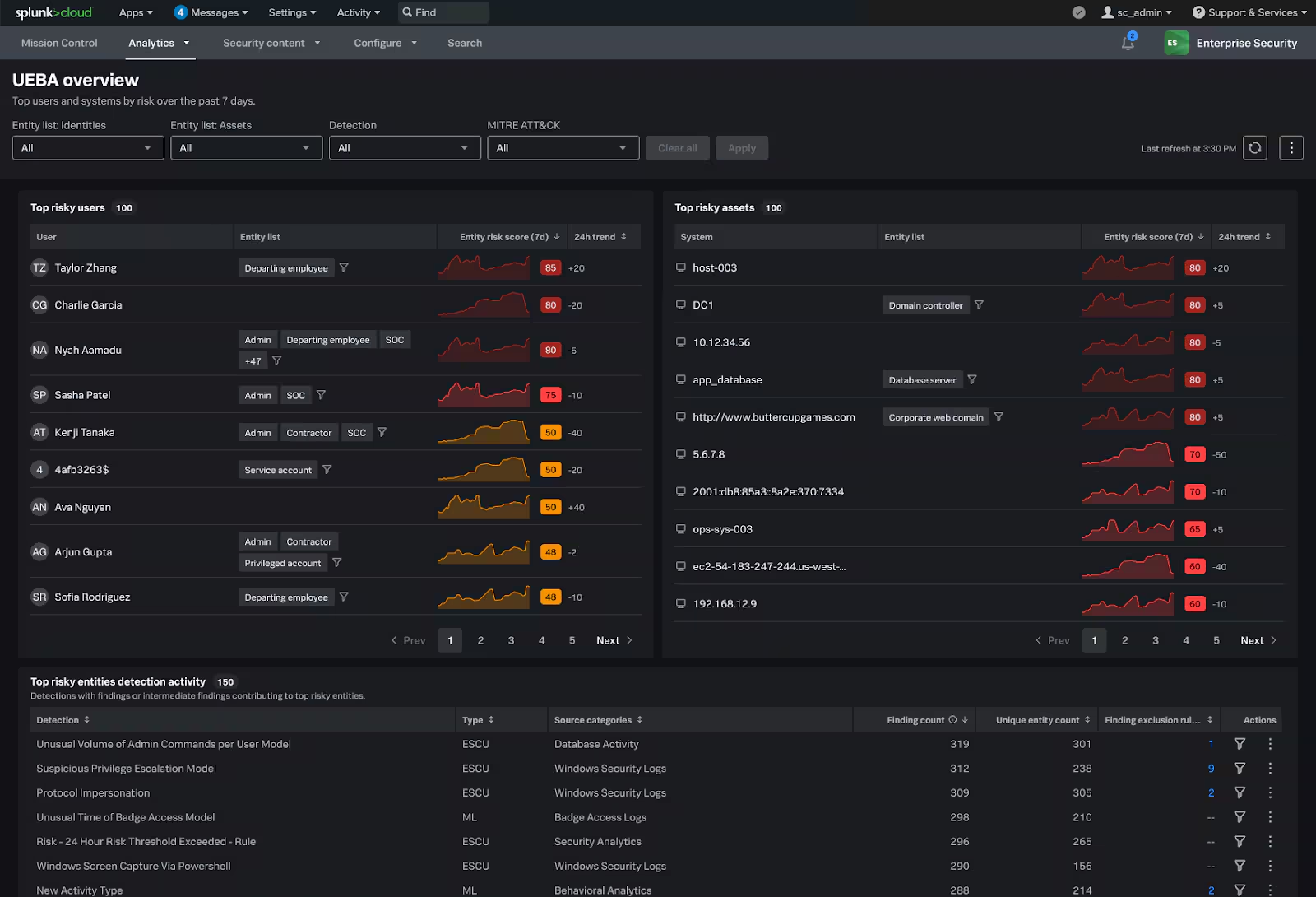
See it in action with this click-through demo
Elevating Your TDIR Strategy
By seamlessly integrating UEBA and SOAR, ES now delivers end-to-end incident response within one platform. This means SOCs can:
- Unify Detection and Strengthen Security Posture: Combine behavior-based anomaly detection with traditional correlation rules and threat intelligence for comprehensive coverage. Amplify visibility into user and entity risk across the enterprise.
- Streamline Investigations: Deliver detailed attack timelines, root cause analysis, and drill-down capabilities within a centralized SecOps platform.
- Accelerate Response: Automate threat prioritization and enable SOC teams to focus on high-fidelity alerts, reducing noise and improving operational efficiency.
- Scale SOC Operations: Transform billions of raw events into a manageable set of prioritized threats, enabling faster and more effective incident management. Reduce alert fatigue through prioritized, risk-based threat scoring.
Are you ready to find out why Splunk Enterprise Security is the leading AI-powered SecOps platform? Take the next step and explore ES Premier.
Follow all the conversations coming out of #splunkconf25!
Related Articles

Predicting Cyber Fraud Through Real-World Events: Insights from Domain Registration Trends

When Your Fraud Detection Tool Doubles as a Wellness Check: The Unexpected Intersection of Security and HR

Splunk Security Content for Threat Detection & Response: November Recap

Security Staff Picks To Read This Month, Handpicked by Splunk Experts

Behind the Walls: Techniques and Tactics in Castle RAT Client Malware

AI for Humans: A Beginner’s Field Guide

Splunk Security Content for Threat Detection & Response: November 2025 Update

Operation Defend the North: What High-Pressure Cyber Exercises Teach Us About Resilience and How OneCisco Elevates It