How Good is ClamAV at Detecting Commodity Malware?
"People tell you who they are, but we ignore it, because we want them to be who we want them to be.”
- Don Draper
Earlier this year we announced some security enhancements to how we handle submissions to Splunkbase. The simple statement is we are making things faster/cheaper/better where Splunkbase security is concerned.
Faster in that it takes less time for a developer to get an app into our platform.
Cheaper in that it’s more automated.
Better in that the security controls applied to each submission offer better protection from cyber-nasty than before.
In the course of our endeavors to level-up we discovered something interesting. In the tradition of tabs vs spaces, there was a sharp divide among my colleagues regarding ClamAV. Some were convinced it was no good. Others that it was free and did a good job of catching low hanging fruit. Everyone felt confident in their view. Nobody had the data.
So, we conducted a study and got the data.
(Shout out to our awesome-sauce summer intern Neel Bhavsar who did literally all of the hands-on work!)
What Did We Do?
Fundamentally there were two prevailing opinions about ClamAV in our org. Some of us felt that ClamAV wasn’t worthwhile to implement because, like any signature-based AV engine, it lacked the ability to detect modern forms of malware. The other was that ClamAV was free, open-source, and provided a good baseline of protection.
To sort this out we conducted an efficacy study wherein we applied ClamAV to over 400,000 malware samples from MalwareBazaar, bucketed as follows:
From there we ran the entire data set through ClamAV, Avast, Defender, and Falcon. Also, it should be noted that Falcon is not the same kind of general-purpose tool ClamAV and Avast are. Falcon focuses on executables and dlls. Here are the efficacy results from ClamAV.
Results
Overall Accuracy on All files
All in all Clam detected just under 60% of the malware in the sample. 249696 / 416561 (59.94%) to be exact.
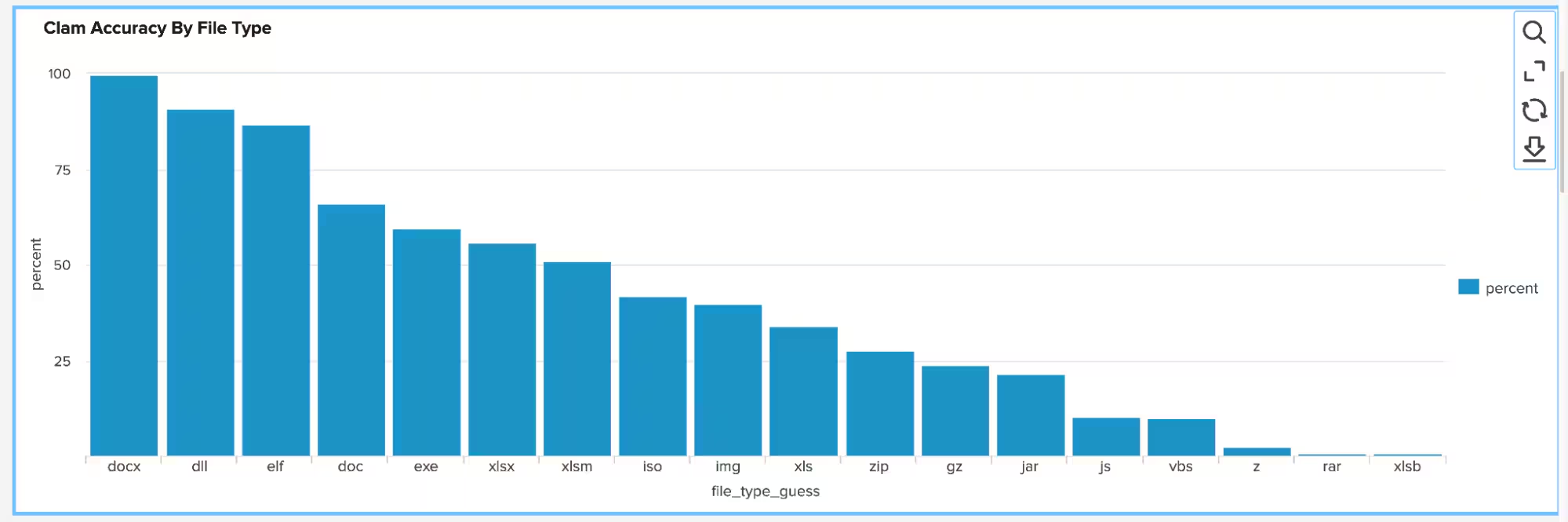
Accuracy By File Type
As can be seen from the chart above, ClamAV did well on docx, dlls and elf malware. However, it has missed quite a few important file types such as exe, xls* and zip.
Accuracy by Top Level Category
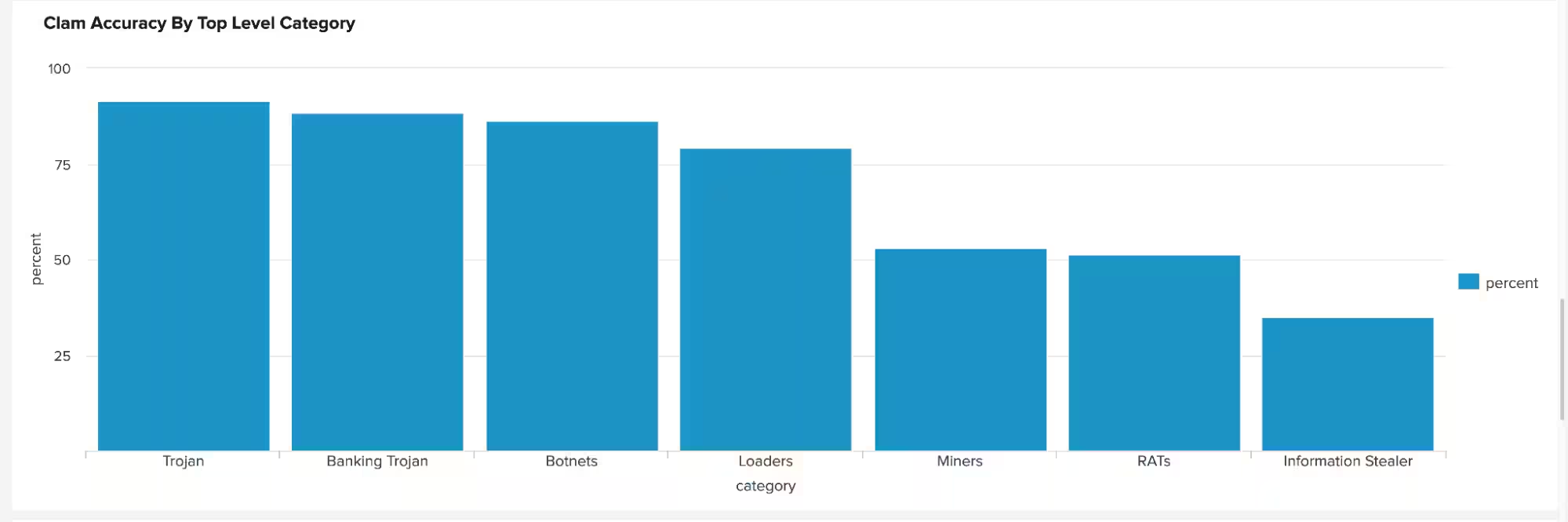
Note: Two of the categories are not present in the chart (Adware & Ransomware) due to the limited number of samples present in the dataset.
So is ClamAV Any Good at Detecting Commodity Malware or What?
As far as this data goes, the answer is “it depends”. The results indicate ClamAV is highly reliable at detecting certain types of malware in certain types of files. If your use case for ClamAV involves inspecting those things, then ClamAV is an amazing, free, tool. Conversely if your use case involves, say, looking exclusively at jar files the data indicates you’d likely fail to detect quite a lot of nasty.
One additional point worth mentioning, in favor of ClamAV, is the fact that it’s highly customizable by way of yara integration. This makes it particularly valuable for security organizations that want to dogfood data from their internal threat hunting activities or are looking to supply custom detection rules to detect anomalies.
So there's the data. May it help you and your org make efficacious decisions where AV tooling is concerned. And, as always, Splunk Tools are pretty handy for turning data into useful doing.

----------------------------------------------------
Thanks!
David Holiday
Related Articles

Predicting Cyber Fraud Through Real-World Events: Insights from Domain Registration Trends

When Your Fraud Detection Tool Doubles as a Wellness Check: The Unexpected Intersection of Security and HR

Splunk Security Content for Threat Detection & Response: November Recap

Security Staff Picks To Read This Month, Handpicked by Splunk Experts

Behind the Walls: Techniques and Tactics in Castle RAT Client Malware

AI for Humans: A Beginner’s Field Guide

Splunk Security Content for Threat Detection & Response: November 2025 Update

Operation Defend the North: What High-Pressure Cyber Exercises Teach Us About Resilience and How OneCisco Elevates It