From Instinct to Insight: Why Metrics Are Essential to Threat Hunting Success
Threat hunting is often viewed as an art form, driven by curiosity, intuition, and instinct. For a mature threat hunting program to prove its value, we need more than gut feelings. We need numbers.
Metrics help you understand what’s working, what’s not, and how your efforts contribute to broader security outcomes. They allow you to communicate value to stakeholders, align hunts with organizational priorities, and continuously improve your approach.
In this article, we’ll explore why metrics are critical to threat hunting success. We'll use the PEAK Framework as a foundation and expand on it with additional measurement pillars that any team can adopt.
These metrics help you do more than track activity — they help you demonstrate the value of your hunts, measure operational effectiveness, and support ongoing team and skill development. To keep things actionable, we’ll organize these metrics into three categories:
- Impact metrics
- Coverage metrics
- Operational metrics
Whether you’re a one-person show or part of a growing blue team, metrics can transform your hunting from instinctual to intentional.
Recap: The PEAK Framework
The PEAK Framework stands for Prepare, Execute, and Act with Knowledge, it's a practical structure for building and maturing threat hunting practices. It encourages:
- Documenting hypotheses and observations
- Structuring hunts in repeatable ways
- Acting on findings and lessons learned
Metrics act as a link between the “Act” and “Knowledge” stages of the PEAK Framework. They provide clarity on what your hunts are uncovering, where your efforts are paying off, and how your strategy should evolve. By capturing the outcomes of your hunts, metrics help distinguish between those that deliver actionable results and those that are purely exploratory.
- A high percentage of actionable hunts suggests your team is asking the right questions and focusing on high-value areas.
- On the other hand, a lower percentage isn’t a failure — it’s a signal that there may be gaps in data, unclear hypotheses, or opportunities to refine your approach.
Examples of PEAK-aligned metrics
- Percent of hunts that produced actionable findings
- Time spent per hunt (measured by quality and outcome, not just effort)
- Data sources used vs. needed (highlighting visibility gaps)
- Repeatability of hunts (can findings or methods be reused?)
Now, let's take a look at the impact, coverage, and operational metrics for threat hunting. And pay attention for a bonus fourth category of metrics, too.
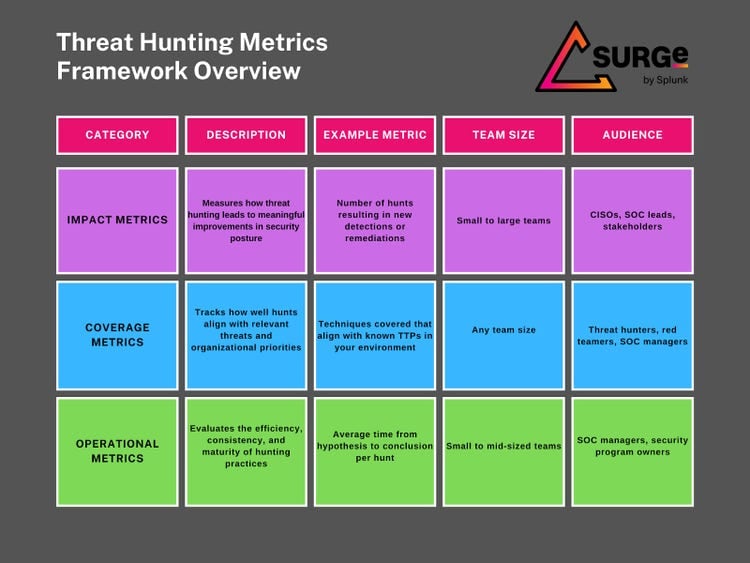
Impact metrics: Proving the value of hunting
Impact metrics show how your hunts lead to meaningful changes in your organization’s security posture. These are often the most compelling metrics for stakeholders.
Examples:
- Number of new or improved detections
- Policy or process improvements initiated from hunt findings
- Gaps identified and closed (e.g., visibility gaps, misconfigurations)
Think of these metrics as your return on investment (ROI) for your team. A new detection, a reduced response time, or a resolved gap isn't just a win. It's a measurable proof that your hunts are making an impact. Metrics are the truest measurement of efficacy; they go beyond telling stakeholders what you hunted and show how that work improved security. Simply saying “we hunted X” isn’t enough, you need numbers that show progress, outcomes and value over time.
Coverage metrics: Are you hunting the right things?
It’s not enough to hunt frequently; you need to hunt strategically. Having a clear strategy, even a simple one, helps ensure your efforts are focused and effective.
For example, you might choose to "hunt the right end of the kill chain" and work backward. Other teams may start with identity-based attacks or threat intel-derived hunts. What matters is that your team has a strategy and that metrics reflect how well you’re following it.
Examples:
- Techniques currently covered compared to known TTPs relevant to your organization
- Alignment of data sources to attack surface (are you hunting where it matters?)
- Percentage of hunt topics derived from threat intelligence
These metrics help evaluate whether you’re addressing high-impact areas or just picking off low-hanging fruit.
Operational metrics: Efficiency and maturity in threat hunting
Operational metrics provide insight into how well your team is functioning. They’re especially useful for SOC leads, CISOs, or any team lead tracking growth over time.
Examples:
- Average time from hypothesis to conclusion
- Number of hunts conducted per quarter
- Ratio of ad hoc vs. planned hunts
- Documentation completeness and reuse rate
These can help uncover bottlenecks, workload distribution, or where processes need improvement.
Metrics for skills growth & team development
Bonus areas for success: Threat hunting is an opportunity for team growth and shared learning. Metrics in this category track how individuals and teams are evolving in their skill sets.
Examples:
- Number of team members leading hunts
- Contributions to internal knowledge bases
- Cross-team briefings or presentations generated from hunt findings
These not only help with performance reviews but also show the cultural impact of your hunting program.
A simple way to get started with hunting metrics
You don’t need to build an elaborate dashboard from day one. Start small:
- Track 2–3 metrics per hunt.
- Use tools your team already relies on (JIRA, spreadsheets, hunt logs).
- Focus on trends, not snapshots.
Over time, you can mature your tracking based on what matters most to your team and stakeholders. Align your metrics to your current PEAK maturity level and revisit them regularly.
Best practices and tips to know for threat hunting metrics
Customize metrics to fit your organization’s reality
Metrics only work if they’re relevant. Every organization has different priorities and constraints. Don’t force a metric because it worked for someone else.
Ask questions like:
- What matters to our leadership?
- What are we trying to prove or improve?
- Where do we want to grow?
Examples:
- A healthcare org may track incident prevention and HIPAA-aligned hunts.
- A startup might value speed and detection coverage over volume.
- A public sector team may prioritize resilience and continuity metrics.
Start by picking one or two metrics tied directly to your org’s risk or strategic goals. Expand only when those are well understood and actionable.
Share stories with stakeholders, based on metrics
Don’t just deliver numbers, deliver a story. Metrics only resonate when they’re tied to outcomes and framed in terms of risk reduction, compliance, or operational improvements.
Tips for storytelling:
- Use digestible visuals (bar charts, trend lines).
- Highlight trends over time (not just hunt-by-hunt).
- Translate technical wins into business language.
Example language:
- “In Q2, our hunts uncovered 3 gaps in MFA enforcement, leading to a 20% increase in coverage.”
- “Credential abuse hunts led to 2 new detections now protecting against unauthorized lateral movement.”
Start small, grow intentionally
Remember, progress, not perfection. Start with a shared doc or log. Choose 2–3 stakeholder-facing metrics and track them consistently. As your team matures, so will your metrics. The goal isn’t more data — it’s better insight.
Make threat hunting count
Metrics aren’t just for dashboards: they’re tools for reflection, communication, and impact. When threat hunting becomes measurable, it becomes strategic.
Small teams can punch well above their weight when they can show the story behind their work. Track what matters, align it to your mission, and share it clearly.
Threat hunting isn’t just about curiosity — it’s about driving change. And metrics give you the language to make that change visible.
Next steps
- Try applying a few metrics to your next hunt.
- Identify what matters most in your environment.
- Explore the PEAK Framework if you haven’t already.
As always, security at Splunk is a team effort. Credit to authors and collaborators: David Bianco, Mick Baccio, Ryan Fetterman.
Related Articles

Predicting Cyber Fraud Through Real-World Events: Insights from Domain Registration Trends

When Your Fraud Detection Tool Doubles as a Wellness Check: The Unexpected Intersection of Security and HR

Splunk Security Content for Threat Detection & Response: November Recap

Security Staff Picks To Read This Month, Handpicked by Splunk Experts

Behind the Walls: Techniques and Tactics in Castle RAT Client Malware

AI for Humans: A Beginner’s Field Guide

Splunk Security Content for Threat Detection & Response: November 2025 Update

Operation Defend the North: What High-Pressure Cyber Exercises Teach Us About Resilience and How OneCisco Elevates It