Platform Blogs
Latest Articles
template
category
category
platform
hideCategoryPill
true

Announcing Splunk Federated Search for Amazon S3 Now Generally Available in Splunk Cloud Platform
Announcing the general availability of Federated Search for Amazon S3, a new capability that allows customers to search data from their Amazon S3 buckets directly from Splunk Cloud Platform without the need to ingest it.

Addition of Syslog in Splunk Edge Processor Supercharges Security Operations with Palo Alto Firewall Log Reduction
Addition of Syslog in Splunk Edge Processor Supercharges Security Operations with Palo Alto Firewall Log Reduction

Revolutionize Data Ingestion: Introducing Terraform Support for Splunk Cloud Platform
Splunk Cloud introduces Terraform support for Index, IP list, & HEC token management for efficient data ingestion.
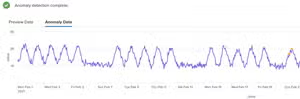
Developing the Splunk App for Anomaly Detection
A technical overview of the Splunk App for Anomaly Detection, which uses machine learning to automatically configure anomaly detection jobs on time series data.

Enhancements To Ingest Actions Improve Usability and Expand Searchability Wherever Your Data Lives
Along with the respective Splunk Enterprise version 9.1.0 and Splunk Cloud Version 9.0.2305 releases, Ingest Actions has launched a new set of features and capabilities that improve its usability and expand on configurability of data routed by Ingest Actions to S3.
Flatten the SPL Learning Curve: Introducing Splunk AI Assistant for SPL
At .conf23, we announced the preview release of Splunk AI Assistant - Splunk's first offering powered by generative AI.

Splunk Edge Processor Enhancements Offer Greater Data Access and Improve Data Management
On the heels of an exciting GA in March and the April announcement of its regional expansion, we are excited to share the latest updates to Splunk Edge Processor that will make it even easier for customers to have more flexibility and control over just the data you want, nothing more nothing less.

Fastest Time-to-Value Anomaly Detection in Splunk: The Splunk App for Anomaly Detection 1.1.0
Splunk App for Anomaly Detection simplifies ML, making anomaly detection easy. It streamlines tasks, enabling ML integration in everyday workflows. Just load data, select the field, and click "Detect Anomalies."

Swimming in Sensors and Drowning in Data: The Role of Splunk Partners in Delivering Splunk Edge Hub
With the proliferation of edge computing and the release of Splunk Edge Hub, partners have additional functionality to accelerate the detection, investigation and response of threats and issues that will inevitably occur in physical and industrial environments.