Stop Configuration Outages Before They Start
Observability Raman VasikarlaKey takeaways
- Manual verification of encrypted secrets in code repositories creates dangerous bottlenecks, forces teams to share sensitive credentials, and leaves security gaps that only surface during live deployments.
- A decoupled two-repository architecture automates encryption validation by separating developer workflows from private decryption keys, eliminating human gatekeepers without expanding security risk.
- Intelligent key caching and self-service validation pipelines cut runtime by 70% and give developers instant, safe feedback on their configurations without ever exposing sensitive credentials
Modern enterprise cloud infrastructure is fundamentally driven by data configuration. Whether managing complex, heterogeneous environments across multi-cloud footprints or navigating rigorous compliance landscapes, infrastructure-as-code (IaC) and configuration repositories serve as the foundational blueprints of the modern enterprise.
Yet, embedded deep within these blueprints lies a persistent operational and security hazard: secrets management.
To maintain a robust security posture, sensitive values such as TLS private keys, database credentials, and third-party API tokens—must be cryptographically secured before they enter version control repositories. However, verifying that these values have been encrypted accurately across development, staging, and production environments has historically introduced a significant manual bottleneck.
When configuration validation relies on human gatekeepers, continuous integration pipelines stall, deployment catalogs fail to compile, and configuration-driven platform outages skyrocket across the industry.
To achieve true digital resilience, platform engineering teams must shift left, moving past manual verification toward an automated, Decoupled Self-Service Validation Architecture.
The Friction of Manual Verification and Identity Sharing
In an enterprise-scale cloud footprint spanning thousands of active clusters, engineering teams frequently roll out certificates, rotate keys, or inject new credentials into configuration trees.
Traditionally, validating that an encrypted string accurately matched with its intended plaintext counterpart requires extensive manual intervention. Because private decryption keys must remain highly restricted to protect platform integrity, application developers could not independently verify their own cryptographic strings. Consequently, engineering teams were forced to securely share plaintext passwords with infrastructure SREs over communication channels or ticketing systems. The operations on-call engineer would then have to manually authenticate into restricted configuration management master hosts and execute ad-hoc decryption scripts to cross-check the values.
This legacy approach introduces severe systemic liabilities:
- The Manual Dependency Bottleneck: Centralized platform engineering teams become continuously bogged down by repetitive maintenance requests, creating operational friction and severely degrading developer velocity.
- Security Policy Compromise: Transferring plaintext values across secondary channels to facilitate manual cross-checking breaks zero-trust architectural boundaries.
- The Delayed Execution Blind Spot: If an engineer accidentally commits an unencrypted secret block or implements a mismatched public key version, the defect remains undetected until the code hits a live deployment environment, triggering immediate compilation failures and downstream platform downtime.
The Decoupled Two-Repository Validation Pattern
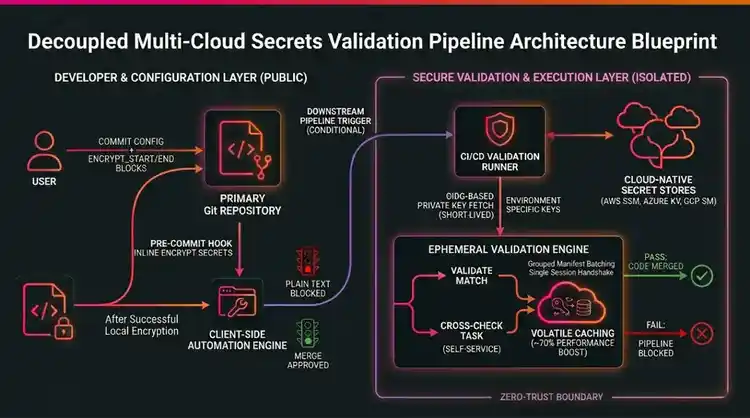
To eliminate the human gatekeeper entirely without expanding the blast radius of sensitive cryptographic keys, modern platform engineering utilizes a decoupled, two-repository architecture. This pattern separates the public developer-facing workflow from the restricted decryption and validation runtime.
1. The Client-Side Configuration Abstraction
At the local development level, engineers explicitly tag single-line tokens or multi-line certificates inline within their configuration files using distinct, localized markers.
When triggering a localized configuration utility or pre-commit hook, a client-side automation engine scans the modified files. The engine automatically infers the target deployment tier (e.g., Development, Staging, Production) and the specific Cloud Service Provider (e.g., AWS, Azure, GCP) based entirely on the underlying repository directory pathing or regional metadata parameters.
The tool seamlessly fetches the corresponding public key which is safely committed inside the public configuration repository encrypts the plaintext string inline and reformats the block into a structured cryptographic payload. To enforce this behavior, rigorous automated filters run at the continuous integration (CI) gate; if an unencrypted marker or a corrupted payload attempts to pass through a merge request, the pipeline instantly blocks the code from reaching protected branches.
2. The Isolated Downstream Validation Engine
The actual verification safety net operates inside a completely isolated, downstream repository dedicated exclusively to security validation. When an encrypted configuration block is modified in the primary repository, the main pipeline automatically triggers a conditional downstream workflow execution.
By separating the validation engine into an isolated code space, the enterprise can strictly guard access to private decryption keys. The primary development environment never possesses visibility into the raw keys. Instead, the downstream validation runner securely fetches cloud-native private keys from localized secret stores (such as AWS Parameter Store, Azure Key Vault, or GCP Secret Manager) using short-lived, OpenID Connect (OIDC)-based token authentication.
Mitigating API Throttling via Ephemeral Key Caching
On a global enterprise scale, thousands of configuration adjustments are executed daily. If a security pipeline must request OIDC tokens and execute an API call to a cloud secrets manager for every individual encrypted value within a massive infrastructure manifest, severe cloud API throttling occurs, and pipeline runtimes balloon exponentially.
To optimize performance and ensure rapid developer feedback loops, the validation engine implements an intelligent cryptographic caching strategy:
- Grouped Manifest Batching: The incoming validation payloads are scanned, parsed, and grouped dynamically by cloud provider and unique deployment environment.
- Single-Session Handshake: The pipeline initiates an authentication handshake precisely once per cloud provider-environment combination.
- Volatile Key Caching: The correct private decryption key is securely loaded into the volatile, ephemeral memory space of the isolated CI runner.
- Bulk Execution and Purge: All encrypted strings targeting that specific cloud tier are cross-checked and validated in bulk simultaneously. Once the execution concludes, the volatile memory space is completely purged.
By caching keys per provider-environment session, platform teams can slash overall pipeline execution runtimes by approximately 70%, creating a highly scalable security framework.
Scaling Through Automated Self-Service Cross-Checking
Beyond automated background checks during the pull request phase, this decoupled architecture provides an explicit interface for developers to run on-demand cryptographic cross-checks safely.
Through a secure, parameter-driven pipeline interface, a developer can independently input an encrypted payload alongside the expected plaintext value and select the target environment from a secure drop-down menu. The runner automates the background OIDC key fetch, compares the values strictly within an ephemeral memory layer, and returns an instantaneous pass or fail result to the user.
No plaintext secrets are ever exposed to the version control logs, no long-lived administrative infrastructure credentials are created, and developers gain absolute autonomy over their release readiness.
Conclusion: Engineering Resilience Into the Core
True digital resilience requires a shift from reactive incident triage to proactive system hardening. By replacing manual gatekeepers and shared credentials with an automated, downstream multi-cloud validation pipeline, enterprises can dramatically accelerate software delivery velocity. More importantly, it ensures that configuration-driven vulnerabilities are engineered completely out of existence, keeping global cloud infrastructure inherently secure, stable, and highly available.
To see how you can bring comprehensive, real-time observability and reliability to your automated delivery pipelines, explore the Splunk Guide to CI/CD Monitoring or get started today with a free trial of Splunk Observability Cloud.
Related Articles

Publish Your Splunk SOAR Apps Faster

Crossed Swords 2025: Lessons From the Frontlines of Cyber Defense with Splunk Enterprise Security