Splunk Advances the OpenTelemetry Project with Its Latest Donation, the OpenTelemetry Injector
Splunk is very excited to be sponsoring Kubecon North America once again, kicking off this week in Atlanta, GA. As many know, Splunk is one of the top contributors to the OpenTelemetry project. We’re happy to have sent many of the Splunkers who serve as project maintainers and contributors to lead SIG meetings and engage with the greater community in the OpenTelemetry Observatory, sponsored by Splunk.
The OpenTelemetry project is now as popular as Kubernetes. However, despite its rapid growth and widespread adoption, the project faces challenges that can hinder its implementation and broader use, such as how to get started and instrumentation overhead and effort. Since the beginning of our involvement, Splunk’s mission has been to make OpenTelemetry accessible and easy to adopt for every organization and every environment. Today, we’re excited to announce a donation that will help solve the challenges of implementation for everyone — the OpenTelemetry Injector.
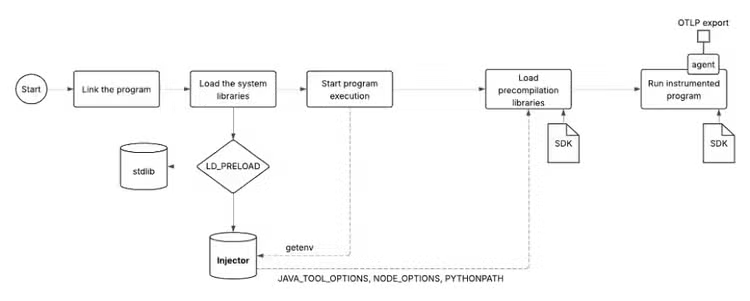
The OpenTelemetry Injector is the most significant donation for the project to date, because it fills a crucial gap in the OpenTelemetry ecosystem by providing an effective, zero-code solution for automatic instrumentation in non-Kubernetes environments —accelerating OpenTelemetry adoption and simplifying observability for a wider user base.
The OpenTelemetry Injector enables zero-code instrumentation for applications running on Linux hosts and eliminates the operational burden of instrumentation. While other solutions like the OpenTelemetry Operator cater to containerized and Kubernetes environments, the Injector is specifically designed for traditional virtual machine (VM) environments, enterprise data centers, hybrid technology stacks, and legacy systems. This expands OpenTelemetry's reach and ease of use for organizations with diverse infrastructure. By making instrumentation easier and less intrusive, the OTel Injector encourages wider adoption of OpenTelemetry for organizations with existing applications where code changes might be difficult or impractical.
Splunk continues to innovate and helps to facilitate adoption of OpenTelemetry. For users of the Splunk Distribution of the OpenTelemetry Collector, we’ve added features like multiline log support, zero-code instrumentation, sensitive value redaction, and troubleshooting tools. Splunk customers who are operating in Kubernetes environments, the Splunk Distribution of the OpenTelemetry Collector offers improved logging scale, advanced metrics collection, sophisticated pipeline features for data manipulation and routing, and support for Kubernetes annotations and multiline logs.
Most recently, we’ve added Automatic Discovery and Profiling. Automatic Discovery is a zero-code instrumentation feature that detects and collects signal data from third-party services, such as databases and web servers. Through auto-discovery, the Collector automatically generates a configuration snippet that you can modify and incorporate into your existing configuration to retrieve your services’ data. It tests built-in configurations for supported metric receivers against discovered endpoints, dynamically adding configurations to the metrics pipeline at runtime — enabling advanced observability capabilities, simplifying deployment, and reducing operational overhead. This feature is currently available in the Splunk Distribution of the Collector and will be available upstream in 2026.
Profiling offers deep, code-level insights, continuous performance monitoring, enhanced root cause analysis and faster remediation, optimized resource utilization and cost management, visibility into third-party libraries, and improved engineering workflows. While profiling capabilities are available outside of the Splunk Distribution of the Collector, Splunk profiling is mature and production ready, and we offer enterprise-level support for Splunk Customers.
Splunk customers can also benefit from two new impactful OpenTelemetry enhancements. For Splunk Observability customers, we’ve added OpenTelemetry functionality into the AppDynamics Agent. This combined agent is the first step in simplifying and evolving the agent management ecosystem for all of our customers, giving them a choice of observability backends that best suit their needs. You can read more about that here.
For Splunk Enterprise customers, it now ships with the Splunk Distribution of the OpenTelemetry collector embedded by default. Splunk customers gain significant benefits from the integration of the Splunk OpenTelemetry Collector into their observability strategy, whether they are using Splunk Observability Cloud or Splunk Enterprise. This integration streamlines data collection, enhances observability, and provides greater flexibility, and there’s more to come in the very near future to help customers more easily adopt OpenTelemetry to gain greater control over their telemetry data and reduce telemetry costs.
You can find more information about how to get started with the OpenTelemetry Injector here. You can watch our webinar explaining the differences between the different distributions of the OpenTelemetry collectors here. For general information on OpenTelemetry and how to get involved with the project please visit opentelemetry.io.
Related Articles

Getting Synthetics Right: A Best Practices Series for Synthetic Tests You Can Trust
Why Is Log Data So Important In Observability?