Instrumentation Your Way: Introducing a Combined Splunk AppDynamics Agent
Observability Courtney GannonIn 2025, microservices are everywhere and Kubernetes is the de facto standard for operating cloud native applications. But not all apps are built in microservices architectures. For most enterprises, hybrid environments are the reality, with their business run on a mix of three-tier and cloud native applications.
For Splunk AppDynamics customers that are also adopting Splunk Observability Cloud for their microservices environments, we want to remove the technical burden of collecting telemetry data for use across either solution.
About the Combined AppDynamics Agent
This updated AppDynamics Agent provides customers with a common agent to collect telemetry data for use in either Splunk AppDynamics or Observability Cloud. Users can avoid costly and disruptive replacement and changes in their deployment and integration pipelines, while evaluating which APM is best for them.
The new agent contains both AppDynamics Agent code and Splunk OpenTelemetry code, which is deployed the same as any other AppDynamics Agent. In fact, there’s no need to install new agents. Simply update your existing agents and latent OpenTelemetry functionality will be added as a normal update. You can update via the Smart Agent or whatever means you use today.
We’re Offering Three Modes
- AppDynamics Mode, for AppDynamics users that primarily build and operate tiered applications. You can simply stay on that solution by default. The AppDynamics mode ensures compatibility with the current way the AppDynamics agent is used.
- Splunk Mode, for AppDynamics customers that have truly hybrid applications with transactions that span tiers and microservice and are looking to adopt Observability Cloud. Observability Cloud is being augmented with AppDynamics capabilities to better cover tiered application use cases, which you can read more about below.
- And Dual Mode, for organizations that have largely, but not entirely separate teams running three-tier applications and microservices applications. We are building integrations between AppDynamics and Observability Cloud to make it easy to use these two products together in troubleshooting workflows. This is great for evaluating or transitioning to Observability Cloud, but not recommended for extended use in production.
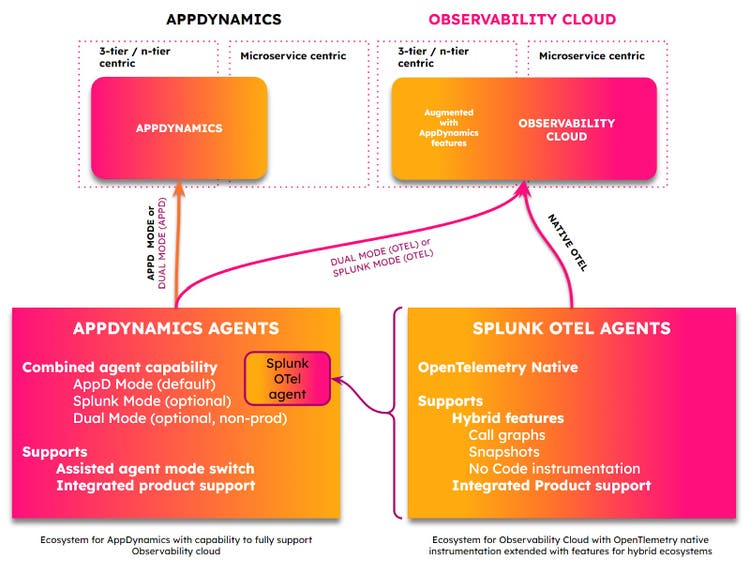
We didn’t just combine the agents — we also updated the Splunk OpenTelemetry Agents with AppDynamics-like hybrid features, making it easy to evaluate Observability Cloud for monitoring hybrid applications.
Both ecosystems of agents will continue to be developed, maintained, and supported to provide continuity for existing users. The agents will undergo low-impact changes and evolution toward greater use of OpenTelemetry. Initial supported languages are: Java, Node.js, and .NET.
Splunk’s Goal is to Provide Best-in-Class APM Solutions to Address All of Our Customers’ Needs
In addition to simplifying the agent ecosystem, Splunk is bringing the best of AppDynamics features to Observability Cloud, for customers that prefer a single experience that bridges both worlds. We’re releasing new features in Splunk Observability Cloud to fully support hybrid applications and strengthen our APM capabilities — building on AppDynamics’ proven expertise in monitoring traditional n-tier applications.
Highlights include:
- Business Transactions provide flexible, precise monitoring of business workflows.
- Call Graphs deliver code-level insights and enable faster root cause analysis.
- Service map grouping uses indexed span tags to visually group related services so they match how teams work.
- Service instance visibility i mproves correlation between application and infrastructure data.
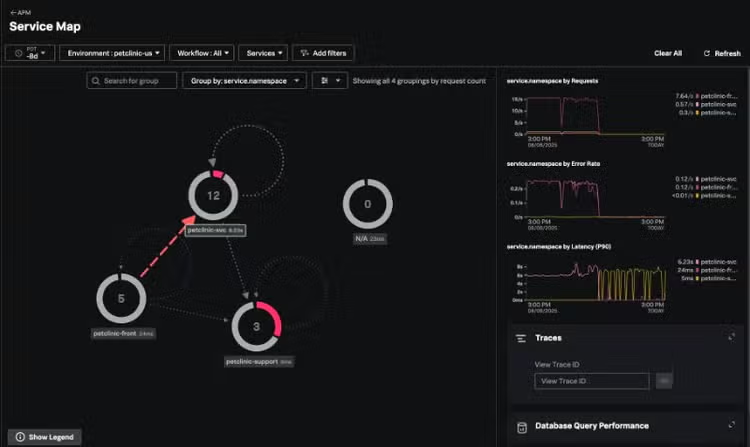
You can learn more about the combined AppDynamics Agent here, and you can read more about all of our other Observability innovations, including Hybrid APM in this blog. We’re hosting technical sessions where we’ll discuss both of these new features in-depth at .conf25. If you aren’t able to attend this year, catch the replays after the conference at conf.splunk.com.
Follow all the conversations coming out of #splunkconf25!
Related Articles
Agentic Observability from Day One: From OpenTelemetry to AI Agents.

Monitoring Model Drift in ITSI