Meet Observability Studio: Your Local OpenTelemetry Workspace
Observability Bhanu KovuriKey takeaways
- Observability Studio helps developers validate and improve telemetry locally while writing code, before information is lost or reaches production.
- The tool combines telemetry exploration, instrumentation guidance, and validation to help teams build more reliable observability practices.
- Built on OpenTelemetry, it supports real-time inspection of traces, metrics, and logs while helping teams catch issues early in development.
Observability for Developers
Developers have a common observability problem: write instrumentation today, discover missing attributes tomorrow, and fix it after context is already lost. Observability Studio is built to close that gap. An open source, community-driven local OpenTelemetry workspace that helps developers and coding agents instrument, inspect, and validate telemetry while code is still being written.
Observability Studio bundles everything a developer needs to receive, explore, and validate telemetry on a laptop. It keeps data in memory on localhost, updates the UI in real time, and exposes the same data to REST clients, MCP-enabled coding agents, and a VS Code extension. This post walks through every major feature in the Observability Studio: the collector and Telemetry Explorer, agent skills, validation, the extension, eval harness, and release tooling.
OpenTelemetry: One Instrumentation, Many Backends
OpenTelemetry (OTel) is a CNCF-backed, vendor-neutral standard that unifies instrumentation of APIs, SDKs, semantic conventions, and the OTLP export protocol. You instrument once and send telemetry to an in-process exporter, a collector, or directly to any backend that speaks OTLP—including Splunk Observability Cloud, Jaeger, Prometheus-compatible systems, and others.
Instrumentation Layers
- Auto-instrumentation attaches to frameworks and libraries (HTTP servers, gRPC, database drivers, message queues) with minimal code changes.
- Manual instrumentation adds business-context spans and metrics—payment capture, inventory reservation, model inference latency—that auto-instrumentation cannot infer.
- Resource attributes identify the service (service.name), environment (deployment.environment), and host or container metadata so backends can slice data correctly.
The Collector Pattern
The OpenTelemetry Collector receives, processes, and exports telemetry. A local collector on ports 4317 (gRPC) and 4318 (HTTP) lets applications send OTLP without cloud credentials. In production, collectors batch, filter, sample, and route data to multiple destinations—reducing SDK configuration churn and keeping secrets out of application processes.
Semantic Conventions: Shared Language for Telemetry
Raw spans and metrics are only useful if attribute names and values are consistent. OpenTelemetry semantic conventions define standard names for HTTP routes, database systems, messaging destinations, exception types, and more. When every service labels HTTP status as http.response.status_code rather than ad-hoc variants, dashboards, detectors, and AI-assisted analysis work across the entire estate.
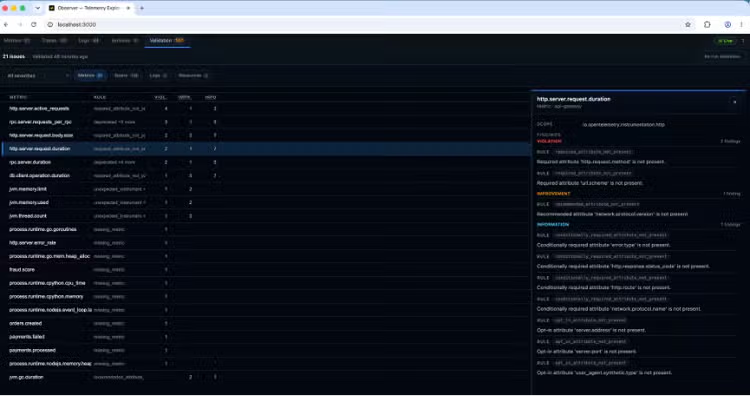
Validation against semantic conventions catches gaps before production: missing service.name, spans without parent context, metrics with wrong units, or HTTP server spans that omit route templates. Tools such as Weaver (used in Observability Studio's Validation tab) analyze in-memory telemetry snapshots and report findings with links to affected traces, metrics, and logs—turning convention compliance into a fast feedback loop during development.
Building an Observability Practice
Audit Before You Instrument
Observability Studio is built around a simple idea: you should be able to inspect, explain, and defend your telemetry with evidence—not guesses. Auditability here is not a compliance checkbox. It is what makes OpenTelemetry development reviewable: what you think you instrumented, what you actually emit, and how you alert. A structured audit answers the questions you need for a reviewable baseline:
- What is this service? Which languages, frameworks, and entry points does it expose—and which files prove that (manifests, main, controllers, Compose/systemd startup)?
- What is already wired? Which OpenTelemetry dependencies, init code, and OTEL_* environment variables exist today?
- What signals are missing? Which HTTP routes, background jobs, and outbound calls still lack spans or metrics—and which should appear in inventories, not vague summaries?
- What should the audit flag before instrumentation proceeds? Are there anti-patterns such as double SDK initialization, hardcoded OTLP endpoints, missing propagators, tracers in hot paths, high-cardinality attributes, or logs without trace context?
Instrumentation in Observability Studio
Observability Studio brings instrumentation into the same place you develop: a local workspace where you can assess coverage, add OpenTelemetry to a service, inspect what it emits, and confirm it meets expectations before anything leaves your machine.
Coverage audit: A read-only audit scans the repository and produces a structured observability report—what is already instrumented, what is missing, and what should be fixed. That report becomes the shared baseline for instrumentation and for later operational setup.
Guided instrumentation: An instrument workflow adds OpenTelemetry to the service in one coherent pass, aligned with how the application already runs in development. It focuses on getting a complete, runnable telemetry baseline rather than scattered one-off changes.
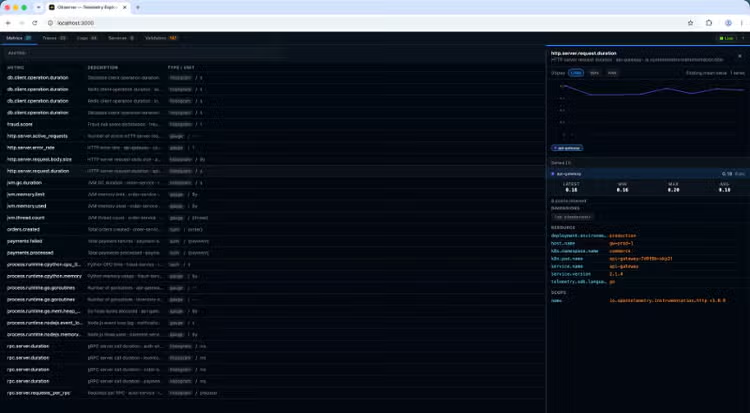
Local telemetry explorer: A built-in Observer receives live traces, metrics, and logs and presents them in an interactive UI—so you can confirm end-to-end behavior, drill into requests, and review signals as they arrive.
Semantic validation: Validation checks incoming telemetry against OpenTelemetry conventions and surfaces clear findings by severity, helping you catch naming and context problems early while you still have fast feedback.
Instrumentation in Observability Studio is not only about adding packages; it is the full feature path from knowing your gaps, wiring the service, seeing live data, and trusting it before you depend on it in production.
Operational Detectors and SLOs
After instrumentation stabilizes, define detectors or alert rules on golden signals: latency, traffic, errors, and saturation. Classify metrics by type (latency histograms, counters, gauges) and map them to Terraform or API-driven detector definitions. Pair technical alerts with SLOs tied to user-visible outcomes so on-call engineers prioritize customer impact over noisy infrastructure thresholds.
Observability in the Development Loop
The biggest shift in modern observability is moving the instrumentation left. Developers should see their own traces while coding—not only after a staging deployment. A local telemetry explorer that ingests OTLP, renders traces, metrics, and logs, and exposes validation findings closes the gap between "it works on my machine" and "we can debug it in production."
Local Workspace Pattern
- Run a collector and UI on localhost (e.g., Explorer at port 3000, OTLP at 4318).
- Point the application exporter at the local OTLP endpoint.
- Simulate real-world traffic to validate end-to-end visibility, ensuring tracing captures the complete journey without any blind spots.
- Run semantic validation; fix convention violations before merging.
- Expose the same validation via REST or MCP so coding agents can check telemetry programmatically.
AI-Assisted Workflows
Agent skills complement human workflows. A read-only audit skill scans repositories for coverage gaps without modifying code—ideal before planning instrumentation. An instrument skill adds SDK setup, auto-instrumentation packages, and targeted custom signals following language-specific references (Go, Python, Node.js, Java). A configure skill can turn audit findings into detector Terraform for Splunk Observability Cloud. Keeping skills repo-scoped and versioned alongside the collector ensures agents and developers share the same conventions.
Security, Privacy, and Cost
- Never log secrets, tokens, or raw session identifiers; redact PII in structured logs.
- Use sampling in high-traffic production paths; retain full fidelity in development.
- Scope API keys and ingest tokens to collectors, not application source code.
- Review cardinality: unbounded label values (user IDs as metric tags) explode storage cost.
- Treat telemetry pipelines as security boundaries—validate OTLP ingress and collector configs.
Conclusion
Observability Studio is not a single tool—it is a discipline built on high-quality telemetry, shared semantics, and habits that start on the developer laptop. OpenTelemetry lowers the cost of instrumentation; semantic conventions and validation to ensure that data remains meaningful; and modern platforms unite exploration, alerting, and remediation. Teams that invest in observability during feature development ship faster, incident responders spend less time guessing, and customers experience fewer prolonged outages. Start with an audit, instrument incrementally, validate locally, and carry the same signals confidently into production.
Further Reading
Related Articles

UEBA Superpowers: Detect and Eliminate Advanced Threats with Machine Learning

A New Threat Emerges: APAC BOTS Day 2026 Registration Is Open