Synthetic Monitoring vs Real User Monitoring: What’s The Difference?
It’s important for both technical and business teams to understand the different web performance monitoring options that are available as well as their various use cases and the benefits of each. In this article, we’ll compare synthetic monitoring and real user monitoring (RUM).
Defining synthetic and real user monitoring
Let’s start with a brief definition of two of the more prominent web performance methodologies:
- Synthetic monitoring vendors provide a remote (often global) infrastructure that visits a website periodically and records the performance data for each run. The measured traffic is not of your actual users; it is synthetically generated to collect data on page performance.
- Real user monitoring (RUM) vendors provide an agent (JavaScript) that is injected on each page of a website or application. The agent reports on the page load data for every request that is made for each page. As the name suggests, this technique monitors an application’s actual (real) user interactions.
(Uncover the must-have features of synthetic monitoring tools.)
Comparing synthetic monitoring vs real user monitoring
Both RUM and synthetic monitoring are useful for managing the performance of websites and applications, and the two methodologies work well when paired together. They each bring different—and complementary—information to the table.
A quick summary of the differences:
- Synthetic monitoring helps diagnose and solve shorter-term performance problems.
- RUM offers insight into long-term trends.
Now let’s take a deeper dive into six of the benefits that synthetic monitoring provides over real user monitoring.
Test at every development stage
Synthetic monitoring can be used to test websites and web applications in pre-production, while RUM applies only in production.
These pre-production test results can be used to baseline performance and set alert thresholds when an application or website is live, but they also can help to prevent performance issues from making it into production at all, when it can be costly and time-consuming to retroactively fix them.
Monitor in a controlled environment
Synthetic monitoring actively allows users to monitor the performance of their website or application with a set of controlled variables—geography, network, device, browser, cached vs uncached, etc.—over time. This allows users to block out much of the noise that is reported with real user monitoring. As a result, users can:
- Identify latency and downtime promptly.
- Scientifically isolate and diagnose the root cause of any performance issues that may arise.
A/B test third-party performance effects
Synthetic monitoring affords users the ability to create tests that exclude or include third-party assets. This allows site admins to easily demonstrate to other stakeholders the performance impact of a particular third party.
For example, an engineering lead could create a test that excludes a problematic marketing plugin and run the test side-by-side with another test that includes the plugin to clearly show the impact of the plugin on availability and performance. A user could also leverage synthetic monitoring to quantify the impact of switching third-party ad providers or their CDN.
Benchmark against competitors
Because synthetic monitoring doesn’t require any installation or code injection on a website to start, users can easily monitor the performance of any of their competitors’ websites and applications. Then, they can effectively benchmark their own performance against those key competitors over time.
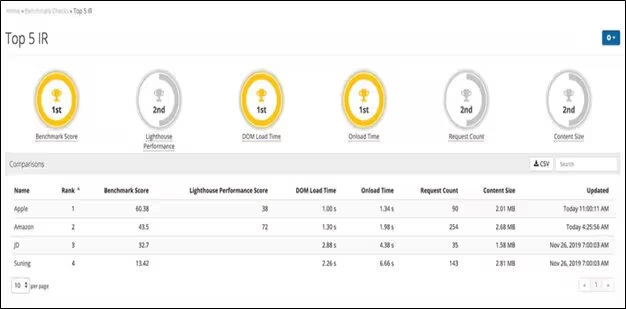
Monitor 24/7
If an issue arises during off-hours or other low-traffic periods, synthetic monitoring provides the insight you need to quickly identify, isolate, and resolve problems before they affect users and negatively impact both revenue and brand equity.
Baseline & analyze performance trends across geographies
With synthetic monitoring, baseline tests can be set up to mirror the way your end-users truly access your applications. These baseline tests can monitor key transactions from a wide range of geographic locations while testing from multiple browsers and devices.
Summing up synthetic monitoring vs RUM
The key to a holistic view of your website or application’s user experience is to harness the power of both real user monitoring and synthetic monitoring. Synthetic monitoring has many important strengths, and a synthetic-only approach to web performance can be beneficial.
However, understanding the benefits of a real user monitoring platform and then incorporating it as part of a broader web performance strategy can provide additional, critical insight to ensure that a site or application is not only fast but also tailored toward the needs of the real end-users.
Related Articles

How to Use LLMs for Log File Analysis: Examples, Workflows, and Best Practices

Beyond Deepfakes: Why Digital Provenance is Critical Now

The Best IT/Tech Conferences & Events of 2026

The Best Artificial Intelligence Conferences & Events of 2026

The Best Blockchain & Crypto Conferences in 2026

Log Analytics: How To Turn Log Data into Actionable Insights

The Best Security Conferences & Events 2026

Top Ransomware Attack Types in 2026 and How to Defend