The Role of Prompt Engineering in Useful AI: Benefits, Techniques, and Applications for Better Prompting
The rise of generative AI has brought both excitement and uncertainty across industries. Excitement is due to its impact on productivity and operational budget. Uncertainty, in contrast, is due to differences in outputs, bias, and security risks.
Thankfully, improving prompt quality through prompt engineering can largely address these downsides. With prompt engineering, you can create powerful AI applications — and ensure that AI models accurately understand and respond to human language.
In this article, we’ll introduce you to the basics of prompt engineering, its benefits, applications, and techniques for using it to transform language models into more effective ones than ever.
What is prompt engineering?
Prompt engineering is the process of developing and reviewing high-quality prompts to guide language models, particularly large language models (LLMs). These models are artificial intelligence (AI) systems designed to generate human-like text after analyzing large datasets. So, to use them, you’ll need to issue a command or task known as a “prompt” that they are to act on.
Prompts are instructions or guidelines engineers or users provide to language models to guide their outputs. They include specific input text, writing prompts, topic-specific keywords, or other information to help the model generate the desired output.
It could be a question like “What is the name of the current pope?” Or a task like “generate ten topics for a cloud analytics blog.”
However, these Gen AI tools sometimes produce repetitive, unreal, biased, or emotionless outputs. So, you’ll need to optimize the prompts to avoid such outputs. That is what prompt engineering is all about.
(Related reading: LLMs vs, small language models, explained.)
Example of prompt improvement
For example, here’s a prompt I gave ChatGPT:
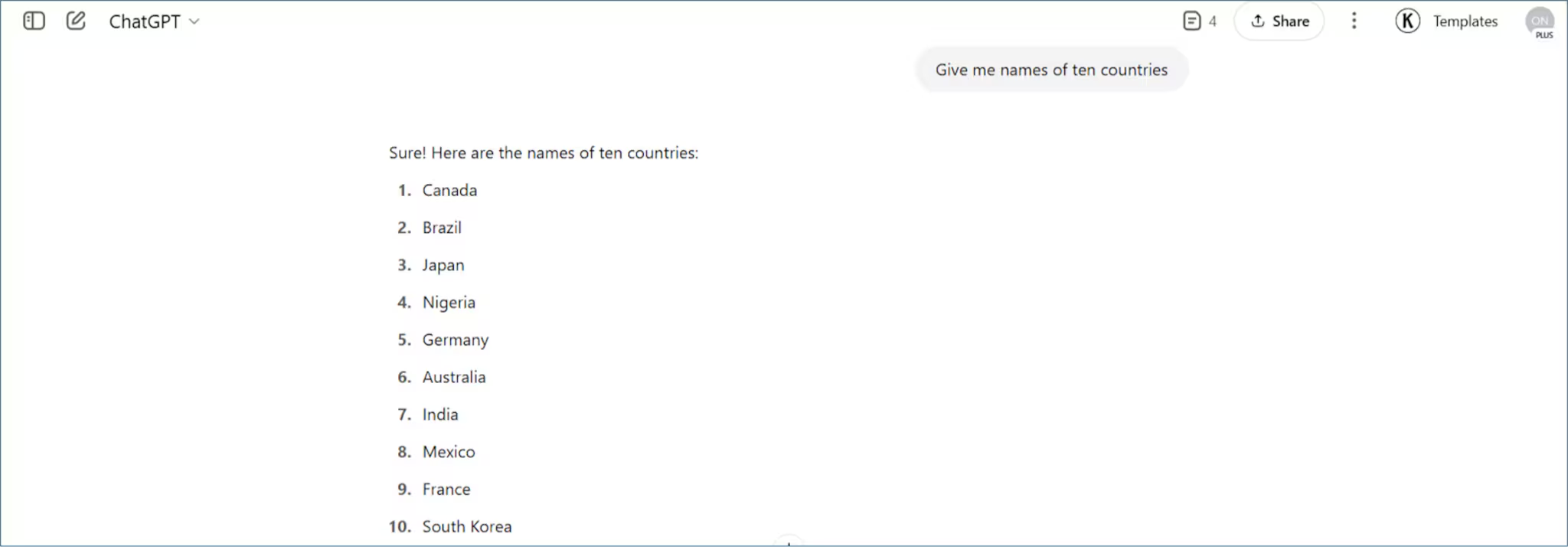
This information is correct, but not helpful for my research about Asian countries, so I went back and gave it a more detailed prompt.

Voila! A much better result, which moved my research forward, down the path I wanted to explore.
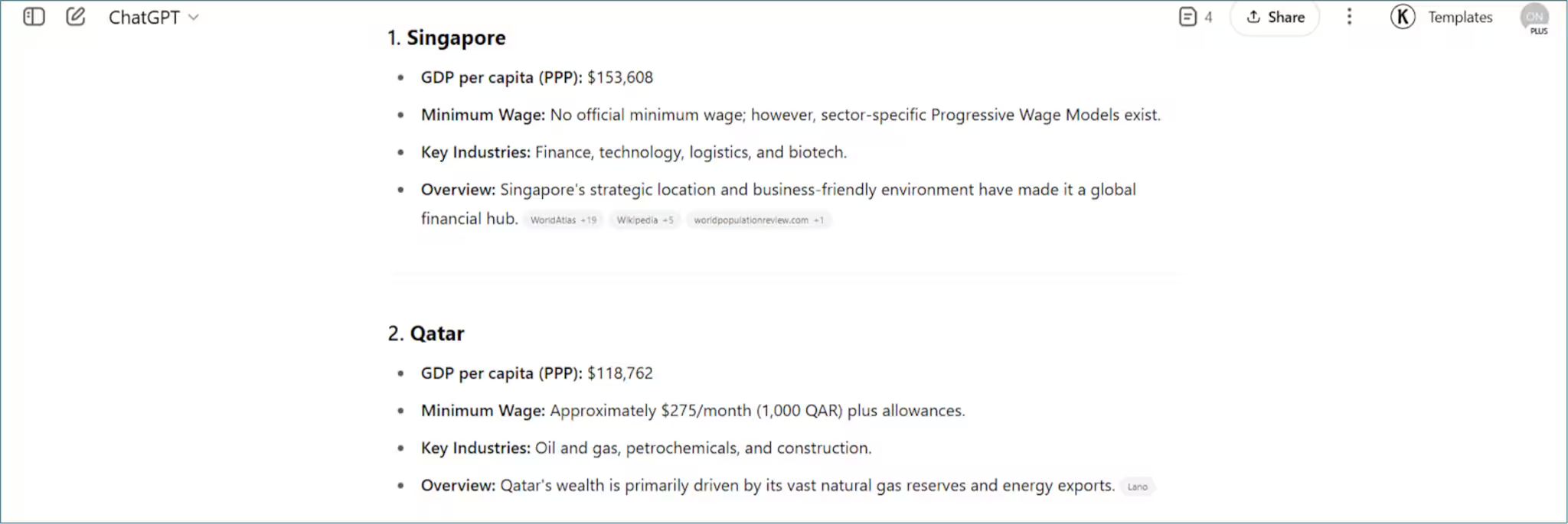
That’s the power of prompt engineering. Providing more context and information about the specific countries I need information on improves the quality of the output.
Applications of prompt engineering
There are a few results you will be unable to get from a gen AI tool or LLM with a good prompt — which is why almost every area of human life has been impacted by it. From regular work life or activities, to self-development, career planning, and even academic, here are some of the top use cases of prompt engineering we’ve found:
- Text generation: Prompt engineers can generate text for various applications, such as chatbots, virtual assistants, and content creation. They are critical to ensuring the text is relevant, accurate, and meets specific criteria.
- Summarization. Language models can summarize long articles, documents, and even books. The right prompts guide the model to focus on the most critical information and present it concisely.
- Translation: Language models translate texts from one language to another. Prompts can provide the appropriate context to guide the model in producing accurate translations.
- Healthcare: Models can analyze medical records, generate reports, and assist with clinical decision-making. Prompt engineering helps ensure that they yield accurate and clinically relevant information.
- Customer service: Customer service increasingly relies on AI to create chatbots and automated responses to customer inquiries. Prompt engineering helps chatbots generate accurate, relevant, and helpful customer answers.
How does prompt engineering work?
To understand the fuss about prompt engineering, let’s refresh ourselves on generative AI, especially because prompt engineering is not only applicable to LLMs. Gen AI learns patterns from an existing dataset and gives a unique output.
The downside is that whatever it produces may lack depth, creativity, and repetition. This also leads to ethical concerns and a fear of plagiarism when using these AI models. Remember the copyright problems that Open AI’s Studio Ghibli-style images generated? That’s a clear example of how murky or questionable that outputs from AI can be.
Prompt engineering works thanks to a series of technical and non-technical processes, which include the following:
- Understanding the architecture behind these AI models and communicating with them in a way they know. For instance, ChatGPT, backed by a transformer model, uses contextual probability to make sense of every input and generate a suitable output.
- Formulating the right prompt, one that is clear, concise, and contextual.
- Configuring the model with the correct settings so it delivers the right output.
The technical aspects that are fundamental to the performance of these AI models led to the rise of the prompt engineer role. However, the prompt engineer role has become obsolete as AI companies learn to pre-configure their models before releasing them to the public.
Benefits of prompt engineering
The most significant benefit of prompt engineering is that it allows us to get the best possible result from every input. Especially because generative AI tools, models, and LLMs follow the simple computing rule of garbage in and out.
Plus, each generative AI tool and LLM works differently — so therefore must be prompted differently. For instance, ChatGPT 4.5 is more direct, feels more natural, and has great long-term memory, while Claude Sonnet 3.7 has an extended thinking mode, providing more winded logical answers. (Check out the LLMs we recommend for different tasks.)
Knowing how to humanize content is another upside to prompt engineering. Marketing is an industry that has seemingly feels the most threatened by the rise of generative AI, with the different opportunities for adoption it offers. Still, marketers have risen to the challenge by embracing these tools, particularly for writing and editing.
Bias reduction, an ethical issue debated since LLMs became a thing, is also possible through prompt engineering. If these biases are left unchecked in AI outputs, they will keep entrenching harmful stereotypes that paint a bad image of organizations — and do not contribute to societal progress.
For example, this UNESCO study on Gen AI shows the alarming tendencies of LLMs to perpetuate gender and racial stereotypes. Some of the prompt engineering tips applicable here include:
- Using neutral language in prompts.
- Requesting credible and verifiable sources.
- Including diverse perspectives in outputs.
Which brings us to the next point…
Prompting techniques for better outputs
To engineer effective prompts, you must be strategic and go beyond the basic one-line questions, especially if you desire detailed and unbiased answers.
Here are some techniques for getting an LLM to deliver the best output:
Add a context
Contextual prompts help Gen AI tools narrow down results from the large datasets they work with. Remember the example we used in the first section of this article? Notice how the first result brought up countries from different continents, but we got more relevant and richer results by situating the follow-up prompt in Asia.
It also helps eliminate some racial or gender bias that these tools are pre-programmed with. For example, you can ask an AI tool to list top performers in a field and the model, on its own, may pull up only names of male-identifying persons. In reality, the field may have all genders represented, but the AI system may favor a particular gender simply due to the data available to it.
Using a prompt template (like my example for Asian countries), you can refine your prompt to ensure the LLM delivers an output that is a mix of male and female performers. Over time, this also teaches the model you’re using to provide more diverse answers.
Providing context for LLMs
When using LLMs, don’t simply ask it to perform a task. Instead, the more details you provide, the better response the LLM can output to you — like your role, what you’re trying to accomplish, and whether the model has any requirements or helpful details that you can provide to it. Challenge the LLMs to answer hard questions. In decision making tasks, for example, you can ask the model to explain its reasoning.
Be explicit
Vague prompts will produce vague answers; hence, you must be as clear and detailed as possible when interacting with LLMs. Being clear when crafting prompts entails:
- Starting with a verb.
- Highlighting the specific audience your prompts cater to.
- Adding examples of answers you want the gen AI to imitate.
- Asking the model to tell you what it needs to complete a given task or activity.
Avoid using complicated language or adding unnecessary information that could confuse the language model and distract from your goals.
Iterate on your prompts
Creating prompts is not a one-and-done endeavor. It’s an iterative process, so it’s critical that you continuously refine and improve the prompt based on feedback and results. Thankfully, most LLMs act like chatbots, so you can keep querying the output from every prompt until you get your desired result.
It will help you ensure your language model generates accurate and relevant output over time.
Adopt chain of thought prompting (CoT)
Chain of thought prompting refers to the practice of decomposing complex user queries into intermediate prompts that serve as few-shot examples to step-by-step answers. Think of it as giving someone some maths equations to solve, but you don’t stop there. You go on to use the right formula to solve one of the equations so that they can figure out the remaining questions independently.
CoT prompting is ideal for complex tasks as it involves breaking down the request by giving more context or solving it so that the AI model can imitate and produce the correct output.
While we recommend chain of thought prompting, there are other prompting techniques you can explore based on the type of query and the size of your generative AI model. These include:
- Zero-shot prompting: When you give the model a direct instruction without an example prompt to gain additional context and reasons. Prompt examples under this are summarization, translation, or example generation. The prompt on Asian countries is a zero-shot prompt.
- Few-shot prompting: You provide the LLM with examples of a task to generate a desired response.
Prompt engineering is the future of human-AI collaboration
Prompt engineering is critical to using powerful and effective language models for many applications. By crafting high-quality prompts, you can guide language models and ensure they generate accurate and relevant output that meets their specific criteria.
Prompt engineering is not a one-size-fits-all, single-time approach. It requires careful consideration of use cases and the broader environment in which the language model will be used. However, with the right approach, best practices, and ongoing refinement, prompt engineering will open up even more possibilities for innovation and progress in AI.
Related Articles

How to Use LLMs for Log File Analysis: Examples, Workflows, and Best Practices

Beyond Deepfakes: Why Digital Provenance is Critical Now

The Best IT/Tech Conferences & Events of 2026

The Best Artificial Intelligence Conferences & Events of 2026

The Best Blockchain & Crypto Conferences in 2026

Log Analytics: How To Turn Log Data into Actionable Insights

The Best Security Conferences & Events 2026

Top Ransomware Attack Types in 2026 and How to Defend