The OSI Model: Understanding the Layered Approach to Network Communication
Key Takeaways
- The OSI Model is a seven-layer framework that standardizes the functions of a telecommunication or computing system, breaking down network communication from physical transmission (Layer 1) to application-level processes (Layer 7).
- Understanding each layer of the OSI Model is essential for troubleshooting, designing, and securing networked systems, as it clarifies how data moves, is managed, and enables efficient isolation and resolution of network issues.
- While most modern networks use the simpler TCP/IP stack, and not all protocols map perfectly to the OSI Model, it remains a foundational tool for learning, discussing network architecture, and understanding where specific technologies and protocols fit and interact.
The Open System Interconnection model — the OSI model, for short — shapes how we build digital environments. A conceptual framework, the OSI Model describes how different computer systems communicate with each other inside networks and cloud/internet environments.
Today, let’s look at how the OSI Model affects our digital lives, applications and networks.
What is the OSI model and why do we need it?
The OSI model was first adopted in 1984 by the International Organization for Standardization (ISO) when networking was ruled by competing technologies such as Ethernet, Token Ring, FDDI and ARCNET. Like today, there were many different incompatible machine technologies and operating systems from companies such as IBM, Burroughs, Univac, Hewlett Packard, and more.
In the early 1980s, there were no agreed-on standards or blueprints for how two different computer systems could exchange data. The OSI Model was created to provide a framework for how diverse computer systems using different technologies can talk to each other.
The OSI Model abstracts and describes the activities, processes, and standard protocols used for cross-system communication.
It helps communicate and visualize how digital communication operates for a wide variety of uses including design, engineering, marketing, documentation and more. It is also used for troubleshooting and isolating network issues.
The OSI Model today: OSI vs. TCP/IP
The OSI Model isn’t the only conceptual framework used in networks and the cloud and internet. The internet also comprehensively uses the TCP/IP framework model as another foundational set of communications protocols.
Unlike the seven layers of the OSI model, the TCP/IP model is typically described with fewer layers, often four or five. While the layers don't map perfectly one-to-one, the TCP/IP model's layers broadly correspond to functions found across multiple OSI layers. Many TCP and TCP/IP protocols are referenced in the OSI Model.
Understanding both models provides a more complete picture of how modern networks operate.
Even today, manufacturers, engineers, vendors, users and others still reference the model to determine what components are necessary to make their systems talk to other systems. Both the OSI Model and the TCP/IP Model have been absorbed and internalized into digital lives at such a basic level that they are both explicitly and implicitly used without even thinking about it.
Understanding the OSI Model: A top-down view
The OSI Model is divided into seven layers that describe the activities and processes needed for disparate computer systems to communicate with each other over networks and the cloud/internet.
Often presented from top to bottom (layer 7 to layer 1), the OSI Model describes the path that data takes from the end-user level (layer 7: Application Layer) down through the stack to the physical transmission of bits across communication links and network cards (layer 1: Physical Layer), and all layers in between.
This top-down perspective aligns with how users interact with applications and how data begins its journey from a software process.
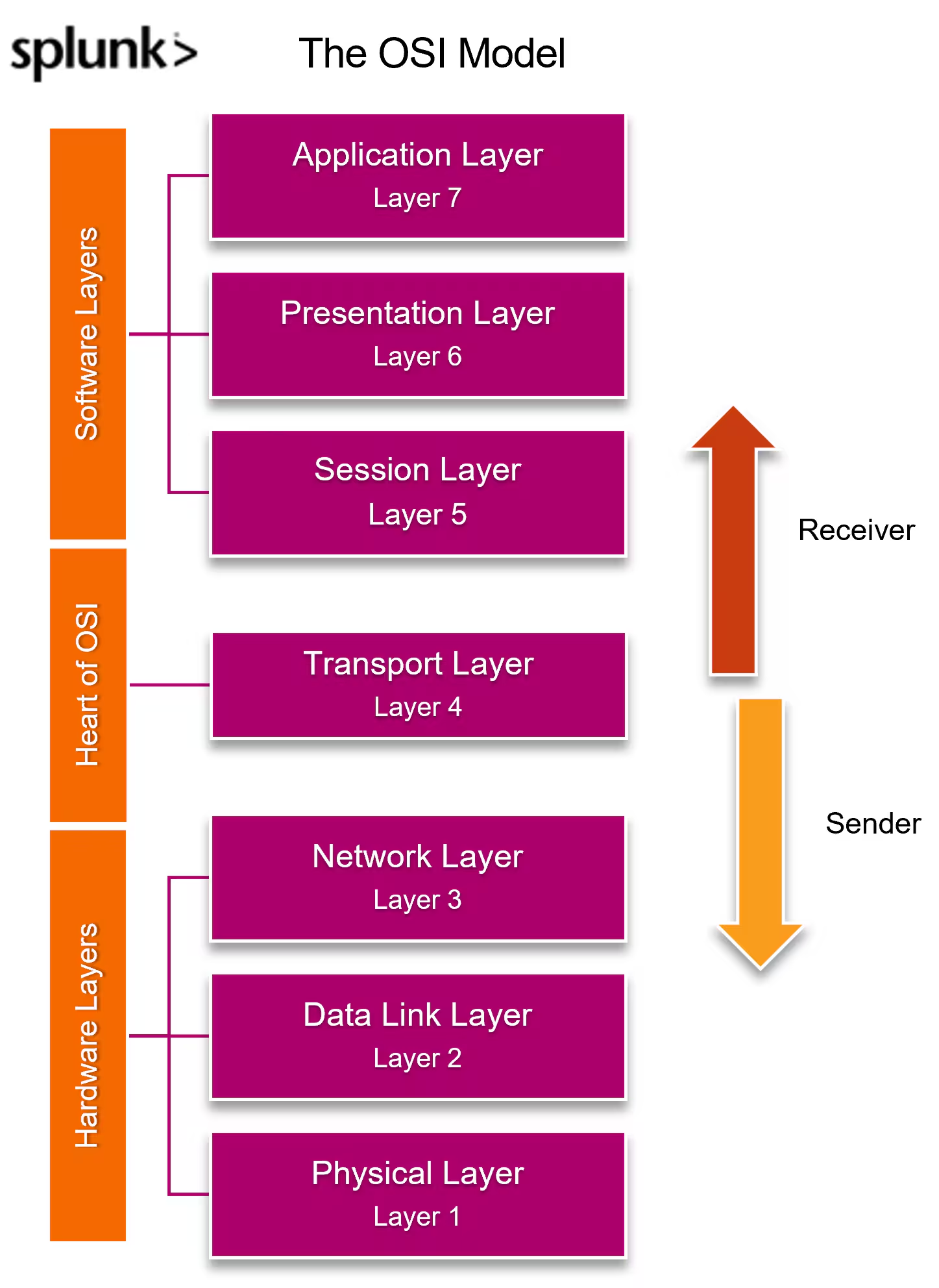
The OSI Model for how different computer systems communicate with one another
Why do you need the layered model?
The network architecture needs to be comprehensible and interoperable. Integration with external network elements and services should be standardized. In a layered network model, each layer offers modularity and abstraction to other layers. That means that changing one layer element does not affect the functional performance of another layer element.
For example, if your page load speed is slow but your network hardware is performing optimally, you can troubleshoot, fix and modify the application layer (HTTP) without having to change the physical devices. Individual layer functions can be reused, modified and scaled — across topologies, functions, and differences that may exist in other layers.
So why the OSI layer model in particular? The industry has widely accepted the OSI model as their preferred choice and it comes down to the following reasons:
- Open source: To scale across global markets, business organizations want to avoid vendor lock-in situations. Relying on proprietary network communication protocols and frameworks may limit their global exposure and ability to scale.
- Simplify network model: The OSI breaks down complex network architecture into seven logical layers, each serving a unique set of functions. This allows the industry to design, understand, and manage their technology systems to serve specific roles in data communication, without needing to know the end-to-end technology stack.
- Simplify troubleshooting: Since the layers are logically decoupled, problems across the layers can be isolated. This reduces the time spent in debugging and finding the issue root cause.
- Simplify security, data integrity, and reliability: Each layer can have its own security protocols and controls to address unique challenges facing the network at different logical layers of the network. While this approach allows targeted defense at every level, it also creates redundancy in security protection — and that’s a good thing.
- Easier to develop: Apps and services can be developed around standardized APIs and protocols that are widely adopted across global markets. For example, a messaging app can be developed at the Application Layer 7, while sharing the same mechanism for security and data transmission as other applications running on the same network architecture.
- Consistency in functions and protocols: Since every layer follows its own well-defined functions, the behavior is standardized across platforms, devices and services.
Besides this, like any popular open-source technology, early adoption of the OSI model by prominent players in the industry has had a knock-on effect, encouraged by large enterprises such as Cisco, HP, and IBM to build interoperable networking technologies. It emerged as a universal language of how data communication should take place across the global Internet and telecom expansion.
Breaking down the OSI model: Grouping the layers
Looking at the OSI Model, notice that the seven layers can be grouped into three general categories. These groupings allow us to generally refer to OSI model function — software, Heart of OSI, hardware — based on their primary role in the communication process. We'll explore these layers from the top down (Layer 7 to Layer 1).
- Software layers: The Application, Presentation, and Session layers (layers 7, 6, and 5) are collectively referred to as Software Layers of the model. This is where transmission activity associated with software apps occurs, including operating systems, web browsers, and custom applications.
- Heart of OSI: The Transport Layer (layer 4) is also referred to as the Heart of OSI. This is the crucial layer where the actual end-to-end transmission between different systems is managed.
- Hardware layers: The Network, Data Link, and Physical layers (layers 3, 2 and 1) are collectively referred to as the Hardware Layers of the model. This is the journey the data takes through the physical components and network infrastructure on each system as it is processed for transmission or delivery.
The 7 Layers of the OSI Model (Top-Down)
Let's now look at each individual layer, starting from the top (closest to the user) and moving down towards the physical network. The seven layers of the OSI Model reduce the design complexity of networked systems, each describing sub-functions within the Software, Heart of OSI, and Hardware groupings.
Software Layers
Layer 7: Application Layer
The application layer is the closest layer to the end user. It receives information from the end user and sends results back to the user. Despite its name, Layer 7 is not where client applications live. This layer provides the protocols that allow software/apps to transmit data, including:
- HTTP and HTTPS
- FTP
- POP & SMTP
- DNS
- Telnet
- DHCP
- SNMP
The main functions are summarized as follows:
- At this layer, most of the functions are defined by the services and applications operating on the network. The layer itself only acts as an interface between the user and the application.
- Important functions include quality of service (QoS) specifications, service identification, security access, and security controls. The layer also functions for resource negotiation, ensuring that the services are available before starting data transmission.
Layer 6: Presentation Layer
The presentation layer ensures the data is prepared in a usable form for the application layer (receiving side) or for the network layer (sending side). Layer 6 is responsible for:
- Data translation
- Encryption & decryption
- Compression
- Other data preparation items
The main functions are summarized as follows:
- Negotiating the transfer of syntax between two network entities is the primary activity here. It ensures that the same data structure is interpreted between different systems. It is needed since the data may be encoded, compressed, and translated in different ways.
- Performing important security functions such as data encryption and decryption. Complex algorithms such as GZIP and LZ77 may be used to reduce data volume for faster transmission.
Layer 5: Session Layer
The session layer creates and maintains the sessions (connections) that two systems need to speak to each other. Layer 5 defines:
- When sessions are created and opened
- How long sessions remain open to successfully exchange data
- When to close sessions
- And more
It also creates checkpoints to ensure and synchronize data transfer. The main functions are summarized as follows:
- Managing and controlling the dialog (communication sessions): The layer initiates and releases data packets in the beginning (session initiation) and the end of the communication session (teardown) respectively. It is important to ensure that the communicating network entities agree on when to begin, how to exchange, and when to end the data transmission.
- Managing tokens, in half-duplex environments where only one entity is allowed to communicate at a time. A token is a special controlling message that allows the holding entity to perform a communication task. A full-duplex environment allows both entities to communicate simultaneously.
- Mapping session-level connections to the underlying Transport Layer. Essentially, this means the layer identifies the sessions attributed to each data transmission. The layer manages how the application-level sessions are using the available Transport connections. This helps with data transmission continuity and identifying when a transport connection has failed.
Heart of OSI Layer
Layer 4: Transport Layer
The transport layer uses transmission protocols including Transmission Control Protocol (TCP) and User Datagram Protocol (UDP), to manage network traffic between systems to ensure correct data transfers.
- On the sending side (moving down the stack), it takes data from the session layer and breaks it into segments for the network layer.
- On the receiving side (moving up the stack), it reassembles the segments from the network layer and passes them on to the session layer.
Layer 4 also handles flow control and error control, regulates transmission speed and requests retransmissions if needed. The main functions are:
- Establishing and releasing connections between network devices for the duration of the data transmission.
- Performing functions such as end-to-end flow controls and error detection, sequence control, and segmentation are performed at this layer (for TCP connections, PDU is a segment).
- For stateless and connectionless data transmission (UDP), this layer also includes PDU delimiting, which allows the network to maintain continuous communications across independent data packets. For this connection type, PDU is a datagram.
Hardware Layers
Layer 3: Network Layer
The network layer decides which physical path the data will take across potentially multiple networks. It’s responsible for breaking up transport layer segments into smaller network packets for transmission and for reassembling those packets on the receiving system. This layer routes packets to their destination, mostly by using IP addressing.
Layer 3 processing is generally bypassed when the sending and receiving systems are on the same local network. The main functions are:
- The PDU at this layer is the data packet. This layer handles how the packet is routed between controlling subnets or different networks.
- Making available the Data Link layer connections for Transport Layer entities. This is achieved primarily by selecting the path and service, and assigning a network address-to-data link address mapping.
- Important functions include network connections and multiplexing, network segmentation and blocking, error detection and recovery, sequencing, and flow control.
- Enforces Quality of Service (QoS) parameters to the network connection. These parameters may include limits on delay, availability, jitter, and reliability.
Layer 2: Data Link Layer
The data link layer defines the format of data on the local network segment. Like the network layer, the data link layer enables data transfer between two directly connected nodes or systems on the same network. Layer 2 also corrects errors that may have occurred at the physical layer (layer 1).
It uses media access control (MAC) processing for flow control and multiplexing between two systems on the same link. It also uses logical link control (LLC) to provide flow control and error control within the local network segment.
The main functions are:
- Controlling interconnections between network entities such as circuits within the physical layer. For this layer, PDU is the data frame.
- Identifying, exchanging, and managing configurations and parameters to execute these controls.
- Detecting issues such as errors. These errors may arise from physical factors such as temperature and Electromagnetic Interference (EMI).
- Managing Data Link layer functions such as establishing and splitting connections, managing data sequence, flow control and synchronization, error recovery, and connections.
Layer 1: Physical Layer
The physical layer converts and transmits raw bit stream data (1s and 0s) over the physical medium. Layer 1 concerns the physical and electrical connections the system uses. It includes:
- Wireless frequency links, like Wi-Fi and wireless network connections
- Network cabling (Ethernet, fiber optic, etc.)
- Light-speed transmission, such as fiber-optic cabling
- The physical specifications for data transmission, including voltages, signal types, and pin layouts
The physical layer also discusses network components such as hubs, repeaters, modems, network adaptors (NICs), etc. The main functions are summarized as follows:
- Physical activation and deactivation of data transmission.
- Transmitting Protocol Data Unit (PDU) bits across the network. For this layer, PDU are the individual data bits.
- Executing algorithmic processes for transmission, such as multiplexing and demultiplexing.
- Managing physical layer components and sequencing to ensure that the data moves in the required sequence.
How data is transmitted in the OSI model: The bi-directional journey
Think about a common action you take every day, like clicking a link to visit a website or sending an email. While it seems instantaneous from your perspective, behind the scenes, your computer and the network are performing a complex series of steps defined by models like OSI.
The OSI Model is inherently bi-directional. It is used by both the data sender and data receiver, and the two sides change roles during the transmission process. Understanding this flow from the user's initiation to the final delivery is key to seeing how the layers work together.
When you, as a user, initiate an action that sends data from your system — like requesting a web page — that data starts at the Application Layer (Layer 7) on your system. It then travels down through each layer to the Physical Layer (Layer 1). At each layer, the data is processed and encapsulated, meaning the layer adds its own header (and sometimes footer) information to the data unit it received from the layer above. This added information is necessary for the corresponding layer on the receiving side to correctly process the data.
When data is received by your system — like the web page content arriving — it arrives first at the Physical Layer (Layer 1) and travels up through each layer to the Application Layer (Layer 7). At each layer, the data unit is processed, and the header/footer added by the corresponding layer on the sending side is removed (decapsulation). The data is then passed up to the layer above until it reaches the Application Layer and is delivered to the end-user application (your browser).
As an example, when your browser requested the URL for this article, it made the request first at the Application Layer (Layer 7). The requested data — URL and transmission information — was processed and modified as it traveled down the OSI Model stack, through Layers 6, 5, 4, 3, 2, until it was transmitted as raw bits at the Physical Layer (Layer 1) towards the Splunk web servers.
At Layer 1, the Splunk servers received the bits and processed the data up through their OSI model stack (Layers 2, 3, 4, 5, 6). The request was finally understood at the Application Layer (Layer 7). The servers then processed the request, retrieved the HTML code and transmission information, and transmitted the article back to your browser. This response data started at the Application Layer (Layer 7) on the server and traveled down the stack to Layer 1 for transmission. It was then received at Layer 1 on your system and traveled up your stack (Layers 2 through 6) until it arrived at your browser (Application Layer, Layer 7) where you’re reading it right now.
Because the model is bi-directional, both sides — your browser and the Splunk Web servers — function as sender and receiver:
- Your browser sends the URL request (7-1 flow) and receives Web page content (1-7 flow).
- The Splunk servers receive the URL request (1-7 flow) and send the Web page content (7-1 flow).
This data transfer framework can be modeled and used by almost all computer systems in internal networks and in the cloud/internet.
And that’s how the OSI Model defines how data is transferred in both directions.
The value of the OSI model
The OSI Model provides an invaluable framework for understanding how complex network communications function, breaking down the process into manageable, standardized layers. Its logical structure simplifies design, troubleshooting, and development across diverse technologies.
While technology constantly evolves and other models like TCP/IP are also fundamental, the OSI Model's core concepts remain a critical reference point for network professionals and engineers worldwide. So, while the specific implementations or dominant models might shift over time, the fundamental layered approach pioneered by OSI is likely to endure as a way to conceptualize digital communication.
Related Articles

How to Use LLMs for Log File Analysis: Examples, Workflows, and Best Practices

Beyond Deepfakes: Why Digital Provenance is Critical Now

The Best IT/Tech Conferences & Events of 2026

The Best Artificial Intelligence Conferences & Events of 2026

The Best Blockchain & Crypto Conferences in 2026

Log Analytics: How To Turn Log Data into Actionable Insights

The Best Security Conferences & Events 2026

Top Ransomware Attack Types in 2026 and How to Defend