Offensive vs. Defensive Security: What's The Difference?
Key Takeaways
- Offensive security simulates attacks to uncover vulnerabilities: Red teams, acting as simulated attackers, use penetration testing and other tactics to identify weaknesses in an organization’s defenses before real attackers can exploit them.
- Defensive security is the frontline of protection: Blue teams focus on monitoring, detecting, and responding to threats in real time using tools like firewalls, intrusion detection systems, and incident response plans to secure systems against active attacks.
- Splunk empowers both red and blue teams: By providing real-time monitoring, advanced analytics, and automation, Splunk helps blue teams defend systems effectively and enables red teams to identify and address vulnerabilities during proactive assessments.
Offensive security and defensive security are two overarching approaches to strengthening your security posture, especially against severe threats like DDoS and ransomware. Ideally, all businesses and organizations should engage in both types of security. Briefly, the differences are:
- Offensive security simulates attacks and identifies your system's vulnerable points, typically via techniques like penetration testing.
- Defensive security is reactive and incorporates tools such as firewalls and encryption for threat detection and mitigation.
Let's look at how they both work and which one is better. We'll also explore some key challenges and best practices to get the most out of these.
What's offensive security?
With offensive security, you can use methods like penetration testing to find weaknesses in your network before hackers can exploit them. Briefly, here's how:
- Define the goal you want testing to achieve.
- Use scanning tools to find how an application will respond to attacks.
- Once you know the vulnerable points, try to exploit them. For example, you may use SQL injection to steal online assets.
- Report on vulnerabilities and their impact and share with relevant stakeholders.
The goal with offensive security is to simulate real-world attacks in order to test your organization's security posture.
The person who performs offensive security testing is known as an ethical hacker or a "white hat hacker". Before you confuse them with malicious hackers, here's what sets them apart:
- Ethical hackers work with private business and/or organizations like the FBI to identify and fix vulnerabilities to protect either the business or, in some cases, the state.
- On the other hand, malicious hackers exploit vulnerabilities to steal important data, such as bank details, for their gain.
(Related reading: black vs. white. vs grey hacking: what's the difference?)
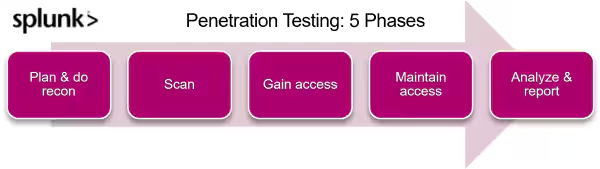
Steps involved in offensive security
Offensive security protects online assets from cyberattacks by finding loopholes in the system. There's no one way to implement this approach, but it involves these basic steps:
- Reconnaissance: The first step is to monitor any suspicious activities in a network, system, or application, depending on your goal and target. Here, ethical hackers collect more information about vulnerable points in the systems to expose the areas that can be easily scanned and compromised.
- Scanning: You've collected some information, and now you want to come into contact with the target. This step involves sending data packets to the target and then interpreting the response you receive. That response may include useful info like: IP addresses, open ports, operating system (OS) details, services installed, and more. Nmap is a popular network scanning tool, and there are several more options.
- Gaining access: In this phase, you actually simulate attacks that exploit the vulnerabilites you found during the scanning phase. Your aim is to understand whether there are security controls that attackers could either bypass or hack, and how deeply they can access into the system.
- Maintaing access: Now you know how and where attacks may access your systems. Next up: find out how they can maintain their access in the system while staying undetected. For instance, hackers may insall keyloggers, backdoors, and/or code snippets that enable them to maintain their access to the system. This is how more advanced threats, like APTs, can be uncovered.
- Reporting your findings: With the pentesting complete, finish up by reporting what you learned. That way the security team or other stakeholders can strengthen the appropriate controls. The report should detail vulnerabilites discovered, the risk of these and how they can be exploited, and the types of data accessible and length of time attackers may stay undetected.
(For more details on each phase, check out our full penetration testing explainer.)
Challenges with offensive security
Although offensive security is a critical aspect of an effective cybersecurity strategy, it's challenging to implement across different jurisdictions while staying within budget.
Here are some common challenges you may face with it:
General constraints
Offensive security operations, like penetration testing, may face these few limitations:
- Challenging to gain access to the system of the entire organization.
- May face false positives by focusing on points that are not vulnerable.
- Disrupt normal business activities.
Costly process
Since you need to hire specialized white hat hackers, offensive security can be expensive. Here are a couple of reasons about why these hackers are expensive to work with:
- They use expensive tools and techniques.
- They don’t receive public recognition for their work.
- They may face legal charges — that's what happened to Malta’s white hackers and their lecturer.
So, if you want to conduct thorough penetration tests, it’s time to increase your security budget.
Identifying unknown attacks
Every organization wants to avoid unknown threats, but an offensive security approach fails to do that. Implementing this approach fully can take days. So, if there are any vulnerabilities in the system, zero-day attacks can exploit them within minutes. This makes it impossible to predict some unknown attacks quickly.
Defining defensive security
Defensive security incorporates different security measures to protect your network from attacks. Unlike offensive security, it focuses on setting up robust systems and networks rather than seeking vulnerabilities. This procedure is initiated after an incident occurs and here's how it works:
- Teams set up network security devices, such as firewalls, to minimize unwanted traffic access.
- Then, they monitor networks to detect any incidents.
- If any incident occurs, they swiftly mitigate it to minimize the damage in a data breach.
Steps involved in defensive security
With no offensive security in place, it’s so important to create a defensive security plan to damage the control after an incident occurs. Here are some key steps to ensure a secure and resilient system:
- Assess risk: Identify the type of attack—is it phishing, DDoS, or some other kind? After identification, assess the associated risks and their potential impact. For instance, malware was the top attack most businesses faced in 2024.
- Mitigate: To minimize downtime, respond to this incident as early as possible. In 2023, the forensic investigations took an average of 33 days. You should aim to do it in less time.
- Create a policy: Next, draft a clear policy to mitigate the identified attacks in the future. You could include tactics such as using strong passwords or turning off certain file types. For example, you might develop a policy that blocks .exe files.
- Implementation: The last step is to implement the security policies. For example, if your policy blocks a certain file type, implement it across all user devices.
Challenges with defensive security
Most businesses rely on defensive security to protect sensitive data and mitigate attacks. However, you may face these challenges while taking preventive actions:
Skill gaps
Defensive security requires a team of experts to handle sophisticated threats like malware and phishing. That’s why the demand for skilled cybersecurity professionals is high. However, businesses are facing a shortage of skilled IT experts worldwide. More than four million professionals are needed to fill this gap.
Since these professionals have many career options, retaining them is challenging. Here’s what you can do to attract good talent:
- Offer attractive salaries and perks.
- Hire trained ones who want to build a career in cybersecurity.
- Consider them as an asset and invest in their training.
Trust issues
Trust is a major concern with this approach for several reasons. First, you must give access to the security team, so spotting those with malicious intentions is hard. Secondly, using third-party tools can increase the risk of data leaks.
Limited resources
Like offensive security, budget is the biggest concern in defensive security. Small businesses do not have enough budgets for proper security measures. Also, companies that invest in defensive tools do not always get the expected value. This is because these tools may show false positives, which, if not spotted, can impact the security team's efficiency.
Best practices for offensive and defensive security
Protecting your network against vulnerabilities will always present challenges. However, you can always prevent these issues by adopting some best practices. Here are some recommendations to enforce these security methods more effectively:
- Backup data regularly: It adds an extra layer of security, allows you to minimize downtime, and prevents permanent data loss.
- Monitor third-party access: You should not give third-party tools access to the entire architecture. Instead, give role-based access and keep monitoring any malicious activities.
- Employee training: Due to the cybersecurity market skill gap, investing in employee training is extremely important. For example, you can train your team on why they shouldn't open suspicious links. This way, you know you’re working with a security-aware team.
- Consider it an investment: Don't see cybersecurity as a cost but an investment. When customers see that protecting their data is your priority, they will want to work with you.
Be offensive and defensive
Offensive and defensive security have their benefits and challenges. They involve different steps but have the same goal — to protect your online data. Offensive security is proactive in finding vulnerabilities before hackers do, while defensive security detects threats after they occur. You must incorporate both for a more robust security system.
Related Articles

How to Use LLMs for Log File Analysis: Examples, Workflows, and Best Practices

Beyond Deepfakes: Why Digital Provenance is Critical Now

The Best IT/Tech Conferences & Events of 2026

The Best Artificial Intelligence Conferences & Events of 2026

The Best Blockchain & Crypto Conferences in 2026

Log Analytics: How To Turn Log Data into Actionable Insights

The Best Security Conferences & Events 2026

Top Ransomware Attack Types in 2026 and How to Defend