Maturity Models for IT & Technology
Key Takeaways
- Maturity models measure an organization's capabilities over time: They provide a structured framework to assess progress, identify gaps, and guide improvements in areas like IT, security, or business operations.
- Progressing through maturity levels requires strategy and alignment: Organizations move from ad hoc or reactive processes to optimized, proactive operations by investing in tools, skills, and consistent processes that align with business goals.
- Splunk supports organizations in advancing operational maturity: With its data-driven approach, Splunk helps businesses gain visibility, automate workflows, and achieve operational excellence.
Setting meaningful goals for your technology investment decisions requires an understanding of your requirements. Primarily, that’s…
- Knowing what you need.
- Knowing your current situation relative to those needs.
- Knowing what improvements or preparations are necessary before adopting new technologies and processes.
Measuring your IT maturity is one way to advance your IT performance — in a way that aligns with your organizational goals and minimizes the risk of failure. You can compare your current situation to a group of peers or competitors and also to industry benchmarks.
Let’s take a look.
What is a maturity model?
The term “maturity model” refers to any way of comparing your performance of something against an established benchmark. In our case, we’re looking at maturity models in IT and technology.
These scoring schemes allow you to identify and address gaps that prevent your organization from maturing in your IT journey and from developing more advanced ways to work. Once the technologies and processes are established in place according to your true stage of adoption maturity, your managers and IT teams can effectively communicate and onboard new users.
Roles and responsibilities are well defined and adapted according to the needs of the organization. An established qualitative and quantitative basis drives every decision pertaining to changes and the adoption process; realistic scheduling, investments, outcome and manageable risks are expected as a result.
(Related reading: IT benchmarking).
Comparison: maturity vs. performance vs. capability
“Maturity” when it comes to a technology function is different from its process performance and process capability.
- Technology process capability refers to the range of different outcomes that can be expected by adopting a new or different technology process. It is, however, one of the key assessment parameters guiding your IT performance score and thus, the maturity representative for new technologies and processes available.
- Technology process performance refers specifically to the actual outcome of your technology process adoption. Analyzing how well you perform on your current technology process in context of the available alternatives can serve as a guideline to identify the gaps and understand what changes are necessary. You can evaluate your achieved outcomes compared with expected outcomes, how well your organizational requirements were met, the goals achieved and the resulting risk exposure.
Technology process capability (expected results) and technology process performance (actual results) can be important components of the technology process maturity assessment. The maturity score implies the potential to improve process capability depending on the current state and achieve process performance in a future state – the states referring to adoption of digital transformation initiatives, technologies, processes and functions.
When an organization reaches maturity to adopt new technologies, it already features a rich process that can be consistently applied to adopt the new systems in all projects and functions across the organization.
Popular maturity models
While many maturity models exist and can be optimized for your business goals depending on the industry vertical and nature of digital transformation initiatives, let’s discuss …
Capability Maturity Model
Let’s start with the popular and well-established Capability Maturity Model (CMM) framework. CMM is one of the early process-oriented maturity model frameworks.
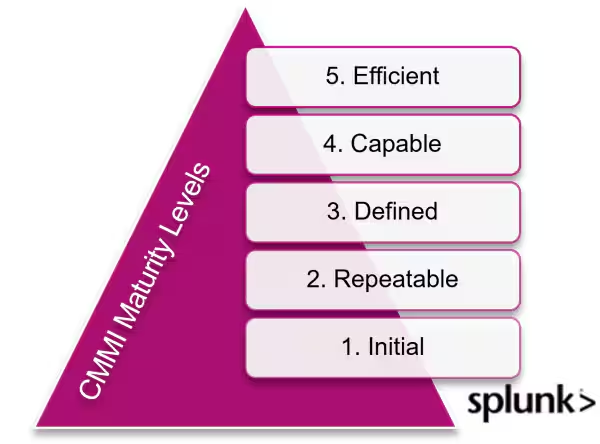
Developed in 1986 by the U.S. Department of Defense Software Engineering Institute (SEI), the CMM contains five process maturity stages, each building on continuous and evolutionary improvements. It gives an ordinal scale of measuring and analyzing technology process evolution across the following five levels:
- Initial. In this phase, the starting process is often chaotic and undocumented. Managers don’t have a fixed guideline and unexpected hurdles ranging from inadequate technical expertise and budget to lack of stakeholder commitment and executive buy-in can follow.
- Repeatable. Here, a bare minimum repeatable process framework is in place. The process may not be the most efficient option but it can be standardized and followed consistently by all business departments and IT functions.
- Defined. In this stage, the process framework is well documented and integrates coherently with other business processes and the wider project goals, which can range from financial performance to security and regulatory compliance.
- Capable. Here, the outcomes of the process can be evaluated against established metrics. Intricate details, gaps and opportunities are identified based on the chosen metric. Systems are in place to collect information, track and analyze the performance of the technology process or function.
- Efficient. At your most mature, a continual feedback improvement mechanism is in place. The process is continuously optimized through small and incremental changes. A quantitative measure of improvements is established and compared against risk exposure. Change management and risk mitigation activities are also established to make the process more efficient.
Capability Maturity Model Integration (CMMI)
Modern iterations of CMM such as Capability Maturity Model Integration (CMMI) integrate the concepts of modern Agile framework best practices to further improve the scoring model. It introduces concepts of interactive, repeatable and continuous feedback and improvements inspired by the Agile framework.
Cybersecurity Maturity Model Certification (CMMC)
CMMC has been around for years, supporting the U.S. Department of Defense, CISA, and private organizations the world over.
The Cybersecurity Maturity Model Certification (CMMC) 2.0 is the next iteration of the model, that was announced in November 2021 with timed milestones. The CMMC Model 2.0 is notional until rulemaking is complete.

Gartner Maturity Model
Among more recent scoring schemes for adopting new innovations and digital transformation projects is the Gartner Maturity Model. It measures a score rating low (1) to high (5) for your organization’s process maturity corresponding to new technology functions based on Gartner’s own research serving as a benchmark.
The research scores several metrics across different technology functions to understand how well the existing process and gaps map to improvements promised by new technology systems. Therefore, several maturity models from Gartner can help you guide decisions on technology process changes and adoption.
FAQs about Maturity M,odels
Related Articles

How to Use LLMs for Log File Analysis: Examples, Workflows, and Best Practices

Beyond Deepfakes: Why Digital Provenance is Critical Now

The Best IT/Tech Conferences & Events of 2026

The Best Artificial Intelligence Conferences & Events of 2026

The Best Blockchain & Crypto Conferences in 2026

Log Analytics: How To Turn Log Data into Actionable Insights

The Best Security Conferences & Events 2026

Top Ransomware Attack Types in 2026 and How to Defend