What Is ITOps? IT Operations Defined
Your organization is like a digital fortress: within its walls is a vast landscape with countless interconnected systems, data pipelines, and critical services that keep it thriving.
IT Operations serves as vigilant defenders, ensuring your gates are secure, systems are optimized, and disruptions are resolved swiftly. It’s the backbone that keeps everything running smoothly, maintaining uptime, optimizing resources, and addressing issues before they escalate. By strengthening your foundation, ITOps enables your organization to grow, innovate, and thrive without worrying about stability or security.
Here is what you need to know about IT operations, what it is, how it works, and why it matters.
What does IT operations mean?
IT Operations, or ITOps, teams manage and upkeep your business’s IT infrastructure, ensuring that your organizational system operates efficiently and cost-effectively to promote business growth. ITOps also oversees the adoption of new technology, like software automation and cloud computing, to optimize your business processes and reduce manual tasks.
ITOps gives your organization a valuable advantage by maintaining your service provider’s technology components and computing requirements. It improves workflows and increases the availability, proficiency, and performance of IT operations, processes, and services.
By resolving IT services faster and more efficiently, ITOps provides two benefits:
- Reduced service outages
- Improved user experience
By prioritizing your ITOps team, you can maintain secure, reliable IT systems that adhere to industry regulations and best practices. They also play a key role in ensuring the security of your organization.
The roles and responsibilities of IT operations
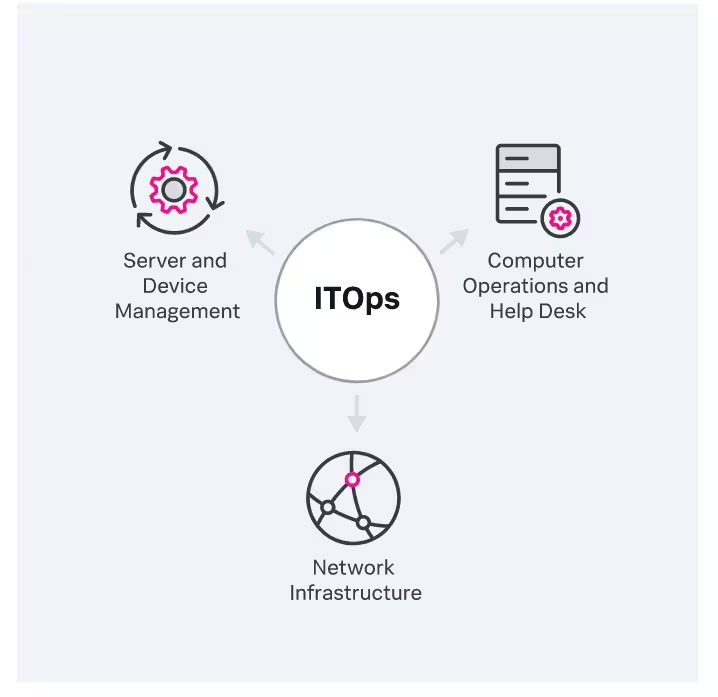
We’ve talked about what ITOps does in general, but what does it look like practically for your organization? ITOps includes a wide range of activities, from managing network operations to overseeing the virtual and physical components of a company’s IT environment.
As a result, IT operations managers and their teams take on diverse roles and responsibilities. However, some core responsibilities are common across most organizations, including:
Run solutions
The primary purpose of ITOps is to run solutions. This includes everything from performing data backups to configuring your servers to restoring your systems in the case of an outage or update. They seek to optimize system performance and allocate the right resources where they are needed most to impact service delivery.
Running solutions involves:
- Configuring and fine-tuning systems
- Allocating resources
- Ensuring data is properly backed up and restored
Resource allocation
ITOps is responsible for allocating and overseeing resources within the IT infrastructure to certify that operations remain efficient and uninterrupted. For IT Operations management, this means overseeing budgets for:
- Software tools
- Hardware
- Other necessary infrastructure components
Most ITOps personnel management follows one of two approaches: training teams to be versatile generalists that can handle various operational issues or creating a team of specialized experts that can each focus on maintaining specific systems or services.
In both scenarios, ITOps managers require real-time data, like service desk metrics and system uptime stats, to form decisions and ensure resources are most effective in supporting your organizational goals.
Infrastructure management
Another key responsibility of ITOps is overseeing IT infrastructure, whether on-premises or in the cloud. Infrastructure comprises network hardware, computing systems, cloud resources, and software applications. Managing this infrastructure involves overseeing cloud-based applications, maintaining network security, managing physical facilities, and supporting hybrid cloud environments.
Incident and security management
How quickly your organization responds to issues significantly impacts your security posture and the frequency of service outages. IT operations teams play a vital role by managing incidents using ITOps tools, established response protocols, and effective escalation procedures.
They turn chaotic situations into structured, manageable workflows with repeatable outcomes, ensuring incidents are resolved efficiently. Through retrospectives and post-mortems, teams gather insights from past incidents to create step-by-step workflows.
These workflows are then integrated into service management tools, enabling streamlined and effective incident management for future challenges.
Service desk support
While service desks are sometimes separate functions within IT, they fall under the umbrella of ITOps for many organizations. ITOps teams often handle the help desk and ticketing system, troubleshoot issues, and address root causes of IT-related problems.
ITOps also supports the services offered by IT teams by maintaining the infrastructure and systems that power the service desk. When customers create tickets or requests through your service desk, ITOps ensures that your organization’s underlying network, servers, and applications operate efficiently to support these interactions.
In some cases, advanced teams leverage Service Level Agreements (SLAs) to set expectations and define the ITOps response times and resource allocation they need to resolve issues quickly and effectively.
Why IT operations matter for your organization
With the wide variety of roles and responsibilities that ITOps fulfills, it’s not hard to imagine the incredible benefits a team would bring to your organization. Here are some of the top ways IT Operations matters:
Enhance efficiency
As organizations grow, chaos and disorder tend to follow. It often leads to confusion and delays in processes—ITOps steps in to find the bottlenecks and apply a system-wide solution that helps to streamline workflows.
With automation, precise task routing, and optimized resource allocation, ITOps ensures that issues are directed to the right person and place from the start, eliminating unnecessary hand-offs and communication gaps.
With ITOps, teams can build practices and channels that help the proper work get to the right people at the right time, resulting in faster resolutions and more efficient operations.
Increase productivity
ITOps boosts productivity across your organization by optimizing systems to run efficiently without disruptions. Combined with automation, or AIOps, it streamlines repetitive tasks like patch management and system maintenance, reducing manual workloads.
This allows teams to focus on high-priority issues and strategic initiatives. ITOps also centralizes IT operations, providing leaders with a holistic view for better decision-making, faster inefficiency identification, and swift improvements.
Improve reliability
Reliability is no longer a nice thing for customers; it’s essential. One Gartner study found that customers expect brands to deliver on product performance and be dependable in customer support. Customers and employees expect your systems to be reliable around the clock. While many organizations experience 99.990% yearly uptime, some want to take it a step further.
To get even more reliability, ITOps is invaluable. These teams are all about fixing issues quickly and keeping things running smoothly. The first step is making it easy for customers and employees to report problems immediately.
When teams have the right tools and processes, they can solve issues as soon as they pop up, keeping response times fast and customers happy. Organizations that use ITOps often see impressive uptime rates.
(Related reading: reliability metrics.)
The role of IT operations in cybersecurity
ITOps teams play a vital role in cybersecurity as they manage and monitor IT systems and servers, patch vulnerabilities, and create and enforce infrastructure policies. Here are the critical cybersecurity roles that IT operations play.
Network security
ITOps is critical for monitoring and managing IT networks for security. This role is essential in limiting outages and enhancing the user experience, but it is also crucial for your organization's cybersecurity. To ensure security, they closely monitor:
- Traffic patterns
- System performance
- Security events
Teams can quickly identify security problems like unauthorized access, unusual data transfers, and emerging threats so that organizations can respond rapidly and minimize the damage.
Plus, their proactive approach prevents events from escalating and provides valuable insights for long-term network improvements and security enhancements.
Patch management and vulnerability mitigation
IT Operations teams play a critical role in overseeing the network infrastructure. They spend their days managing:
- Internal and external telecommunications
- IT communications
- Port management
- Network health
- And more
As a result, they are in the best place to catch and mitigate critical vulnerabilities before they become an issue. They can identify vulnerabilities through threat intelligence feeds and management tools.
When patches are available to fix problems, ITOps test them in controlled environments to ensure they don’t disrupt existing services before scheduling and deploying them across the infrastructure.
After deployment, vulnerability scans will verify the successful application of patches and ensure no residual risks. Plus, they document these activities for compliance and auditing purposes while reviewing the process to improve patch management for more efficient responses to future vulnerabilities.
(Related reading: vulnerability management)
Disaster recovery planning
Planning for the worst-case scenarios is essential for organizations today: the 2023 Disaster Recovery Practices Survey from Forrester found that 17% of those surveyed said they experienced a significant outage, disaster, or business disruption. Developing a disaster recovery plan is the key factor that determines whether these incidents remain a minor inconvenience or escalate into a full-scale business shutdown.
One of the most critical ITOps jobs is planning, simulating, and practicing disaster recovery situations to help protect organizations from significant downtime. This includes simulating potential disasters and issues to ensure they improve their approaches before experiencing them in real-time.
Maintaining the fortress: ITOps for your organization
While ITOps and Security teams have often been viewed as separate entities, they both play crucial roles in ensuring your organization remains unbreeched against cyber criminals.
ITOps teams mitigate security risks through:
- Operational security practices
- Disaster recovery planning
- Configuration management
- And more
The right tools and practices can ensure your organization is safe from invisible threats as they form the backbone of a secure and resilient IT environment.
ITOps ensures that your systems are optimized for performance, and your team also fortifies them against the unseen dangers that could otherwise slip through the cracks.
FAQs about ITOps
Related Articles

Security Books & Articles: Must-Read List From InfoSec Experts

Incident Severity Levels 1-5 Explained

Cloud Network Monitoring: An Introduction

The Democratization of Data: The Pros & Cons of All That Data

Trunk-Based Development vs. GitFlow: Which Source Code Control is Right for You?

What Is TBD? Trunk-Based Development & Its Role in CI/CD

Status Pages: The Ultimate Guide

When and Why To Adopt Feature Flags