The Industrial Internet of Things: A Primer
IIoT is an acronym for the “Industrial Internet of Things,” referring to connected devices and advanced analytics in manufacturing, transportation, energy, and other industries.
General Electric coined the term “Industrial Internet” in 2012 to describe a third wave of innovation (the first being the Industrial Revolution of the 19th century and the second being the introduction of mainframe computers in the 1950s through the 1990s.) Today, industrial internet represents the fourth industrial revolution, or Industry 4.0, which brings together smart devices, advanced data systems, and physical and human networks to allow businesses to increase operational efficiencies and improve business decisions and outcomes.
IIoT is part of a larger system of interconnected devices called IoT, or the “Internet of Things.” In IoT, a “thing” could be any physical object from a coffee pot to a car, as long as it can connect to the internet and communicate with a network of other devices without human intervention.
The benefits of IIoT are numerous, and it has multiple applications across a wide range of industries. Connected companies see a reduction in downtime and maintenance costs, an increase in production, stronger workplace safety, and generally get a better idea of what’s going on in their operations. We’ll explore all of these ideas, including how IIoT is being used in digital transformation, in the pages that follow.
IIoT Overview
IIoT technology is used to bring automated instrumentation, data collection and analysis, reporting and decision making to industrial operations. It enables this through an interconnected system of smart sensors, gateways, software platforms, and cloud servers. Sensors are deployed on machines where they capture data and send it to the gateway, which functions as a hub between the connected devices and applications and services running in the datacenter or the cloud.. This data can then be accessed by workers via a computer or mobile device.
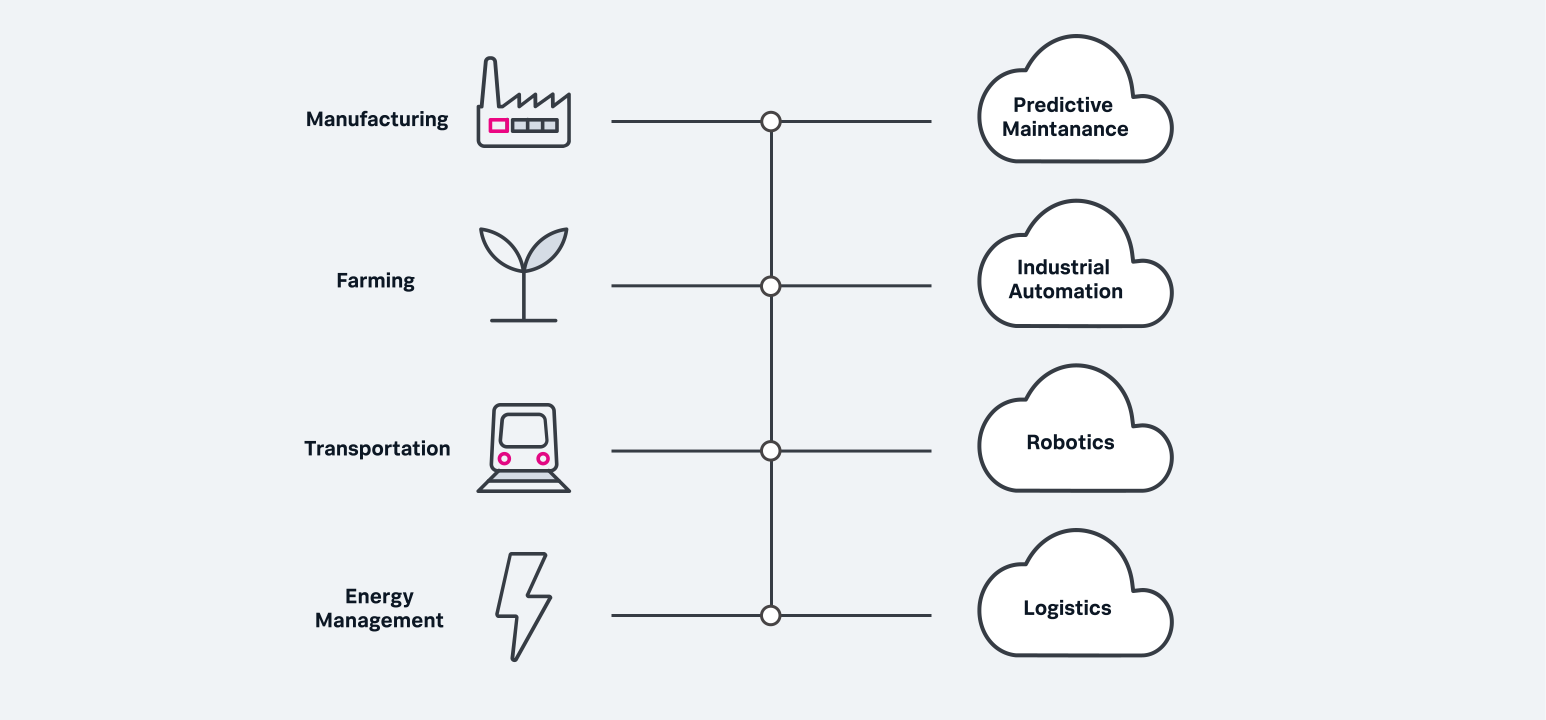
How IIoT is used in practice varies widely, with new industrial applications being introduced as more industries adopt it. Several applications have proven particularly popular, including:
- Predictive maintenance - Historically, operations and maintenance teams have relied on two primary models to avoid unexpected failures; either schedule-based maintenance or condition-monitoring using the limited and inflexible analytics supplied by control system interfaces or manually collected data inputs such as vibration analysis. The unpredictability of failures makes planning manpower and availability of replacement parts difficult, leading to high costs. In an IIoT system, industrial machines are equipped with smart sensors that continuously monitor equipment condition by tracking temperature, pressure, vibration frequency, and other parameters in real time. This data is sent to the cloud to be contextualized with the equipment’s model, setting, usage, and maintenance data, and then run through predictive analytics algorithms to determine if and when the equipment is likely to fail. If a critical issue is detected, a maintenance alert is sent to the appropriate person or team.
- Industrial automation - While automation has traditionally been employed to perform specific manual tasks, in IIoT it is used to monitor and improve operational efficiency of processes and machinery. Smart sensors are used with PACs (Programmable Automation Controllers), PLCs (Programmable Logic Controllers), or other automation tools to collect data from industrial machinery. The data is streamed to applications and services, where it can be analyzed for insights about the machine’s performance.
- Robotics - Robots have been enlisted to perform tasks everywhere from assembly lines to hospitals to fulfillment centers, and are often used for complicated or dangerous tasks or to improve production flow. IIoT systems can be used to monitor and control these robots in new and innovative ways — adding the ability to merge legacy industrial technology with new emerging capabilities like big data, AI, and AR to solve new use cases. As with other types of industrial machinery, robot-sensor data can be harvested for analysis to inform maintenance decisions and performance improvements.
- Logistics - Warehouses can use IIoT to obtain real-time inventory levels, preventing lost sales attributed to lack of stock. Smart sensors can monitor the status of perishable items, alerting managers if storage conditions are at risk of being compromised. Freight operators can track goods in real time to ensure items arrive on time and intact and can use collected data to make shipping more efficient.
IIoT has spurred innovations in manufacturing, farming, transportation, and energy management and further developments are expected in other industries over the next several years.
IIoT vs IoT: What's The Difference?
In the broadest terms, the difference between IIoT and IoT is their respective purpose. IIoT’s focus is to improve an array of industrial processes, while IoT is mainly concerned with increasing consumer convenience. By looking closely at how each achieves its goal, we can get a more detailed picture of how they differ.
- Technology: Both IIoT and IoT employ connected devices, smart sensors, software, and cloud computing servers, but there are major differences in the application of these technologies. IoT devices generally automate simple, everyday domestic tasks—a security camera that sends video to the cloud when it detects an unfamiliar face, for example. IIoT devices, on the other hand, perform highly technical tasks, with a stronger emphasis on precision, interoperability, and reliability.
- Reliability: While reliability is important for consumer IoT, it’s absolutely essential for IIoT. Industrial networks support tens of thousands of machines, controllers, robots, and other types of equipment with multiple endpoints spread over thousands of miles. And there is little tolerance in IIoT for failure of any system. Reliability becomes a greater challenge as more IoT and non-IoT devices and sensors are added.
- Security: In consumer IoT, cybersecurity measures are primarily concerned with user privacy. Consequently, many consumer IoT devices lack robust preventative security defenses, opening them up to hacks and widespread attacks via botnets. Similar attacks on IIoT systems, however, could have greater, far-reaching consequences for the health and safety of victims. An energy grid that’s knocked out via an IIoT exploit, for example, can jeopardize everything from personal safety, to the economy, to national security. Thus, IIoT is subjected to more compliance regulations, visibility and overall risk.
- End devices: In a consumer IoT ecosystem, inputs range from home security systems and wearable devices to smart kitchen appliances. But the output is almost always delivered as a text-based message or a photo sent to a user’s smartphone or tablet. While mobile devices are part of IIoT systems, likely endpoints also include industrial tools like flowmeters, pump controllers, and valve actuators.
IIoT is unique from other IoT technologies because it is tailored to industrial requirements. Among other things, IIoT devices have to be extremely reliable. A light-rail train, electrical grid, or even an airline baggage tracker that goes offline entails significant consequences. IIoT devices are engineered to maintain connectivity and have long lifespans, while also securing data in transit and at rest.
Additionally, a device deployed in an industrial setting needs the ability to integrate with various business systems, such as ERP, EAM, CMMS and others, while also interacting with hundreds of people in a single day. It also needs to take into account a variety of protocols and data formats, making data analysis challenging in light of traditional management technologies. That means that it must be able to communicate frequently, include different applications for each of its functional roles, and recall varying access privileges.
Finally, IIoT is an investment that can help facilitate stronger and more strategic business decisions. Organizations that implement IIoT systems require ROI in the form of reduced maintenance costs, increased efficiency, and improved productivity.
IIoT in Manufacturing
The manufacturing industry has been one of the most enthusiastic adopters of IIoT, largely because the technology enables a host of efficiencies for the industry. With IIoT, equipment can be managed remotely, monitored in real-time, and proactively maintained. The condition, location, and status of products are much easier to track. Product usage patterns are also more easily identified with IIoT, allowing manufacturers to increase production of items that are popular and discontinue those that aren’t before they negatively impacts the organization.
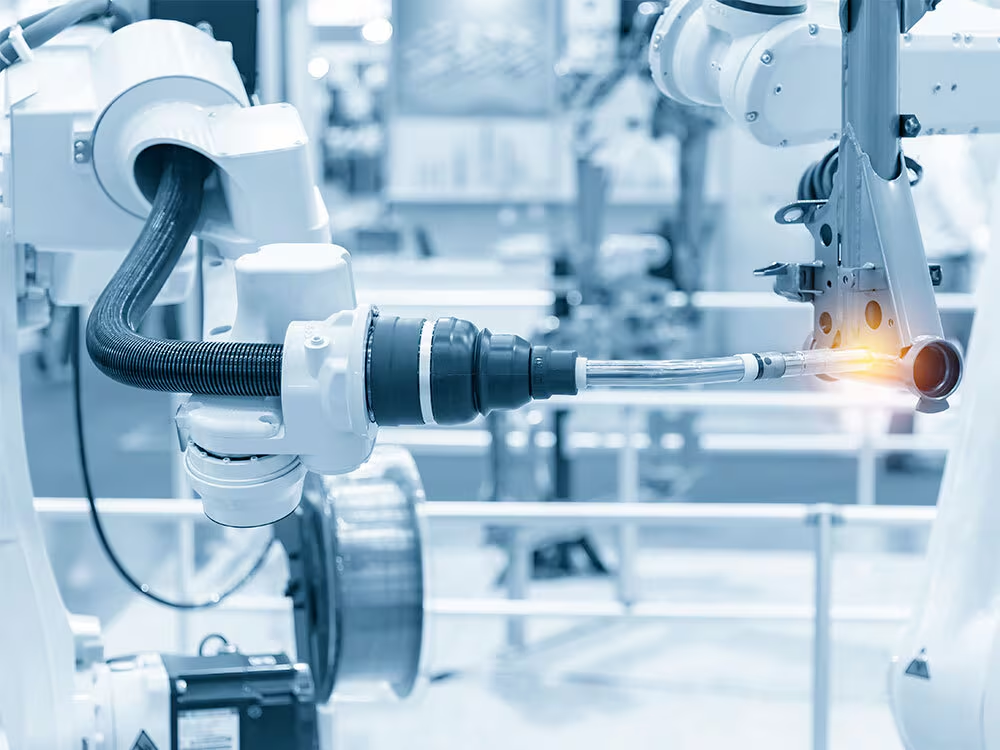
Here are some of the most popular IIoT use cases in today's manufacturing industry:
- Asset tracking - IIoT systems help organizations track their assets with RFID tags that are used as asset identifiers. The identifiers are linked to data about the asset — such as its serial number, model, cost, and area of use — all of which are stored in the cloud. Each time the asset is moved, its tag is scanned by an RFID reader and the record in the cloud is updated. Using this method, the appropriate parties can track an asset throughout its journey, how often and where it is used, and make decisions around maintenance, scheduling, and other logistics.
- Facility management - IIoT helps with virtually all aspects of facility management. The advanced technology facilitates predictive maintenance of equipment, efficient storage and retrieval of large amounts of data, real-time collaboration among team members, and tighter defense for security breaches both from inside and outside the organization.
- Safety monitoring - Geo-fencing boundaries are often used to determine if workers are in a region they shouldn’t be in. The sensors act like an invisible fence that issues an alert when boundaries are crossed. In an IIoT context, this could help ensure safety of merchandise, track employee locations in unsafe environments or minimize workplace accidents.
- Supply chain optimization/inventory management - IIoT is being used to provide manufacturers greater visibility into their supply chains. With the help of sensors, the location, condition, and inventory levels of every product can be monitored in real time. The data is stored and processed in the cloud, where applications can pinpoint each item’s location, monitor its status, predict when the item will run out, and relay all this information to users. This data can then be integrated with the company’s ERP, PLM, or MRP systems. In the event of a supply chain breakdown, the cause can be traced back to the source.
- Predictive maintenance - Companies requiring distributed facilities can use IIoT to manage operations of their plants in other cities, states, or countries. IIoT’s ability to predict machine failure allows companies to schedule maintenance as needed rather than retaining a local maintenance team for on-demand repairs. IIoT also allows companies to remotely access data from other plants and generally keep an eye on out-of-town operations.
How IIoT works with Manufacturing Execution Systems
The question of whether IIoT will replace or complement MES (Manufacturing Execution Systems) is still being debated. Some insiders argue that IIoT will eventually displace MES or force it to modernize, maintaining that most of these systems are outdated and aren’t equipped to collect data in real time from sensors deployed on the factory floor. Nor were they designed for long-term data storage, AI, and analytics. This results in data that’s siloed, if it’s collected at all, and hinders a factory’s ability to achieve a comprehensive view of its operations, predict mechanical failure and other disruptions, and optimize processes.
Others make the case that the two systems are complementary. One of the arguments is that MES can provide product and maintenance data that allows IIoT to predict failure. In this scenario, MES acts as a proxy for devices devoid of sensors, communicating with the IIoT system on behalf of those devices. MES can map and store information on operations that allows IIoT to operate a facility autonomously.
While the question is far from settled, manufacturers wanting to adopt IIoT solutions will have to rethink how they use their MES in the short term.
IIoT as a part of Industry 4.0
IIoT is one of the critical components of Industry 4.0.
Industry 4.0 is a term referring to the technological advancements and new approaches adopted in the industrial sector over the last decade. This period has been informally christened “the fourth revolution” in manufacturing. The first was the mechanization of manufacturing processes through water and steam power. The second was the introduction of assembly lines and the advent of electricity. The third revolution was the rise of computers and introduction of automation to industrial processes. And the fourth industrial revolution is defined by the integration of technologies and new processes — such as IIoT, Cyber-Physical Systems (CPS), Cognitive Computing (CC), and Machine-to-Machine communication (M2M) — into industrial infrastructures.
Defining the IIoT Platform
An IIoT platform is a set of hardware and software that work together to connect industrial processes with information systems. This middle layer can include a variety of components, but at a minimum, it includes the base software (often SaaS), IoT devices, and physical gateways that connect the two together.
Both the software and hardware components are made up of many individual elements. Hardware typically includes smart sensors, IoT devices, human-machine interfaces (HMIs), edge devices, and industrial machinery. Software encompasses an operating system, runtime system, cloud-based software, app development environment, data visualization and data storage tools. There are also industry-specific IIoT platforms and industrial applications that are designed for industries like rail or utility companies.
An IIoT platform’s main purpose is to give you centralized control of all your connected machines and processes while providing the means to view your entire operation and glean the insights to optimize as conditions and requirements change.
The Bottom Line
IIoT is the future of industrial business
IIoT is one of the most significant trends for business processes in industrial environments. And as market speed increases and technology disruptions become more frequent, IIoT is helping companies stay agile and competitive.
IIoT improves just about every aspect of industrial operations: cost savings through predictive maintenance, new operational efficiency through automation, sustainable energy consumption and increased productivity through safety improvements. Further, IIoT gives you previously unimaginable visibility into your enterprise with centralized control and aggregated data analysis. In short, IIoT can enable new levels of performance and profitability in any industrial setting.
FAQs about Industrial Internet of Things (IIoT)
Related Articles

What Is Data Analytics? The 4 Analytics Types You Need To Know

Monitoring vs Observability vs Telemetry: What's The Difference?

Canonical Data Models (CDMs) Explained

Ransomware Families & RaaS Groups

Threat Hunting vs. Threat Detecting: What's The Difference?

The Triple DES Intro: Triple Data Encryption Standard

Elliptic Curve Cryptography: An Introduction

Splunk OnDemand Services: An Introduction & Example