What Are Foundation Models in AI?
Learn Muhammad RazaFoundation Models are central to the ongoing hype around Artificial Intelligence. Google’s BERT, OpenAI’s GPT series, Stability AI’s Stable Diffusion, and thousands of models from the open-source community Hugging Face pretrained on large data assets serve as Foundation Models in AI.
So, what exactly is a Foundation Model? Let’s discuss the working principles, key purpose, challenges and opportunities of Foundation Models in AI.
Foundation models: Properties & objectives
A Foundation Model is a general class of generative AI models that is trained on large data assets at scale. A foundation model must have the following key properties:
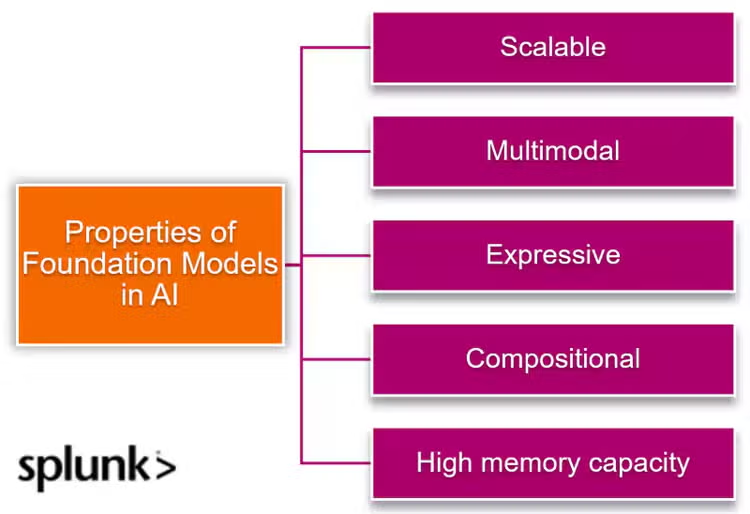
Scalable. The model architecture can efficiently train on large volumes of multidimensional data. Foundation models can fuse knowledge from multimodal data about a downstream application.
Multimodal. The training data can take multiple forms including text, audio, images and video. For example, medical diagnosis involves analysis of:
- Patient radiology (images)
- EHR records and test results (numbers)
- Doctor notes (text)
- Healthcare monitoring devices (logs)
- Video
- Audio
As in multimodal AI, the foundation model can capture knowledge from all information domains that span multiple modes.
Expressive. The models not only converge efficiently to accuracy metrics but can assimilate real-world data used to train them, by capturing rich knowledge representations.
Compositional. The models can effectively generalize to new downstream tasks. Similar to human intelligence, foundation models can effectively generalize on the out-of-distribution data. This information may contain some similarities to the training data, but cannot belong to the training data distribution itself.
High memory capacity. The models can accumulate growing and vast knowledge. Since the models learn from a variety of data distributions, it can continually learn on new data without catastrophically forgetting its previously learned knowledge. This objective is also known as continual learning in AI.
Together, these properties combine to realize three essential objectives:
- Aggregating knowledge from multiple domains.
- Organizing this knowledge in scalable representations.
- Having the ability to generalize on novel context and information.
Training foundation models
Training mechanism typically entails self-supervised learning. In a self-supervised setting, the model learns general representations of unstructured data without externally imposed ground-truth labels.
In simple terms, an output label corresponding to the input data is not known.
Instead, common patterns within the data distribution are used to group them together based on discovered correlations. These categories are generated from a pretext task that is generally easier to solve and are used as supervisory signals or implicit labels for the more challenging downstream tasks such as:
- Classification in computer vision
- Generating human-like conversational text in NLP
Following the same concepts, the paradigm of the Foundation Model is enabled by its scale of learning against large volumes of information, and the deep learning approach of Transfer Learning.
The key idea of transfer learning is to use existing knowledge to solve a complex task. In the context of deep learning, transfer learning refers to the practice of:
- Pretraining a model on a general surrogate task.
- Then adapting or finetuning the model to perform well on a specialized downstream task.
The recent success of transfer learning comes down to three fundamental driving forces in present era of artificial intelligence:
- Easy access to growing volumes of information.
- Breakthrough advancement in silicon processing hardware manufacturing continued at the pace of Moore’s Law. New GPU devices accelerate parallel computing capabilities with every new release, making it easier and cost-effective for researchers to access scalable hardware resources.
- Research and development into AI model architectures such as Transformer models that enable massive parallelism of AI mathematical computation on GPUs efficiently at scale.
Recent advancements in transfer learning, which is the key enabler of general-purpose foundation models used today, are largely attributed to transform-based architecture models deployed in a self-supervised training setting.
AGI & foundation models
The hype around AI is largely based on the promise of AGI: Artificial General Intelligence. AGI refers to an AI agent with intelligence that can surpass a human mind. This promise comes from the emergence and homogenization of general foundation models.
- Emergence refers to the concept of implicitly inducing system behavior instead of constructing it explicitly. This means that for a foundation model, its solution to a complex intelligence task is inferred automatically using its training data as an example.
- Furthermore, the universal nature of a large foundation model is such that it homogenizes the learning models in itself. This means that the foundation model consolidates the model components, architecture, learning algorithm and training regime for all downstream tasks. As a consequence of homogenization, a single generic foundation model can be used to solve a wide variety of tasks that previously required significant feature engineering and fine-tuning on individual tasks.
Limitations of foundation models
Foundation models also have some limitations. Since the model can only train on publicly available information, it can naturally learn a bias toward highly represented groups (or a bias against underrepresented groups).
As we have already observed the instances of inductive bias among popular foundation models, it is safe to say that, so far, no single algorithm or model that can perform well universally.
The No Free Lunch theorem persists. For now, at least, AGI is far from reality.
FAQs about Foundation Models in AI
Related Articles

Kubernetes Cost Management: A Practical Model for Controlling Cloud Spend

What is Automated Incident Response? Benefits, Processes, and Challenges Explained