Dark Data: An Introduction
As big data continues to grow exponentially, so too does the amount of hidden dark data. In a recent Splunk global survey, it was discovered that 55% of an organization's data is considered "dark" — untapped, hidden, or unknown. Despite the growing recognition of data's value, many businesses are struggling to unlock its full potential.
While artificial intelligence promises to drive innovation, only a small percentage of companies are currently using it effectively, largely due to the challenges of accessing and managing this dark data.
In this article, we’ll explore dark data and how it can affect your organization, how organizations can research, access and analyze their dark data, and how they can create a comprehensive strategy to prepare for a new data future.
What is dark data?
Dark data refers to the large volumes of unexplored raw data available to an enterprise. This data may be unstructured, generated with or without knowledge of the organization, and the sources may be ignored simply due to an inadequate data strategy or awareness.
Consider all the customer interactions on social media, logs generated across a large and complex network, and the real-time data streams from IoT devices and machine sensors.
In many cases, organizations lack a strategy to explore these diverse data sources. Without a comprehensive data platform and an end-to-end processing pipeline, they struggle to store, manage, and analyze this valuable dark data.
Ultimately, they may not find downstream use cases and applications that would motivate investments into new data technologies and initiatives focused on dark data analytics.
Why you should care about dark data
Organizations have access to more data than ever before. As we’ve migrated collectively into the data age, a few things have become incredibly clear:
- Data is key to future business success: Organizations expect value out of their data. Most organizations measure key performance indicators or use data to inform decision-making in some capacity.
- Enterprises are leaving swathes of data untouched: Despite the growing importance of data, more and more data goes underutilized or flat-out undiscovered.
Whether organizations lack the necessary resources, tools and skills to make the abundance of data actionable, or they simply haven’t discovered the data they’re generating, that data is critical in decision-making.
We probably wouldn’t feel too comfortable deciding based on 40% of the available information — so why would we do that at the enterprise level?
Let’s talk about some ways we can fill the gap.
How to discover dark data
Because dark data is, by definition, data we don’t know about, we need to do some digging to get started. Organizations can assess their dark data in several ways:
- Identify sources of compute transactions, events and user interactions. Find sources of unstructured data in the form of logs, machine data, multimodal social media information, text and others.
- Measure and extract data from unexplored sources: customer interactions and purchase journey, machine logs and traffic routes, and more.
- Hire experts or train internal expertise.
- Catalog data sources and use data profiling tools.
- Use data sampling to analyze large data sets.
- Audit IAM settings to understand how much data is inaccessible through security measures.
- Monitor data usage and consumption across departments, identifying underutilized resources.
- Use multimodal AI agents and data mining techniques to access, process and analyze unstructured data.
- Interview stakeholders on current and potential data usage & interview your end-users and customers.
- Implement automated data discovery tools.
Analyzing your dark data will enable a wider swath of less technical employees to understand your organization’s needs. Specifically, a dark data analytics solution can provide a more comprehensive, insightful and accurate understanding of users’ data and give them a big picture of their environment.
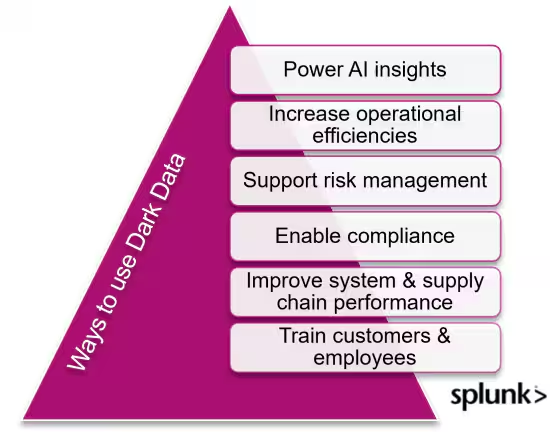
Making use of dark data
While all that data’s been collecting dust, odds are your organization has been missing out on some major insights. Dark data can help organizations to:
- Determine which department in the organization owns what data.
- Improve quality assurance processes.
- Detect and correct process errors.
- Look for privacy loopholes.
- Identify security vulnerabilities.
The number of specific use cases is vast, but let’s zero in on just a few:
Power artificial intelligence insights
One very important use for dark data is its role in fueling AI-powered solutions — more data increases the wealth of information that AI can analyze and should allow AI tools to produce deeper and more accurate insights.
(Learn about generative AI, adaptive AI**& what these mean for cybersecurity.)
Improve operational efficiency
Shining a light on dark data might highlight opportunities for operational improvement, for example:
- Log analysis can point to system bottlenecks or performance issues
- Resource allocation patterns may reveal opportunities for optimization
- System monitoring dark data may allow for predictive maintenance
Assist compliance and risk management
Dark data may contain information relevant to compliance requirements or risk management. Analyzing this data can help identify potential compliance issues or assess risks associated with certain business practices.
That previously untouched discovered data can help:
- Enhance risk modeling accuracy.
- Provide essential information needed for regulatory reporting.
- Identify third-party risks.
- Assist in creating early warning systems.
- Provide evidence and context for audits or investigations.
Harness the many benefits of dark data
The list of potential examples here is extensive and can get incredibly specific. Whether it’s a chance to improve internal system performance, customer support interactions, supply chain processes or internal training, dark data can reveal a vast array of opportunity for an organization willing to put the work in to discover it.
Lost opportunities & risks of dark data
Failure to manage dark data is not just a lost business opportunity, but also a risk concern. Consider the following realities of dark data:
Limited view of decision metrics
Most enterprise organizations drive key business decisions from data. They measure selected relevant metrics and KPIs to make informed decisions. These metrics are influenced by the information generated at source, how it is preprocessed and transformed into an actionable KPI value. Whether these metrics are influenced by dark data, remains unexplored.
There exists no definitive formula to understand whether eliminating undiscovered dark data out of these calculations is preferable at all, especially since the value of dark data is unknown or not sufficiently quantified.
Missed market opportunity
Take the example of dark data relating to customer interactions and customer journey.
- You can analyze purchase patterns and customer preferences from their purchase history, but what about the products they looked for, searched, even added to the cart before abandoning the purchase cycle?
- How do geographic, political, economic and technology trends affect purchase patterns to specific demographics?
To answer these questions, you will need to measure, process and analyze the unexplored internal and external data sources.
Security and privacy risk
A lot of the dark data information may describe individual customers and users of your services. Your business applications and network may process or produce that information without your knowledge.
These interactions must be secure by design, especially for enterprises operating in highly regulated industries. Additionally, your measures to protect user information including dark data will be subject to security and privacy audits and controls.
New business models and features
In a world where enterprises must innovate or perish, finding new features and business models requires them to explore new information. This information may be available from their existing sources or new untapped sources. Either way, new information must be explored to obtain a new perspective on user needs, market trends, business challenges and opportunities.
Solutions for staying ahead of your dark data
So, how do you overcome the limitations and challenges associated with the existence of unexplored dark data?
The biggest risks are the failure to exploit dark data for competitive differentiation, and existence of unmanaged and insecure data workloads and sources that are security sensitive as well as subject to stringent compliance regulations.
Secondly, how do you take advantage of dark data to make well informed business decisions?
Two of the most prevalent technology advancements are well positioned to overcome the challenges and maximize the opportunities associated with dark data:
An end-to-end data lake platform
One that can ingest data in structured, semi-structured and unstructured form in a highly scalable cloud-based data platform. The pipeline integrates downstream applications and tooling for preprocessing and analysis on-read, allowing you to ingest all available data and process only what is necessary.
This approach prevents unnecessary compute usage on preprocessing dark data, while the affordable and scalable cloud storage allows you to explore new data sources that generate information in all data formats.
A large-scale AI model
One that can model behavior and patterns from large data assets, motivating the exploration of dark data sources. With the availability of open-source LLMs, integrated into a standardized data lake platform, enterprises can explore unprecedented new use cases for dark data.
FAQs about Dark Data
Related Articles

SNMP & SNMP Monitoring, Explained

Superapps: What They Are and How They Work

What is Applied Observability?

Product Analytics 101: Definition, Metrics & Tools

What Are TTPs? Tactics, Techniques & Procedures Explained

What is Data Anonymization?

Data Aggregation: How It Works

SQL vs. NoSQL Today: Databases, Differences & When To Use Which