What Is AI Native?
Learn Muhammad RazaKey Takeaways
- AI-native platforms embed artificial intelligence and machine learning throughout the entire data lifecycle, enabling smarter, faster, and more adaptive operations across IT, security, and business functions. Most software today is not AI-native.
- These platforms leverage advanced AI capabilities, including natural language processing, automation, and real-time decision-making, while maintaining a strong focus on data privacy and security.
- By unifying data and AI at every layer, enterprises can accelerate decision-making, automate routine tasks, reduce mean time to resolution, and drive measurable ROI through more efficient, context-aware operations.
AI Native is the term for technology that has intrinsic and trustworthy AI capabilities. AI is introduced naturally as a core component of every entity in the technology system, including its:
- Operations
- Functions
- Implementation & deployment
- Maintenance & optimization
An AI native technology ecosystem enables end-to-end data-driven decision making using advanced AI capabilities and real-time contextual knowledge.
Importantly, the AI systems are also dynamic in nature: they don’t follow fixed predefined rules, but adapt continuously. The underlying resources are built to scale. AI is pervasive across the ecosystem, built naturally from the ground up.
(Related reading: AI ethics & AI governance.)
AI native vs. embedded AI
AI Native is different from embedded AI. Embedded AI integrates AI functionality into an existing technology system. The goal of embedded AI is to enhance the functionality and improve performance of existing technology entities.
Typically, this is achieved by replacing an existing technology component with one that enables AI capability.
Another approach involves adding an AI-based component to the existing technology stack. In both cases, the existing systems do not involve legacy processes and technologies; a new AI component offers sufficient backward compatibility to realize business goals — whether operating as a standalone component or an API interfacing with an external AI service.
A third type of embedded AI controls and optimizes legacy systems and processes. In this use case, the AI component is engineered to interface with the legacy technology.
Characteristics in native AI systems
AI Native is different. Let’s summarize the important characteristics of an AI Native entity:
- AI Native systems have AI capabilities that are intrinsic and trustworthy.
- AI Native system components interact among each other in an AI-aware ecosystem and are designed to enable AI functionality.
- The lifecycle and control of AI native systems is implemented, managed and controlled with AI.
- System behavior is objective and interactive. AI models in an AI Native system are based on a knowledge-based ecosystem: they create and consume knowledge to deliver AI functionality.
- AI Native systems are adaptive and dynamic. AI models train on real-time information and are capable of continual learning.
- AI Native systems are perceptive: they acquire real-time knowledge of the environment conditions. The network reality is represented by growing real-time log data streams.
- AI Native systems serve a business purpose and are outcome-driven. The goal of AI Native systems is not to simply embed new AI functionality without an end-goal.
AI native architecture
Let’s review what an AI Native architecture looks like. It has the following distinct properties:
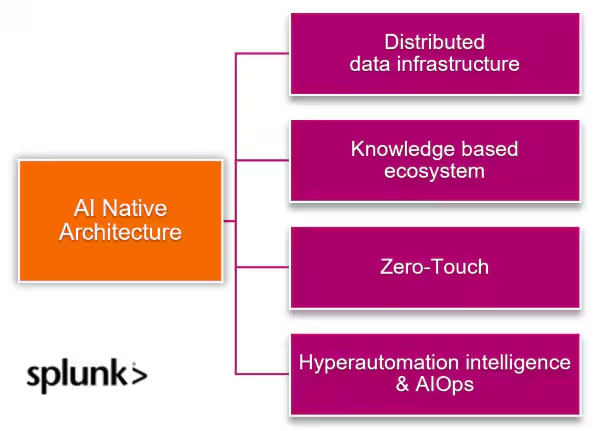
Distributed data infrastructure
AI Native system components are designed to enable intelligence — and they are also distributed.
The infrastructure may execute model training at the network edge as part of a federated learning regime. Embedded GPU and parallel processing chips allow for a privacy-aware intelligent edge AI network. The data infrastructure will have strong security requirements as well as an optimal mix of multi-cloud infrastructure resources.
(Related reading: distributed systems & AI infrastructure.)
Knowledge based ecosystem
Data is generated and consumed continuously and in real-time in all these locations:
- At the network edge
- External nodes and devices
- Centralized private servers
- Public cloud networks
Zero-Touch
A fully autonomous network infrastructure and operations are enabled by Zero-touch. Resources are provisioned, managed and controlled using advanced AI technologies, AIOps, AIaaS, and layers of software-driven orchestration.
Hyperautomation intelligence & AIOps
Intelligence capabilities are introduced into systems and operations at the process level, end-to-end. Automation is entirely data-driven and highly scalable. AIOps replaces manual I&Ops management tasks.
Getting started with native AI: A checklist
So how do you know if you are ready for an AI Native system? Normally, you could consult a maturity model/matrix to determine how your products and services are positioned based for a given approach or technology.
Unfortunately, there is no true AI Native maturity scale yet.
The enterprise AI industry is still evolving and has yet to agree on a universally accepted definition of AI Native; a comprehensive and widely adopted framework for AI Native maturity assessment doesn’t yet exist.
Consider evaluating your AI Native maturity on a spectrum across the following key areas:
- Architecture: New entrants may not have a basic reference AI architecture. An AI Native transformed architecture is fully managed by AI.
- AI Interactions: New entrants see embedded AI functions operating in silos with no interactions. A fully transformed AI Native system is federated. Models can learn and execute functions in a distributed network architecture.
- Data Processing: New entrants may have traditional database systems. AI native data pipelines must process information in real-time and be highly scalable. AI-based data mesh and data lake systems are deployed.
- AI Model Lifecycle Management: New entrants may develop, deploy and decommission AI models manually based on their own requirements. Mature AI Native systems use AI-based automated AI model lifecycle management.
- Security and Privacy: New entrants may not guarantee data security and regulatory compliance with their model training and execution. In contrast, an AI Native system is trustworthy: dependable in its functionality as well as data security and user privacy.
- Autonomy: New entrants may use proprietary techniques and tools to manage configurations, operations, troubleshooting and performance. A fully transformed AI Native system follows an autonomous, AI-driven and self-designing mechanism to scale, manage incidents, and address faults — all proactively.
The future is AI Native
Today, AI is growing and improving rapidly but AI native technologies are rare. In coming years — maybe even months? — we’ll see a huge leap towards native AI systems.
Related Articles

Cybersecurity Awareness Month 2026: The Complete Guide

Threat Actors: Common Types & Best Defenses Against Them