Realtime Feedback: Customer Perspectives at Cisco Live Amsterdam
Leadership Mangesh PimpalkhareKey takeaways
-
At Cisco Live EMEA, customers shared that economic pressure and data overload are driving the need for simpler, more resilient solutions with clear ROI.
-
Organizations are shifting from AI experimentation to practical business value, but need clearer, scalable ways to put it into action.
-
Splunk and Cisco help by unifying data, reducing complexity, and delivering AI-powered tools that turn insight into faster, smarter decisions.
Connecting with customers is the highlight of Cisco conferences and as a product leader, it is foundational to our customer centricity. These conversations ground me in the real challenges they face every day and spark ideas about how our Splunk products can truly make a difference. They also provide real-time feedback on our keynotes and announcements, and offer a clear view into where the industry is headed, helping us continue to innovate and support customers navigating the AI era. More importantly, they guide our team in shaping future products that genuinely meet evolving needs.
To prepare for any customer meeting, I spend time getting an understanding of the customer’s business and their top-of-mind challenges and opportunities. That way, I can align the updates I share about Splunk’s direction to make sure I give them the information that is most relevant to their success. I like to walk away from every meeting having identified specific actions we can take to help the customer on an ongoing basis.
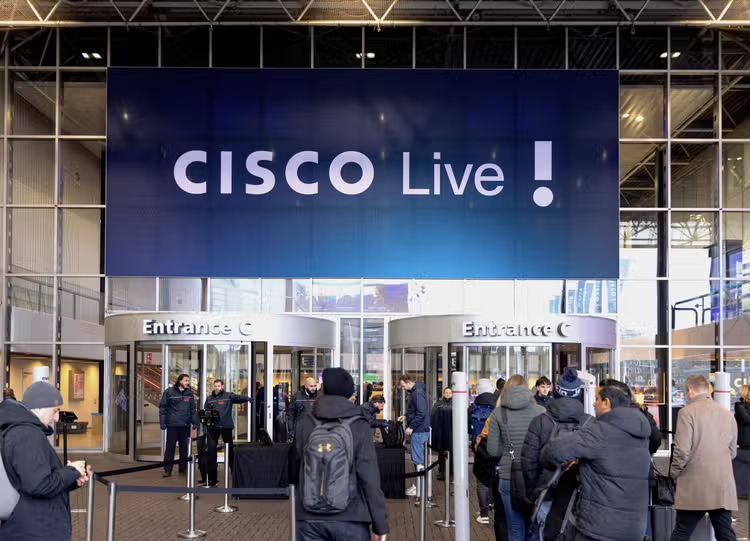
Cisco Live Amsterdam was no exception, and I had the chance to have meaningful conversations with our customers across industries like Retail and Telecom as well as our partners and Managed Service Providers (MSPs). Through these discussions, three key themes emerged around the challenges they are facing, and how Cisco and Splunk are setting them up for success.
1. Economic Pressure and Data Overload are Real Problems
With teams managing the most dynamic IT environments in history, security leaders are now tasked with making their tech stacks more than just secure. They must be resilient.
Rightfully, customers cite ROI as a top consideration, and many noted the economics of maintaining this resilience. Data volumes are at an all-time high and many tech stacks are saturated with vendor point solutions. This translates to large spending and relatively minuscule insight. As an alternative, customers want real ROI in their observability solutions. In fact, they want more value at a lower total cost of ownership, especially as data sprawl accelerates.
2. From AI Ambition to Real Business Value
AI adoption across the enterprise is entering a more practical phase. Early experimentation and excitement have helped organizations understand what’s possible, but leaders are now focused on translating that momentum into tangible business outcomes. For some customers, the hurdle isn’t belief in AI’s potential, but the path to execution. Questions around where to start, how to operationalize AI at scale, and how to connect insights to day-to-day decisions can slow progress.
3. Integrated Solutions are a Must
The modern enterprise carries with it multiple internal dependencies, both in technology and day-to-day business processes. However, many customers find their teams operating in silos and lacking the right tools to connect insights across teams.
Today’s customers have a strong appetite for solutions that create identifiable unity among teams and correlate data across security, observability, networking, and other critical business functions.
Customers want to ensure these insights are shared in minutes or even seconds, and not hours, which can provide business agility and resilience. They also don’t want to spend hours or waste resources integrating these solutions. They desire turnkey options instead of a bunch of puzzle pieces they must assemble themselves.
So, How Does Splunk Provide the Answer?
Hearing this feedback from customers was clarifying and energizing. It reinforced both the real challenges they’re navigating, and the opportunity for Splunk and Cisco to address them. As organizations manage the economic constraints and growing volumes of data, Splunk provides the tools to prioritize and manage data based on business value, ensuring the most important insights are preserved and put to work.
Splunk’s observability capabilities also give organizations a practical way to begin realizing value from AI. Rather than requiring large, upfront transformations, customers can start small and build confidence as they go. Through the Splunk platform, IT leaders can understand the data used to train AI models, see which critical systems AI is connected to, and assess how effectively AI outputs are performing in real environments.
This approach is especially important in complex enterprise environments. As one customer shared with me, Splunk’s foundational presence across both on-premises and cloud environments provides broad visibility without adding complexity. This helps teams avoid investing in fragmented solutions that make it harder to connect data and deliver consistent outcomes.
Looking ahead, what we have planned for the year will further address the challenges our customers are navigating today. For example, we recently announced multiple new agentic AI innovations which allow teams to track the performance, quality, cost, and security of LLM and agentic applications. This will help break some of the barriers to AI adoption as this new technology will show the real value of AI agents within their systems.
Just last month, Splunk hosted AI models became available. This includes the Cisco Deep Time Series Model (in beta), the Cisco Foundation AI Security Model, and the GPT OSS (20B and 120B). Teams may now leverage these models for state-of-the-art analytics, predictive alerting, anomaly detection, infrastructure forecasting, alert prioritization, and attack timeline reconstruction. This will allow organizations to more proactively protect, remediate, and recover—creating a more resilient system. Read this blog for the full list of new Splunk innovations.
I look forward to continuing these conversations at Cisco Live US and working alongside our customers as they turn insight into action.
Related Articles

Staff Picks for Splunk Security Reading May 2021

Advanced Link Analysis: Part 1 - Solving the Challenge of Information Density