AI Tokenomics: From Cost Visibility to Cost Discipline
Leadership Hanlin FangKey takeaways
- Token usage and cost dashboards are essential, but visibility alone does not create cost discipline.
- The largest cost lever is often upstream: determining whether a task needs AI, or a token, at all.
- Data-tiering principles apply directly to AI workloads. Not every piece of context belongs in an LLM window, just as not every log belongs in a hot index.
- AI cost accountability is no longer limited to finance, product, or machine-learning teams. Everyone designing or using an AI workflow, and with optimization efficiency from context harness and skill development is making a cost decision.
The first signs of enterprise AI cost correction are already here.
Companies that rapidly expanded AI access are beginning to cancel subscriptions, impose usage limits, and reconsider which workloads justify the expense. Microsoft reportedly canceled most of its internal Claude Code licenses, in part because of cost. Uber introduced spending caps after exhausting its annual AI budget in four months. They are signs that AI consumption has grown faster than the financial discipline needed to manage it, and enterprises want to manage it effectively when expanding AI. [1] [2]
Vendors are responding by making consumption more transparent. OpenAI provides dashboards and API response data for token usage. Anthropic provides detailed cost and usage reporting through its console and organizational APIs. Similar capabilities are appearing across the AI ecosystem. [3] [4] [5]
That is why AI Tokenomics is more than a dashboard.
AI Tokenomics should be the discipline of treating tokens as the operational currency of an AI software stack, and applying judgment before, during, and after they are spent. Observability is the foundation. Routing and design-time decisions are where organizations gain real control.
The Dashboard Tells You What Happened, but It's Not Enough
Agentic AI does not behave like traditional software with predictable per-seat costs.
An autonomous agent can reason, call tools, retrieve data, delegate work, verify its output, and retry when something fails. Each step consumes additional tokens. If an agent enters a loop, follows the wrong path, or repeatedly loads unnecessary context, the cost can compound before a human realizes what happened.
Splunk AI Agent Monitoring, alongside many other AI Observability vendors, provides the visibility organizations need to manage this behavior. It monitors performance, quality, token usage, estimated cost, and risk, and helps teams identify the agents and requests driving consumption. [7]
- Which agents and models are consuming the most tokens?
- Where are loops, retries, and inefficient tool calls occurring?
- Is higher token consumption producing better results?
- When should an automated safeguard stop an execution?
But another set of questions must be asked earlier:
- Did this task need an agent?
- Could a deterministic rule have handled it?
- Could a smaller model have produced the same outcome?
- Did the model need all the context it received?
- Is the business value of the result worth its total cost?
A mature tokenomics practice must answer both sets of questions.
Lessons We Already Learned from Data
Long-time Splunk practitioners know this discipline from data management.
Effective data tiering has always required a decision: does this data need to remain in a hot index, or can it move to a lower-cost tier? Not every event deserves the same retention period, performance profile, or storage cost. Sending everything to the most expensive tier is an easy architectural choice, but an expensive operational mistake.
The same principle applies to AI. Not every task deserves an agent. Not every agent needs a frontier model. Not every document belongs in the context window. And not every interaction should start with a model call.
The dashboard tells us where the tokens went. Tiering discipline determines whether they need to go there.
Higher Token Consumption Doesn’t Equate to Higher Accuracy
Scope note: These findings come from agentic coding experiments. They demonstrate the scale and variability of agent consumption; they should not be treated as universal token ranges for every workload.
The Token Judgment Ladder
Before deploying an agent, teams should move through the following questions in order:
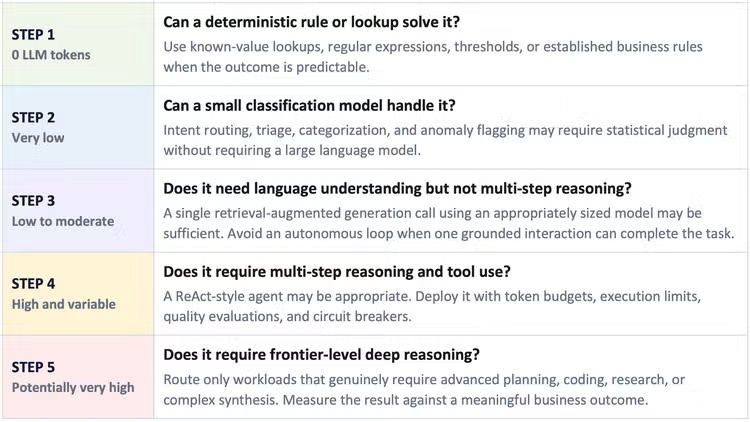
Cost profiles are relative design guidance, not fixed token benchmarks. Research context: source [6].
This ladder helps organizations use AI deliberately and as a result encouraging AI adoption. The goal is to spend tokens where they create measurable value by optimizing the token usage.
Bring Product Judgment into Token Judgement
A useful product design principle has guided machine-learning teams for years: if rules can solve the problem, use rules. If classical machine learning can solve it, do not default to deep learning. If a smaller model is sufficient, do not automatically reach for a frontier model.
That hierarchy has not expired. It has become more important because agents make it easy to skip every rung at once.
What has changed is who must apply the principle. In the past, a relatively small group of product managers, architects, and machine-learning engineers made these decisions. Today, every developer configuring an agentic workflow, every operations team automating remediation, and every analyst asking AI to ‘figure it out’ is making an architectural and financial choice.
Embedding token discipline into everyday design is the next frontier of AI cost governance.
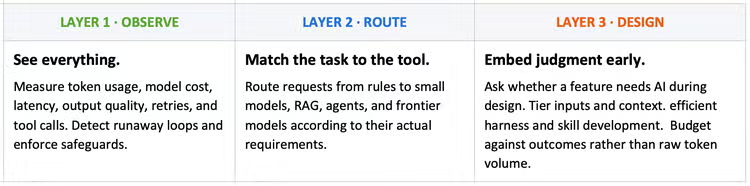
The Three Layers of AI Tokenomics Maturity
Tokenomics Starts Before the Dashboard
AI Agent Monitoring and Observability is a critical foundation for AI Tokenomics. Organizations cannot govern what they cannot see, and effective monitoring can expose the token, cost, quality, and risk signals needed to intervene. [7]
But visibility is the beginning of cost governance, not its final form.
The next level of maturity moves upstream. It introduces routing logic, workload tiering, context discipline, and design-time judgment before an agent starts consuming tokens.
Observe, then route, then design.
Organizations that master all three will not simply spend less on AI. They will build systems that are faster, more reliable, easier to explain, and better aligned with business value.
That is the full promise of AI Tokenomics, and why it is much more than a dashboard.
Sources and Data Notes
- [1] Axios, “AI sticker shock hits corporate America,” May 28, 2026. Microsoft license pullback and enterprise cost correction. View source
- [2] TechCrunch, “Uber caps employee AI spending after blowing through budget in 4 months,” June 2, 2026. Uber budget overrun and usage caps. View source
- [3] OpenAI Help Center, “How do I check my token usage?” API usage dashboard and response-level token data. View source
- [4] Anthropic Help Center, “Cost and Usage Reporting in the Claude Console,” March 16, 2026. Console reporting and CSV export. View source
- [5] Anthropic Platform Documentation, “Usage and Cost API.” Organization-level usage and USD cost reporting. View source
- [6] Longju Bai et al., “How Do AI Agents Spend Your Money?” arXiv:2604.22750, 2026. The 1,000× consumption, up-to-30× run variance, and accuracy findings apply to the study’s agentic coding experiments—not all AI workloads. View source
- [7] Splunk documentation, “Introduction to Splunk AI Agent Monitoring.” Performance, quality, token usage, estimated cost, and risk monitoring. View source
Editorial note: Vendor features, pricing, and corporate usage policies can change. Revalidate time-sensitive claims immediately before publication.
Related Articles

Staff Picks for Splunk Security Reading July 2022

Splunk Security Ops: Building the Blueprint for Success