The Agentic SOC Workforce: Defending at Machine Speed in the AI Era
Security JK LialiasKey takeaway
The Agentic SOC is not a single agent or a sudden leap to full autonomy. It is a trusted operating model where AI carries more of the repeatable work, humans govern the decisions that matter, and every handoff can be verified.
The Moment Is Now
There is a line I keep coming back to: the moment is now.
That can sound dramatic, but for security teams it is starting to feel pretty literal. The operating clock has changed. Frontier AI is giving attackers new ways to move faster, generate more noise, test more paths, and adapt as they go. Vulnerabilities, phishing, supply chain risk, and insider threats were already hard enough. Now those same vectors can be accelerated, automated, and hidden inside more signal than most teams can manually review.
So the question for security leaders is no longer, "Should we use AI in the SOC?" The better question is: how do we use AI to move faster without losing control?
That is the opening for the Agentic SOC.
Why The SOC Has To Change
Most SOCs were built around human-speed work: review the alert, pivot tools, gather context, make a decision, document the action, and move to the next one. That model still matters, but it does not scale cleanly when attackers can move at machine speed.
The asymmetry is the problem. Attackers can use AI to create more attempts, more variants, and more pressure. Defenders still have to prove what happened, decide what matters, and respond safely. If every step waits on a person to manually connect the dots, the SOC falls behind.
The answer is not to hand the keys to autonomous AI and hope for the best. It is to build a model where autonomy is delegated carefully, bounded by policy, grounded in evidence, and governed by people.
That is the real shift: from a SOC where humans carry every repetitive task to a SOC where AI carries work as far as policy allows.
The Agentic SOC Starts With Trust
The Agentic SOC is not about removing people from security operations. It is about giving analysts, engineers, responders, and leaders a better way to scale their expertise.
That matters because trust is what determines how far AI can go. In some parts of the SOC, AI can safely take on high-volume work such as triage, evidence gathering, summarization, and recommended next steps. In other areas, like detection engineering, response automation, or containment, the work is higher judgment. AI can accelerate the work, but people still need to set intent, approve actions, and govern the outcome.
The simplest way to frame it is this: delegated autonomy handles the repeatable work; bounded autonomy supports the high-judgment work.
OPERATING PRINCIPLE
Trust means the SOC can verify every handoff: the evidence, the reasoning, the approval path, the audit trail, and the policy behind the action.
Defend At Machine Speed
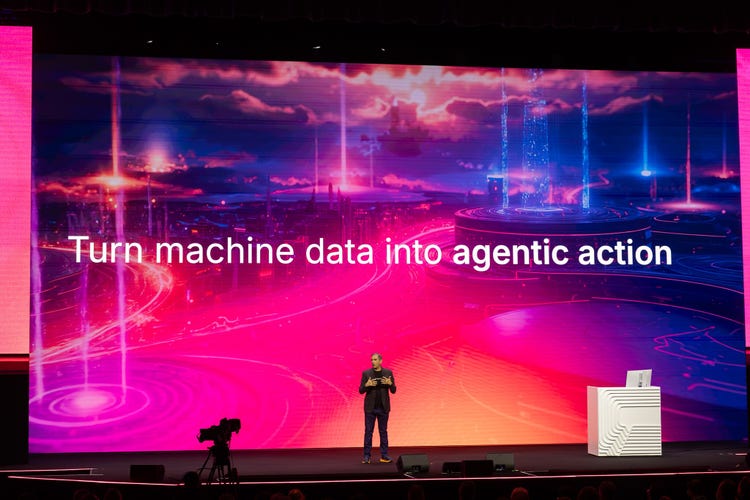
At the highest level, the Agentic SOC is how security teams defend at machine speed without giving up human governance. The narrative breaks into three connected outcomes:
- Defend autonomously: Outpace AI-driven threats with trusted agents and human governance.
- Stop attacks at the source: Combine distributed defenses with enterprise-wide visibility.
- Mitigate critical exposure: Continuously identify, prioritize, and remediate business-critical risk.
These are not three separate stories. They build on each other. The SOC needs autonomy to move faster. It needs data and controls close to the source to see and act across the enterprise. And it needs exposure context so teams can reduce risk before every weakness becomes an incident.
Meet The Agentic SOC Workforce
The Agentic SOC Workforce makes the Agentic SOC easier to understand and adopt. Instead of presenting AI as a long list of standalone capabilities, Splunk is enhancing existing capabilities and introducing new agentic skills within the way SOC teams already operate: Detection & Security Engineering, Threat Hunting, Investigation & Response, and Governance & Policy.
Detection & Security Engineering helps teams build trusted coverage faster. It brings together skills for detection building, automation, connectors, threat graph detection, agentic workflows, and tuning so teams can move from idea to validated coverage with less manual effort.
Threat Hunting helps teams find and disrupt emerging threats. Proactive hunting and malware threat reversing help analysts search across data, test hypotheses, and investigate suspicious activity earlier.
Investigation & Response helps teams contain and resolve threats faster. Triage, investigation, and response skills help move teams from alert to action with more context, consistency, and control.
Governance & Policy keeps the workforce trusted. SOPs, exposure context, shared evidence, approvals, auditability, and orchestration help ensure autonomy stays explainable and aligned to how the SOC operates.
Together, these agents turn individual skills into coordinated SOC action. AI carries more repetitive, high-volume work while humans stay focused on judgment, strategy, and outcomes.
1. Defend Autonomously
Defending autonomously starts with the highest-volume work in the SOC: triage and investigation. This is where teams lose time to false positives, scattered context, and repetitive evidence collection. It is also where purpose-built agentic capabilities can make an immediate difference.
In Splunk Enterprise Security, agentic capabilities work inside the SOC experience instead of becoming another disconnected tool chain.
The goal is simple: help analysts focus on real threats sooner. AI can prioritize, explain, summarize, recommend, and prepare governed response while analysts still own the key decisions.
That is how the SOC starts to move from alert volume to outcome: higher alert coverage, less manual drag, faster investigation, and lower MTTR.
2. Stop Attacks At The Source
The second part of the story is data. Modern security data is exploding, and not every signal can or should be centralized before it becomes useful.
This is where the Cisco Data Fabric story becomes important. The future SOC needs to take Splunk to the data, detect closer to the source, and respond through connected controls. That means preserving the power of Splunk's detection and investigation engine while giving teams more flexibility in where data lives and how it is used.
It also changes response. When security operations connect to Cisco controls and the broader ecosystem, the SOC can move from insight to enforcement with the right context and less delay.
This is a big reason the Agentic SOC cannot just be an AI layer. It needs an open data foundation, unified tooling, and connected enforcement. Without that, AI is just reasoning over partial context.
3. Mitigate Critical Exposure
The third part of the story is exposure. If attackers are moving faster, defenders need to get better at reducing the paths attackers can use in the first place.
Exposure management has to become continuous, contextual, and operational. The SOC needs to know where risk lives, what it touches, whether it is being targeted, and what mitigation path is available.
That is where capabilities like Exposure Analytics become part of the Agentic SOC story, connecting asset, identity, cloud, and risk context so teams can prioritize what matters most.
In practical terms, this helps teams move from reactive defense to proactive risk reduction: discover the exposure, prioritize it with context, remediate or mitigate it, and verify that the risk actually changed.
Why Splunk
Here is the thing that makes this more than an AI story: the Agentic SOC only works if the AI has the right foundation.
Splunk brings together the pieces the SOC already depends on: high-fidelity security data, detection, investigation, response, threat intelligence, automation, exposure context, and governance. With Cisco, that foundation extends further into data fabric, security controls, networking, identity, and AI defense.
That combination matters because security teams do not need another black-box assistant sitting next to the SOC. They need AI that is grounded in their data, connected to their workflows, aware of their policies, and accountable to their people.
Put another way: defending against frontier AI requires frontier AI, but only when the customer has the data, controls, and trust model to use it responsibly.
THE SPLUNK ADVANTAGE
Open data, unified security operations, Cisco context and controls, and governed AI working together across detection, investigation, response, and exposure management.
What This Looks Like In A Real SOC
Picture a high-priority phishing alert landing in the SOC. In the old model, an analyst reviews the alert, pivots across tools, checks threat intelligence, searches related activity, and decides what to do next. Every pivot takes time.
In an Agentic SOC, the workflow compresses. AI can triage the alert, gather evidence, summarize the attack chain, connect threat intelligence, check exposure context, and recommend a response path based on approved procedures.
That is the balance: speed where the work is repeatable, control where the risk is higher, and transparency across the full handoff.
The Maturity Journey
The Agentic SOC is a maturity journey. Teams may start with AI-assisted investigation, deterministic automation, stronger entity context, or better exposure analytics, then move toward delegated autonomy in triage, investigation, and response.
The important part is that autonomy is earned. Teams mature toward autonomy as evidence, guardrails, approvals, audit trails, policy, and operational confidence mature.
That is how humans and AI mature together. AI does more work over time, but people stay accountable for mission, risk, and outcomes.
The Bottom Line
The Agentic SOC is not a future fantasy and it is not a single product feature. It is the next operating model for security teams that need to keep pace with AI-driven threats.
It brings together autonomous triage and investigation, faster detection and automation work, trusted response, distributed data, connected controls, and continuous exposure reduction. Most importantly, it does this with humans still governing the decisions that matter.
That is how we defend at machine speed: not by replacing the SOC, but by giving the SOC a trusted way to scale.
Related Articles

Splunk for OT Security V2: SOAR and More

Zipf's Law and Fraud Detection