Observability Data Transcends Find-and-Fix to Fuel Innovation
Your competitors are racing to innovate and introduce new products and services. Don’t get left behind because you’re fixing all day, every day.
Burning resources with the hope of making current offerings simply work as they should leaves zero time for innovation. Make no mistake; you need to fix what’s broken — and fixing isn’t the enemy of innovation. But the more time your teams spend fixing, the less time they have for innovating. Engineers are too valuable and scarce to be stuck in endless cycles of fixing things. If your components keep breaking, your competitors, whose engineers are free to build new initiatives, are going to eat your lunch.
So then, how do you go from treading water with the hopes of keeping your organization’s head above the water, to traversing oceans in a high-powered vessel? More companies are finally ditching the old “find, fix, and forget it” mindset to tap a much deeper well of insights that actually move the business. Asking “What’s broken?” doesn’t lead to forward progress. Asking, “What’s a more powerful way to use our observability data?” does.
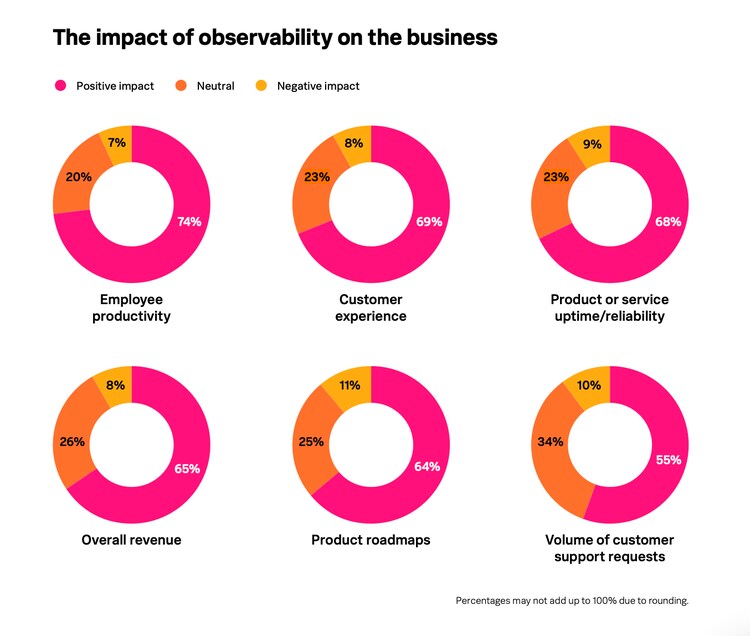
Splunk’s State of Observability: The Rise of a New Business Catalyst shows how ITOps, security, and engineering teams are going beyond fixing what’s broken. They’re collaborating on a greater variety of business initiatives. Mature observability practices bring teams together to improve customer satisfaction and enhance user experiences. But wait, there’s more. As shown by the 64% claiming their observability practice positively affects product roadmaps, they’re even answering “What next?”
Going from reactive fixes to proactive progress
What’s the success catalyst for your enterprise’s next bold decision or innovation? Is it groundbreaking market research revealing untapped opportunities? Perhaps a seemingly minor feature that turns out to be a critical driver behind a radical shift. Often, you don’t know what your next immediate action should be, but the point is steady, reliable data is closer than you think. With a well-developed observability practice, winning insights are already at your fingertips. You can use your available data to see where your users are experiencing pain points, identify the business impact of application performance or code releases, and exponentially more.
They are on the front lines influencing high-stakes metrics like revenue and customer experience. The observability teams making the biggest impact are acting as business sparks that accelerate performance across the entire organization.
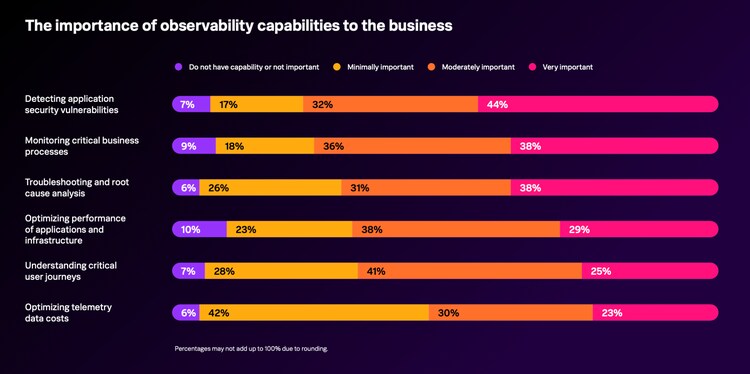
Forward-looking organizations are increasingly leaning on their observability practice to solve a greater variety of challenges and goals, including making it a top priority to capture business metrics. In fact, 74% of respondents say that monitoring critical business processes is moderately to very important.
Observability becomes real when you can tie technical activity to business results. For example, a revenue spike might be traced back to customers receiving a streamlined checkout page with fewer mandatory fields, reducing abandonment. The same visibility allows teams to quickly understand the revenue impact of a software release.
Now, observability is a force that turns application telemetry into business action. Practitioners can use observability data to tell you why, where, and how revenue spiked. A disciplined practice can distinguish between whether it was a new feature release, a major media campaign, etc. Plus, the right data can help you rule out certain activities or changes you made. Sometimes, it was just a lucky or unlucky day, and valuable data can help you spend less time chasing ghosts.
Instead of guessing how customers move through your product, you can practically ride shotgun with them. Observability data can also help you visualize your customer’s experience. You can observe and analyze their journey from initial website visit to order fulfillment. This includes the nooks and crannies in between, illustrating how customers interact with your website, software, and features.
Why did a customer abandon their cart? Telemetry data can provide clues. Why did they click the same button five times? Or, why did contact-us form, chatbot, and cart interactions stay flat despite a significant spike in site traffic (hint: bots)? Data can illuminate potential performance issues. Combining these inputs clarifies how to go beyond improving current interactions to shape future products and experiences. You can even see a replay of their session in your app or on your site. With so many current and emerging issues, from competitor activity to website performance, getting this kind of close-up on your customer experience grants a valuable way to drastically cut the distance between observation and action.
Practitioners get actionable insights they can share across teams, including:
- Real-time, customer behavior data to enhance user-experience
- Potential fixes and optimizations
- How product performance, or even software releases, influences business growth
Data strengthens the observability-business connection and provides a well-informed method for shaping the organization’s path forward. Where traditional practices had people observing in their seats, leaders are on their feet now, proactively executing on valuable observability data.
Uniting around the observability flame
An advanced observability practice provides a unifying source of truth for business decisions, extending its influence far beyond incident response. Correlating telemetry data with business outcomes is already shaping major decisions, including how to boost performance, improve user experiences and customer satisfaction, or even a new plan of action for the business at large. Perhaps you realize users on one mobile platform spend significantly more than others — that might signal it’s time to invest in some app-store marketing on that platform. Point being, organizations need to institute business monitoring right now. Already have a monitoring practice in play? Great. Now, make sure it works with other vital practices to tie it all together for tangible business benefits.
When engineering and ITOps teams have reliable troubleshooting data and can solve problems quickly, they can pivot their focus to tasks that directly impact the business. This includes understanding critical user flows, constructing real-time executive dashboards that inform both technology and business strategies, and correlating application performance issues directly with revenue opportunities.
The data’s been there all along. Every organization has its own treasure trove of winning data.
The positive ripple effect of strong observability practices shows up across key business metrics.
Product teams, in particular, can rely on real user monitoring (RUM) data to gain a granular understanding of users’ experiences. With RUM, you see what happened during user interactions with your app or website, and you can even replay those transactions and see what the user saw.
By correlating this RUM data with core application performance metrics, product teams can draw precise conclusions. For example, an e-commerce company can use observability to visualize the full journey from website visit to order fulfillment, preventing revenue loss and optimizing performance by ensuring third-party app or website components are performing correctly. So, it tracks that 65% of respondents rate their observability solution’s ability to understand critical user journeys as moderately to very important to the overall business. The direct link between technical performance and business outcomes is a hallmark of sophisticated observability.
Light your innovation flame with the observability spark
State-of-the-art observability practices fuel higher revenue, superior customer experiences, and a host of other meaningful organizational goals. The profound value of application data reaches throughout the entire business, extending far beyond the confines of the observability practice itself. You already have the data needed to draw vital conclusions and influence product and business teams.
By embracing comprehensive observability strategies, organizations can evolve their observability practice from reactive problem-solving to proactive momentum, enhancing customer experiences, and securing a clear, competitive path forward.
Explore more peer-driven insights in State of Observability: The Rise of a New Business Catalyst.