Beyond the $600 Billion Cost of Downtime: Building a More Resilient Future for Your Business
CIO Office Kamal HathiAs technology leaders, we’ve now reached a breaking point where our digital ecosystems are as fragile as they are essential. In fact, with AI, disruption is perpetual. Every link in the chain from third-party vendors to AI agents is a potential point of failure. The result is a crisis where the cost of a single outage is no longer just a technical glitch — it’s a threat to the entire organization.
What is the total annual cost of downtime for global organizations in 2026? In Splunk’s latest research report, The Hidden Costs of Downtime, we surveyed 2,000 executives across the Global 2000 and discovered that their aggregate cost of downtime has soared to $600 billion annually. That’s a 50% increase in just two years. For each organization, this translates to $300 million a year — or over $900,000 every hour — from consequences like lost revenue, regulatory fines, and ransomware payouts.
And those are just the direct costs of an outage. Hidden costs like brand damage and product delays stifle growth and market position long after an incident is resolved. So, while an outage may be brief, its impact is anything but.
Leaders can no longer afford to be reactive. The most resilient organizations are moving beyond mere recovery, proactively architecting a foundation of predictive immunity that turns stability into competitive advantage. Here’s what we’ve discovered.
Downtime costs keep climbing
Many direct cost categories are higher in 2026 compared to 2024. For example, regulatory fines ($51M) and ransomware payouts ($40M) nearly tripled. This escalation is driven by stricter enforcement of mandates like GDPR and DORA as well as the rise of highly sophisticated ransomware operations.
But it’s not just finances impacted by an outage. How does downtime affect a company’s brand health and stock price? An alarming 90% of technology leaders report increased demand for customer support in the wake of an incident. When services are down, support lines and frustration surge. It’s the direct impact on people — your customers and employees — that creates a business crisis. It’s no wonder nearly 20% of marketing leaders surveyed say it takes one full quarter for brand health to recover after remediation.
Perhaps for this reason, downtime is increasingly viewed as a material financial risk, with the survey revealing an average 3.4% stock price drop after a single event. Downtime is now seen as a signal of broader organizational failures, including outdated infrastructure and poor risk governance.
Nearly 20% of marketing professionals report taking one full quarter for brand health to recover after an incident is remediated.
Outages come from anywhere
Internal vulnerabilities, external threats, and third-party dependencies make downtime a universal risk across the entire technology stack. For this reason, outages are becoming harder to avoid, with organizations averaging 60 disruptions each year across security, applications, infrastructure, and networks.
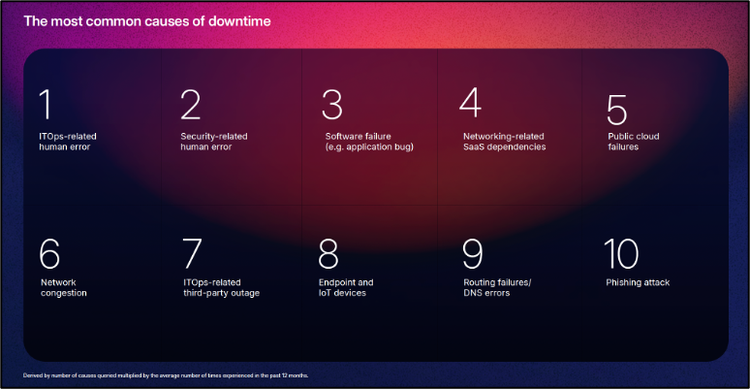
Data points to human error as the primary source of downtime. Issues like software misconfigurations and coding errors are becoming more frequent as IT estates grow in complexity, creating new blind spots and additional points of failure.
A cross-domain approach that leverages unified data, AI-driven automation, and collaborative platforms not only transforms how organizations detect, investigate, and resolve incidents but can also help minimize human error. By combining human oversight with clear context, organizations achieve observability of AI itself. This approach fosters seamless collaboration across SecOps, ITOps, and NetOps teams, providing shared visibility and context that help prevent misconfigurations and accelerate accurate decision-making, strengthening digital resilience and enhancing operational agility.
Overall, the survey reveals that the frequency of downtime remains stubbornly persistent, suggesting that organizations should rethink their resilience strategies. But there is hope: 72% of ITOps and engineering leaders say end-to-end observability is their top investment priority to improve infrastructure resilience.
How AI impacts downtime
A remarkable 44% of technology respondents say they’re using agentic AI to address downtime. The technology is already proving to be a force-multiplier during incident response, autonomously diagnosing issues and executing common fixes, saving valuable time on manual investigations.
But while 56% of all AI users say the technology has reduced downtime risks, every technology leader surveyed reports that their organization has endured some form of AI-related outage in the past year, including from issues like incorrect AI-driven automation (50%) and model drift (50%), as well as adversarial attacks like prompt injections and data poisoning (26%).
Organizations will have to proceed with caution. If you can’t trust it, you can’t use it. Although AI will be influential in the fight against downtime, the technology inherently introduces uncertainty. In fact, 68% of technology leaders worry their AI agents will behave unpredictably and cause outages. That’s why human oversight, empowering teams with observability into AI, and architecting your systems to adapt under pressure remain essential for true digital resilience.
Downtime is inevitable, but its frequency and impact are within our control. As we enter the agentic era, stability will become a true competitive advantage. Moving beyond reactive recovery and embedding predictive immunity into the very fabric of your operations can help protect your brand, satisfy your customers, and turn the perpetual threat of AI-driven disruption and downtime into a foundation for sustainable growth.
Get The Hidden Costs of Downtime 2026 for more survey insights and recommendations on how you can help your organization minimize loss and create operational stability.