If AI Agents Can Access Everything Through MCP, Do We Still Need a Data Platform?
Artificial Intelligence Hanlin FangKey takeaways
- MCP gives AI agents a standardized way to connect to tools, systems, and data sources; connectivity alone does not create operational truth.
- In production, agents need operational truth including trusted context, entity relationships, business impact, governance, and evidence, provided by a data platform.
- The data platform becomes more strategic in the agentic era because agents will reason over data and recommend or trigger action based on it.
Having led AI and machine learning products for more than a decade, I have learned to be mindful with any question that begins, "Does this new technology make the platform underneath less important?"
We heard that question with Cloud. We heard it on machine learning platforms. We heard it again with generative AI. Now I hear about AI agents and Model Context Protocol, or MCP: if agents can access tools and data from many systems, do we still need a data platform?
It is a fair question.
MCP is an important step forward. It gives AI applications and agents a more standard way to retrieve data, call tools, and participate in workflows without every team building one-off integrations.
But access is not the same as understanding.
An agent that can reach many systems still needs to know which data to trust, how entities relate, what changed, what matters to the business, and what evidence supports a recommendation. That is why MCP does not remove the need for a data platform. It makes the data platform more important.
Access Is Not the Same as Truth
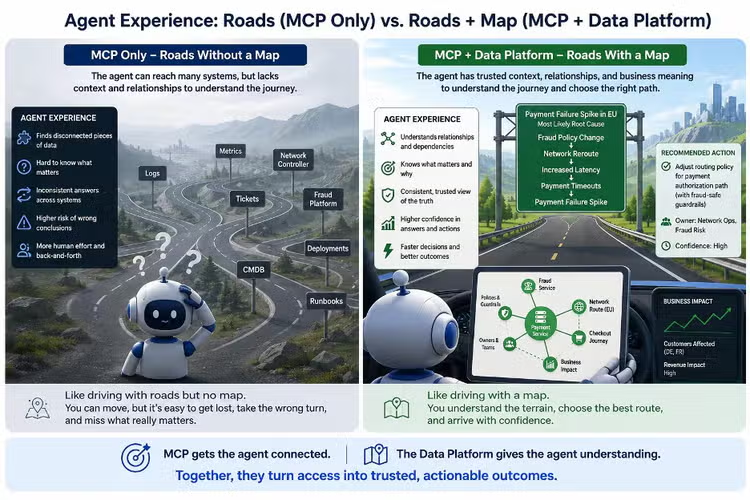
The simplest way to say it is this: MCP gives agents roads into systems. A data platform gives agents the map navigating the systems.
Imagine an executive asking a simple question during a live incident: why are payment failures spiking in Europe? An MCP-connected agent may call the payment dashboard, search logs, check observability metrics, query the network controller, inspect the fraud platform, look at deployments, search tickets, and read runbooks.
That sounds powerful. But the harder work begins after the agent gathers facts. Which signal matters? Which system is authoritative? Are payment-service, checkout-payment-api, and pay-eu-prod the same thing or different things? Did the payment application fail, or did a dependency fail? Was there a fraud policy update, a network change, or both? Which customers are affected?
MCP helps the agent ask questions across systems. It does not automatically reconcile the answers into a trusted operational picture. That is the role of the data platform.
The Payment Failure Spike Scenario
At 10:05 AM, the payment failure rate in Europe rises from 2 percent to nearly 9 percent. Checkout conversion starts dropping in Germany and France. Support contacts rise. The executive question is simple: what happened, and what should we do?
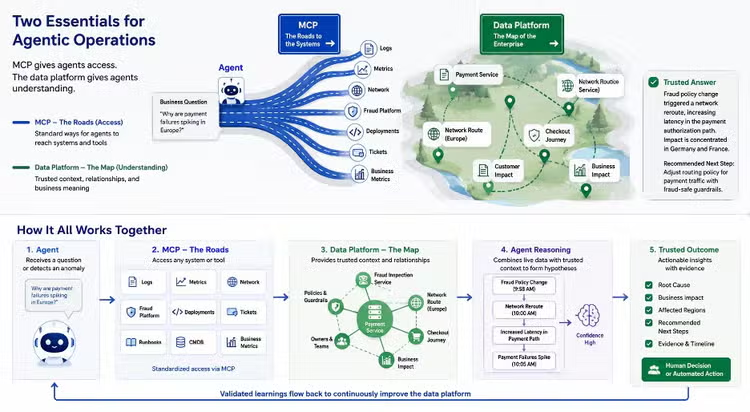
An MCP-connected agent can gather useful facts. Payment logs show timeout errors. Observability metrics show increasing latency. The deployment system shows no recent payment application release. The fraud platform shows a policy change at 9:58 AM. The network controller shows a regional traffic reroute at 10:00 AM. Business metrics show conversion impact starting at 10:05 AM.
Useful, but fragmented.
A data platform such as Cisco Data Fabric, powered by the Splunk Platform helps turn those fragments into operational truth. It understands that the payment service is part of the checkout journey and connects it to fraud inspection, network routing, payment dependencies, customer region, business impact, and service ownership.
Now the answer becomes clearer: The new deployment didn’t fail the payment application. The likely root cause is a fraud-driven network reroute that introduced latency into the payment authorization path in Europe. The business impact is concentrated in Germany and France, where checkout conversion is dropping. The next step is to review or temporarily adjust routing for payment authorization traffic while preserving necessary fraud controls.
That is the difference between a list of facts and an operating answer.
Why Agents Increase the Need for a Data Platform
In the dashboard era, humans used data platforms to search, investigate, and make decisions. If data was incomplete or inconsistent, an experienced analyst could sometimes compensate.
In the agentic era, agents become new consumers of operational data. They will not only retrieve data. They will summarize, correlate, recommend, and eventually trigger workflows. That raises the stakes. Bad data no longer creates only a bad dashboard. Bad data can create a bad recommendation, and over time a bad recommendation can become a bad action.
Enterprise leaders should not treat MCP and data platforms as substitutes. MCP answers: can the agent connect to the system and perform the task? The data platform answers: can the agent understand what the data means, how it relates to other data, whether it is trusted, and why it matters to the business?
One of the most important pieces is the knowledge graph on the data platform. It gives agents a shared map of services, applications, users, hosts, network paths, business processes, policies, owners, dependencies, and historical incidents. Without that map, every agent rebuilds context from scratch. One may infer one relationship, another may infer a different one, and a third may miss the policy context entirely.
The enterprise does not need thousands of agents building thousands of private scratchpads. It needs shared operational understanding that every agent and human team can trust.
Executive Takeaway
The agentic era does not make data platforms obsolete. It changes what we need them to do. The data platform is no longer only a place for storing, searching, and analyzing data. Cisco Data Fabric, powered by the Splunk Platform, becomes the foundation for agentic understanding by bringing machine data, context, relationships, governance, and evidence into one trusted operating layer.
MCP expands how agents connect with systems. But once agents can connect to more systems, the next challenge becomes even more important: how do they know what is true? For Cisco Data Fabric, this is the core product challenge: connect fragmented signals, preserve provenance, understand entity relationships, and make operational context usable by both humans and agents.
That is where the data platform matters. The winners in the agentic era will not simply be the organizations with the most agents or the most tool connections. They will be the organizations that prepare their data, add context with relationships, and provide governance so humans and agents can operate from the same trusted picture of reality. That is the role Cisco Data Fabric is built to play.
MCP gives agents reach. The Cisco Data Fabric gives agents operational truth. And operational truth is what turns agentic AI from an impressive demo into a production operating model.
Related Articles

Add to Chrome? - Part 3: Findings and Recommendations

SOAR in Seconds with Splunk Feature Overviews