Building a Cross-Functional Remote Employment Fraud Response Team
Security Brian Starrs , Jonathan HeckingerIn our first two blogs (Imposters at the Gate: Spotting Remote Employment Fraud Before It Crosses the Wire and Behind the Curtain: Detecting Remote Employment Fraud Inside Your Organization), we demonstrated how to identify remote employment fraud before and after hiring. Now we’ll cover the most complex aspect of REF risk: what to do after you find it.
Picture this: You’ve identified suspicious indicators during a candidate’s hiring process. The critical next steps are when many organizations stumble. Proper planning for this scenario in advance will save a lot of headache down the road. Unlike traditional security incidents that may be handled more independently by security teams, REF response requires navigating employment law, privacy regulations, investigation protocols, and potential termination procedures. It demands a level of cross-functional collaboration for which many security teams have not previously laid the necessary groundwork to be successful.
The Challenge
When Security Meets Employment Law
Remote employment fraud sits at an intersection of security, legal, and human resources, creating unique challenges that traditional incident response playbooks do not address such as:
Legal Complexity: REF investigations must consider employment laws, privacy rights, evidence preservation requirements, and potential litigation risks. A misstep in the investigation process can expose your organization to wrongful termination lawsuits or regulatory violations.
Evidence Type: REF cases often require correlation of traditional technical indicators of behavior, along with observed behaviors during interactions with the suspected fraudulent candidates. This includes:
- Reviewing background verification discrepancies
- Interview question responses (written, verbal, and non-verbal)and candidate resumes
Larger organizations also feature complex recruiting and hiring pipelines that may differ by business unit; this amps up the complexity when gathering indicators through multiple systems.
False Positive Consequences: I ncorrectly identifying a legitimate candidate or current employee as a threat actor can result in significant legal, reputational, moral, and ethical impacts. The stakes are exceptionally high and your security team will be well served by developing a plan in advance for scrutinizing potential cases.
Time Sensitivity: REF actors can cause significant damage quickly. This could be data exfiltration or releasing malicious code into your environment or products you build. We all want a streamlined hiring process to reduce friction for the candidates, but this needs to be balanced with the required due diligence to ensure that candidates are who they say they are.
Building a Program
Establishing Your REF Response Framework
Successful REF response requires a structured approach that brings together security, legal, and HR expertise while maintaining clear roles, responsibilities, and escalation paths. Here are some recommended steps to help you get started on this journey.
Step 1: Foundation and Preparation
Build a REF response team with representation from the following teams:
- Security Operations
- Security operations leads technical investigation, evidence collection, and risk assessment. They provide technical findings, but defer to Legal and HR on employment-related decisions.
- IT
- IT teams can provide information such as IT asset management datasets, which can be helpful in understanding where IT hardware may have been shipped. They may also provide access to IT systems supporting HR hiring processes.
- Legal Counsel
- Legal counsel guides investigations procedures, evaluates legal risk, ensures compliance with applicable employment, data protection and other regulatory laws, and makes recommendations on evidence preservation.
- Human Resources
- Human Resources manage employee relation aspects, coordinates with recruiting teams, people systems, and executes any employment actions (suspension, termination, etc).
- Talent Acquisition
- Talent Acquisition can provide unique insights into hiring processes, candidate verification procedures, and help identify potential gaps in screening processes.
- Executive Leadership
- Executive Leadership is needed to help deconflict and provide resourcing to the teams handling this threat.
Step 2: Detection and Response
Develop well-defined detection criteria for identifying potential REF, using a comprehensive set of behavioral indicators throughout the hiring process to escalate cases of interest. Leverage the provided table as a starting point, and customize it to fit your organization’s needs by adding relevant indicators. This proactive approach will help ensure effective detection and timely escalation of suspicious cases.
(Indicators marked with an asterisk may continue into later stages)
Putting these indicators into your organization's security alerting pipeline can automate analysis of behaviors in aggregate. Here’s a high level sample of what these types of detection and response processes could look like in your organization.
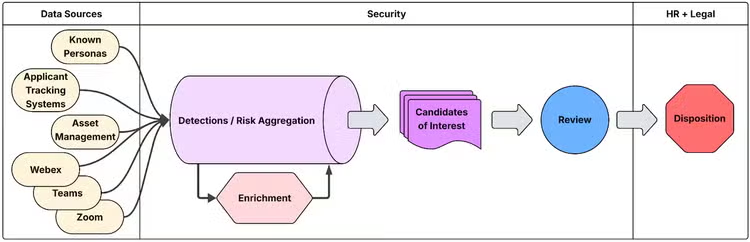
Step 3: Case Review Process
REF cases are rarely black-and-white and being able to derive confidence in your evaluation for the totality of evidence is key. Creating a REF decision framework to coalesce various evidence sources can help. Here is an evaluation framework you can use:
- High confidence cases typically have multiple corroborating pieces of technical evidence and behavioral interactions. There may be clear policy violations or even evidence of malicious activity.
- Medium confidence cases include those with strong indicators of both a technical and behavioral nature. Enhanced monitoring, or behavioral interviews may be appropriate to gain additional information.
- Low confidence cases feature isolated behaviors with potentially legitimate explanations.
Step 4: Case Summary and Stakeholder Review
Once security teams have gathered and analyzed all relevant indicators on a candidate, it is essential to formally consolidate these findings into a comprehensive case summary. This summary should clearly outline the technical evidence, behavioral observations, and any corroborating data, creating a single source of truth for review. The next step is to convene a cross-functional discussion with HR and Legal, ensuring that all perspectives—security, legal compliance, and employment policy—are represented in the decision-making process.
To streamline this process and reduce response times, organizations should establish pre-agreed thresholds and decision criteria for candidate disposition with all stakeholders in advance. By having these criteria documented and endorsed, teams can move swiftly and with confidence when determining whether to proceed with hiring, escalate for further investigation, or discontinue the candidate’s process, all while ensuring consistency, compliance, and risk mitigation.
The Critical Role of Legal and HR Partnership
As you’ve read above, security teams cannot manage this threat alone. Collaboration with HR and legal teams is required in order to successfully manage this threat and early partnership can reduce decision times during an actual incident.
Legal Partnership
Employment law varies significantly by jurisdiction and legal counsel should navigate wrongful termination risks and privacy law compliance. Legal may provide support determining what investigation techniques are legally permissible and help establish procedures that will withstand legal scrutiny. Ideally, this places your organization in a legally defensible position for actions that may be taken during REF cases. REF incidents may also trigger reporting obligations under federal law related to security breaches or potential accidental contact with sanctioned entities. Legal counsel is essential in ensuring that the necessary transparency is affected once certain analytic conclusions are arrived upon.
HR Partnership
HR can provide expertise in applying existing organizational policies to REF scenarios and can help to identify gaps that need to be addressed. They come with experience navigating personnel investigations while maintaining compliance with employment laws and company policies. Perhaps most importantly, HR professionals can help your security team understand the hiring pipeline and key chokepoints where REF checks can be implemented. It’s also likely that they’ll have access to datasets your security team may not have worked with before: Applicant data, background checks, and interview feedback (among others), are all crucial to help build a robust REF identification program.
Measuring Success and Continuous Improvement
Effective REF response benefits from metrics that extend traditional security KPIs–but share a lot of similarities! At the end of the day, understanding and measuring impact, or prevented-impact to the business is paramount. Here are some potential metrics that you might consider measuring in your own organization:
- Mean time to detect: Measure the time from application to detection. Use metrics like this to understand what stages of an interview process you’re most likely to identify fraudulent candidates.
- Time to initial assessment: Measure from the first indicator to completion of the risk evaluation.
- Time to disposition for confirmed cases: Very similar to Mean Time to Contain metrics. Measure how long from the first indicator to the closure of the incident.
- Percentage of REF job applicants to non-REF applicants: Depicts how ‘big’ of a problem this is in your organization, which can further be split by various role types (e.g.: likely higher percentages in software development roles).
- Financial Savings: Preventing the hiring of REF applicants can have very tangible business outcomes in saving wasted hiring costs, mitigating loss of intellectual property, or even more.
These are just a few ideas, but your organization will likely find multiple other benefits from measuring additional attributes associated with REF investigations.
Conclusion
Success Through Partnership
As remote employment fraud (REF) becomes more sophisticated, it's not a question of if it will strike—but when. Unlike traditional incidents, effective response depends on cross-functional partnerships and unified business processes. Security teams that proactively build these with legal and HR won’t just move faster in the moment—they’ll reduce organizational risk, safeguard talent pipelines, and ultimately strengthen resilience against this evolving threat.
Related Articles

Unmasking the Enigma: A Historical Dive into the World of PlugX Malware

UEBA Superpowers: Detect and Eliminate Advanced Threats with Machine Learning