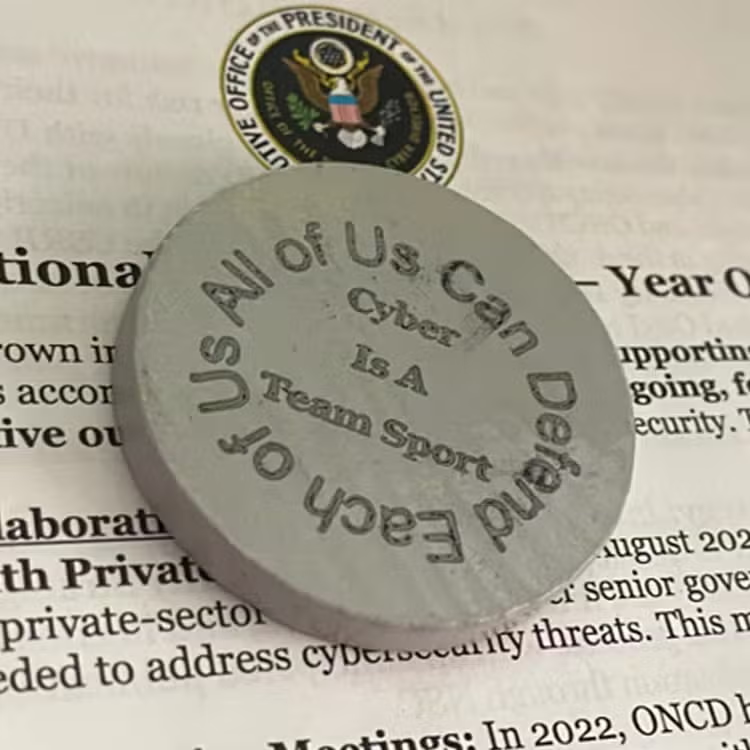
All of Us Can Defend Each of Us

It was a uniquely surreal feeling walking from the visitor entrance into the Eisenhower Executive Office Building a few weeks ago. I’m certain the overcast sky and drizzling rain helped set that tone. Having spent so much time walking these halls in my former role as the White House threat intelligence branch chief, I reflexively headed to Ike’s cafeteria to grab a snack and collect my thoughts before meeting up with the larger group. After leaving public service in late 2018, I didn’t think I would be back in this building again, so when I received a ping from the omnipresent Beau Woods of I Am The Cavalry asking if I’d like to participate in this year’s Hackers on the Hill session, there was zero hesitation on my end.

Hackers on the Hill is a program that brings together technology professionals and policymakers to work on issues related to technology policy. During the program, participants have the opportunity to hear from policymakers and experts on technology-related issues, and to participate in discussions and workshops on topics such as privacy, cybersecurity, internet governance, and more. Additionally, participants often have the opportunity to meet with members of Congress and their staff to discuss the issues that are important to them and to learn more about the legislative process. The goal of the program is to bridge the gap between the tech community and policymakers and to help ensure that technology policies are informed by the perspectives and expertise of the tech industry.

I was invited to a session focused on the Executive Office of the President, and the nascent Office of the National Cyber Director. After a warm welcome from NCD Chris Inglis, and an overview of the Chatham House Rule (always a good idea to have a refresher), we moved into the introductions and an overview of the National Cybersecurity Strategy.

A line from one of the introductory speakers on the topic of hiring and the cyber workforce really resonated. She noted that she was very familiar with being the only woman in the room, and my experience in public service, in technical roles, certainly backs up her claim. I’m excited to see this is an area that is being actively addressed at the federal level. It is well known that a diverse workforce can bring a wide range of perspectives, experiences, and skills to the table. This can lead to more innovative and effective solutions to problems, as well as a better understanding and ability to serve the diverse population of the country. Additionally, a diverse workforce can help to create a more inclusive and equitable workplace culture, and can help to ensure that the department is representative of the population it serves. Events like the National Cyber Workforce and Education Summit, which led to the development of the National Cyber Workforce and Education Strategy are paramount in developing the skills needed to increase the nation’s resilience.

If you want to hear more thoughts on addressing the security talent crisis with more diverse candidates, join me and dear SURGe leader, Ryan Kovar, for the Data Security Predictions 2023 webinar.
I’m certain you’ll hear from me again on the national cybersecurity strategy when it is signed by POTUS, so I'll leave the details for that. However, here’s a quick highlight: I can’t recall ever seeing a strategy this directly prescriptive in its measures, and am impressed to see the focus on the resiliency of critical infrastructure, and the industries that comprise it.

Before concluding for the day, we broke into small roundtable discussions, and I had the opportunity to discuss ransomware with NCD representatives and industry peers who I have admired and respected for a long time. I spent most of the day very impressed at how passionate this group is about raising the bar for cybersecurity. There will likely always be disagreements on how to prioritize and implement new policies across the private and public sectors; however, the goal remains the same of making the internet safer and more accessible for everyone.

- Mick

Related Articles

Predicting Cyber Fraud Through Real-World Events: Insights from Domain Registration Trends
Security
12 Minute Read

Predicting Cyber Fraud Through Real-World Events: Insights from Domain Registration Trends

By analyzing new domain registrations around major real-world events, researchers show how fraud campaigns take shape early, helping defenders spot threats before scams surface.
When Your Fraud Detection Tool Doubles as a Wellness Check: The Unexpected Intersection of Security and HR
Security
4 Minute Read

When Your Fraud Detection Tool Doubles as a Wellness Check: The Unexpected Intersection of Security and HR

Behavioral analytics can spot fraud and burnout. With UEBA built into Splunk ES Premier, one data set helps security and HR reduce risk, retain talent, faster.
Splunk Security Content for Threat Detection & Response: November Recap
Security
1 Minute Read

Splunk Security Content for Threat Detection & Response: November Recap

Discover Splunk's November security content updates, featuring enhanced Castle RAT threat detection, UAC bypass analytics, and deeper insights for validating detections on research.splunk.com.
Security Staff Picks To Read This Month, Handpicked by Splunk Experts
Security
2 Minute Read

Security Staff Picks To Read This Month, Handpicked by Splunk Experts

Our Splunk security experts share their favorite reads of the month so you can follow the most interesting, news-worthy, and innovative stories coming from the wide world of cybersecurity.
Behind the Walls: Techniques and Tactics in Castle RAT Client Malware
Security
10 Minute Read

Behind the Walls: Techniques and Tactics in Castle RAT Client Malware

Uncover CastleRAT malware's techniques (TTPs) and learn how to build Splunk detections using MITRE ATT&CK. Protect your network from this advanced RAT.
AI for Humans: A Beginner’s Field Guide
Security
12 Minute Read

AI for Humans: A Beginner’s Field Guide

Unlock AI with the our beginner's field guide. Demystify LLMs, Generative AI, and Agentic AI, exploring their evolution and critical cybersecurity applications.
Splunk Security Content for Threat Detection & Response: November 2025 Update
Security
5 Minute Read

Splunk Security Content for Threat Detection & Response: November 2025 Update

Learn about the latest security content from Splunk.
Operation Defend the North: What High-Pressure Cyber Exercises Teach Us About Resilience and How OneCisco Elevates It
Security
3 Minute Read

Operation Defend the North: What High-Pressure Cyber Exercises Teach Us About Resilience and How OneCisco Elevates It

The OneCisco approach is not about any single platform or toolset; it's about fusing visibility, analytics, and automation into a shared source of operational truth so that teams can act decisively, even in the fog of crisis.
Data Fit for a Sovereign: How to Consider Sovereignty in Your Digital Resilience Strategy
Security
5 Minute Read

Data Fit for a Sovereign: How to Consider Sovereignty in Your Digital Resilience Strategy

Explore how digital sovereignty shapes resilient strategies for European organisations. Learn how to balance control, compliance, and agility in your data infrastructure with Cisco and Splunk’s flexible, secure solutions for the AI era.