Rethinking Observability: From Risk Mitigation to Business Transformation
It’s time to move beyond viewing observability as just a way to detect and resolve technology-related availability and performance issues. Instead, let’s start thinking about observability as a driver of value and a catalyst for business transformation.
I completely understand where this thinking comes from. For years, vendors have focused on performance improvements—reducing downtime by 20–30%, making applications run better. Those results are real and, very importantly, measurable. In fact, across Global 2000 companies, we’ve seen a 53% reduction in application and infrastructure downtime when organizations invested in building a leading observability practice. *
But today, there’s a more powerful reason to invest: observability is a strategic enabler of growth, agility, and innovation—especially in the era of AI which is forcing every organisation to rethink how they operate. Banks are providing AI assistants to their employees to augment their daily work, restaurant chains are launching AI-powered drive-throughs, electric cars are increasingly becoming data centers on wheels, researchers and doctors are transforming patient care.
While the possibilities are endless, the path forward isn’t straight or clear. Unified Observability has a critical role to play for organizations to successfully figure out how to quickly adapt and invest in the future. Other organizations are likely to lose relevance.
Why a New Mindset Matters
It’s time to shift from seeing observability as a tool for reacting to problems to seeing it as a proactive foundation for business velocity.
- IT is where businesses differentiate themselves from competitors. According to Gartner ® a growing number of organisations are now focussed on observability platforms to measure and improve user experience and measure key business metrics. In their strategic planning assumptions, Gartner shows that by 2027, 80% of organisations that successfully applied observability will achieve shorter latency for decision making, enabling competitive advantage for target business or IT processes. 1 The more sophisticated your use of technology is, and the more closely tied to your business differentiation it is, the greater the sophistication of solution you will need to deliver your desired business outcomes.
The advent of AI supercharges the criticality of these relationships because people are working with AI across a highly complex, distributed, interconnected landscape. The ability to connect with one another and technology from anywhere has become an expectation for employees and consumers. So we need to reimagine the workplace and everywhere organizations serve their customers to deliver better, more secure experiences. - Legacy, siloed tools are inefficient. They're expensive, people-heavy, and create blind spots.
- A “single platform” for observability is an outdated notion. Environments have become so complex, interpenetrated, and volatile that what is needed is a single robust version of the truth. This can only be realised with the federation of multiple data sources and highly differentiated application components.
- Real time means “real time”. It is essential to meet the velocity of macro and micro impacts on the business. A monthly update to a CMDB is out of date for 353 days of the year!
- Modern tech environments are bigger than “Core” IT. They span IT, OT, IoT, and AI. Your tools need to reflect that complexity.
Instead of looking for simplicity in a single product, look for platform advantage—a unified, correlated, and contextual view of all your data, no matter where it lives. This gives you a single robust version of the truth for faster, smarter decisions.
How to Build a Value-Driven Observability Practice
Step 1: Establish a Unified Data Foundation
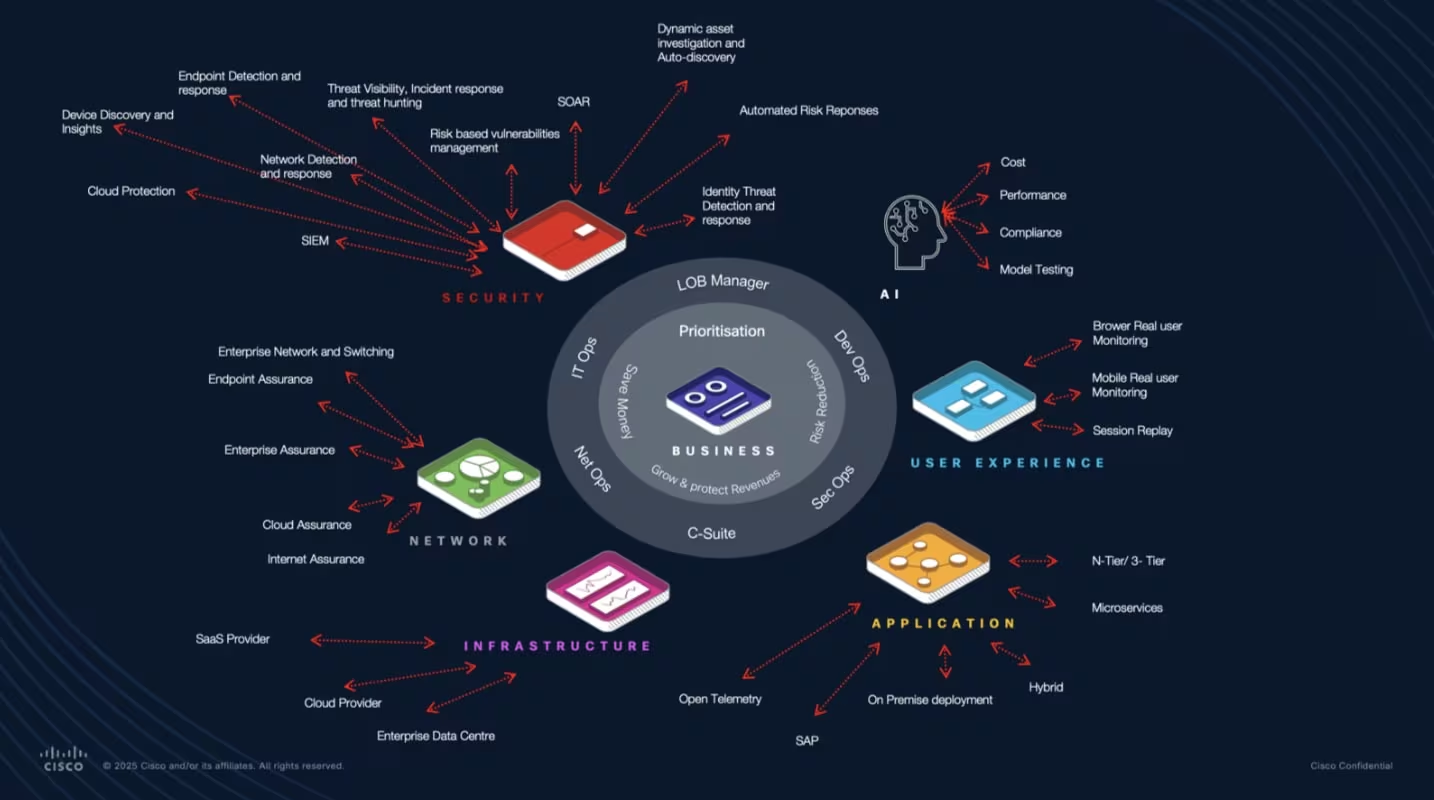
Start with the data. Your tech stack likely includes between 23 and 50 monitoring tools—just for IT.**
Now add in OT and IoT. It’s no surprise clarity is hard to achieve when these tools all sit in silos.
Persona-specific tools can still exist, but everyone should work from a consistent, correlated dataset that spans IT, OT, IoT, and beyond.
Step 2: Connect Observability to Business Value
Think about your value chain—the end-to-end processes that deliver customer outcomes. Each process is powered by people, technology, and critical user journeys. Observability optimizes these component parts—making them faster, more efficient, more intelligent. When every part performs at its best, your business does too.
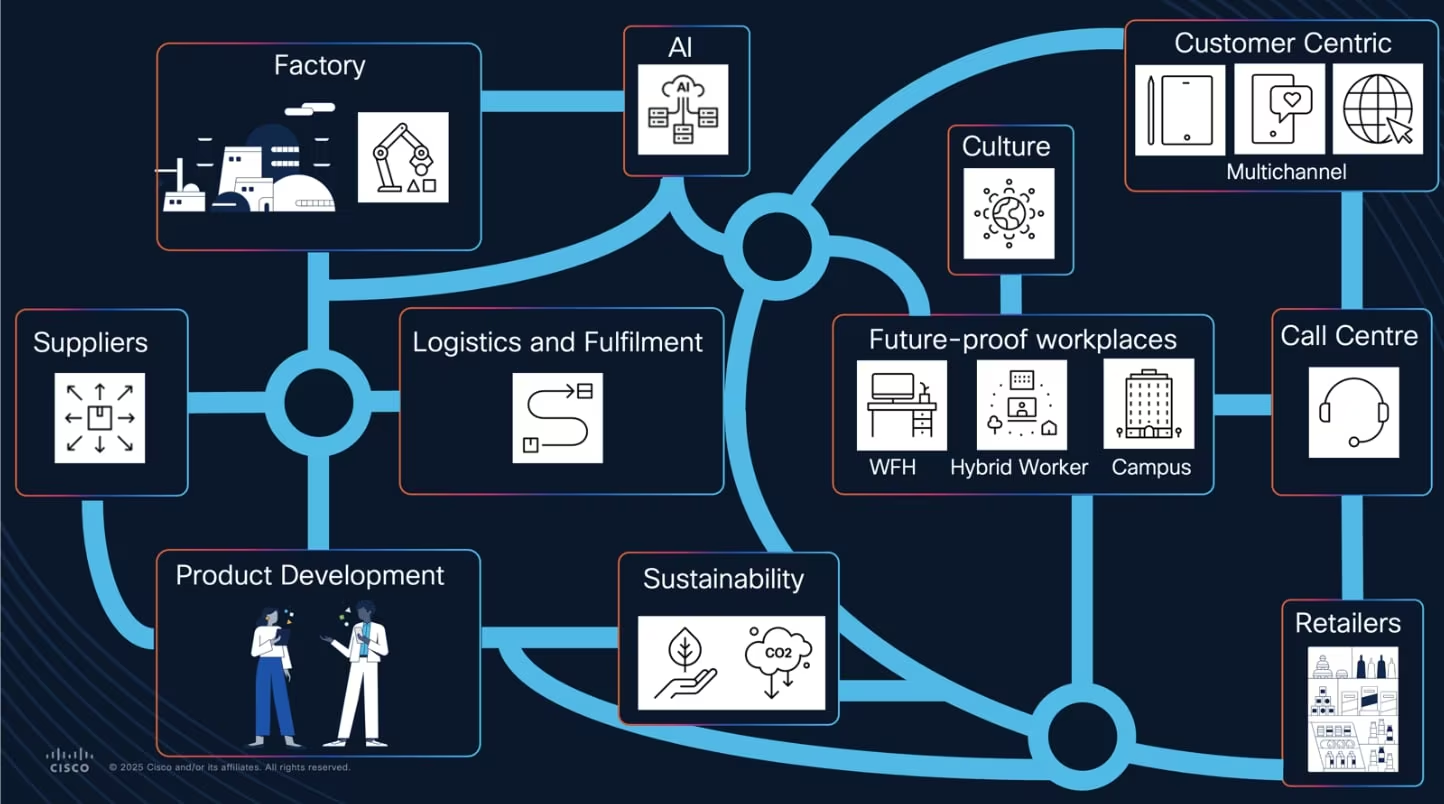
With that insight, you can:
- Rationalize your tech stack with confidence
- Evaluate the success of cloud or tech migrations
- Link performance to KPIs—financial or operational—with clarity
- Break down silos across DevOps, NetOps, SecOps, ITOps, business units, and leadership
- Ensure your AI assistants and agents deliver the desired business outcomes effectively, securely and without bias.
Step 3: Define Your Journey and Start Where It Matters Most
There is no one-size-fits-all path. Your organization’s maturity across people, processes, and tools will shape your observability journey.
Start by defining your end vision—Not just a technology vision but a vision of how technology will support business goals and drive growth. Then work backward to identify today’s most pressing gaps.
Often, the first step is simpler than you think.
For example: A European bank ran an observability maturity assessment with one of our partners. They found 49 gaps. Of those, 40 were technology-related—and 35 of those capabilities already existed within our solution. The remaining 5 were on our roadmap, the rest related to people and process maturity.
So, in conclusion:
- Come back for part 2 of this series
- Get in touch via LinkedIn or email, let’s see what great could look like for you
- See the latest Digital Resilience Innovations from Cisco and Splunk here: https://www.ciscolive.com/on-demand/on-demand-library.html?search.event=1748366287882001oJzH&zid=global#/
*Source: The Hidden Cost of Downtime, Oxford Economics / Splunk, 2023
**Source: State of Observability, Splunk, 2024
1 Gartner Report, Key Functional Considerations to Define Your Observability Platform, by Martin Caren, Gregg Siegfried, Matt Crossley, Mrudula Bangera. Jan 2025
GARTNER is a registered trademark and service mark of Gartner, INC. and/ or its affiliates in the U.S, and internationally and is used herein with permission. All rights reserved.
Related Articles
What the North Pole Can Teach Us About Digital Resilience

The Next Step in your Metric Data Optimization Starts Now

How to Manage Planned Downtime the Right Way, with Synthetics

Smart Alerting for Reliable Synthetics: Tune for Signal, Not Noise

How To Choose the Best Synthetic Test Locations
Advanced Network Traffic Analysis with Splunk and Isovalent

Conquer Complexity, Accelerate Resolution with the AI Troubleshooting Agent in Splunk Observability Cloud

Instrument OpenTelemetry for Non-Kubernetes Environments in One Simple Step