Model Drift: What It Is & How To Avoid Drift in AI/ML Models
Learn Muhammad RazaModel drift is an AI phenomenon that refers to the decay in performance of a machine learning model during inference of data that has deviated in its statistical properties or feature relationships.
Let’s understand why this phenomenon occurs — and how you can avoid it.
What is model drift?
Let’s define model drift as simply as possible:
Model drift refers to a model’s tendency to lose its predictive ability over time. The model has drifted away from its original goal or purpose.
Model drift is an important consideration for AI models deployed in a production environment. That’s because here, in production, the real-world data at inference may deviate vastly from the type of information used to train the models.
Model drift vs. concept drift vs. data drift
The term “model drift” has some related but distinct terms, so let’s clarify them here:
- Concept drift refers to changes in the relationship between input data and the target variable (output) over time, affecting the model's predictions.
- Data drift involves changes in the distribution of input data itself, which can indirectly impact model performance.
- Model drift is often used as an umbrella term encompassing both concept and data drift, indicating any degradation in model performance due to evolving data patterns.
The problems with model drift
When a model is not trained on a sufficiently large pool of data, the AI model may not capture all of the behaviors underlying the data distribution. The model may assume relationships between some inputs and corresponding features — and therefore fail to generalize its behavior on the real-world data that do not comply with the model’s assumptions.
In that case, the model may produce inaccurate results (yes, even when the training stage for the model shows high performance on all accuracy metrics). The consequences for this in the real world are massive: an AI model suffering from model drift in production may cause faulty business decisions and inaccurate predictions on sensitive matters affecting business outcomes.
Model drift is likelier in large language models
Model drift is more prominent for large models that are trained on large volumes of information.
Training these models consumes a lot of time and resources. A single end-to-end training run for an LLM with several hundred billion parameters can cost several million dollars.
And you need more than a single training run. It takes several experimental runs to reach a final state of architecture, model parameters, and learning algorithm scheme that fits optimally to a given data distribution.
(At the high end, Google’s Gemini Ultra cost an estimated $191 million to train in 2024, whereas DeepSeek broke this trend in 2025, showing how it may be possible to reduce training to just a few million dollars.)
Static or historic data for training
Now, the key challenge here is that large models are typically used to solve complex and real-world AI problems such as conversational AI. Any language model is learning from data—it figures out how inputs relate to outputs in the datasets provided for training. Typically, that training data is historical and static.
But over time, the real world changes, as does data coming from it. Any new data may have attributes vastly different from the one used to train the model. That means any patterns your AI or ML models learned may no longer hold true.
Here, the model has drifted from its purpose. The model is not as accurate as it should be or used to be because the rules it learned from older data no longer apply. That means you’ll see unexpected deviations in the model performance — so you certainly don’t want to rely on it.
For example, an LLM may be trained on published internet content that contains language nuances and cultural trends from older age groups. An ecommerce website, previously aimed at an older audience, now wants to target a younger audience using an LLM shopping assistant. The younger audience may not relate to the language nuances or assistance provided by the LLM, because their culture, preferences, and purchase patterns are vastly different from the older audience.
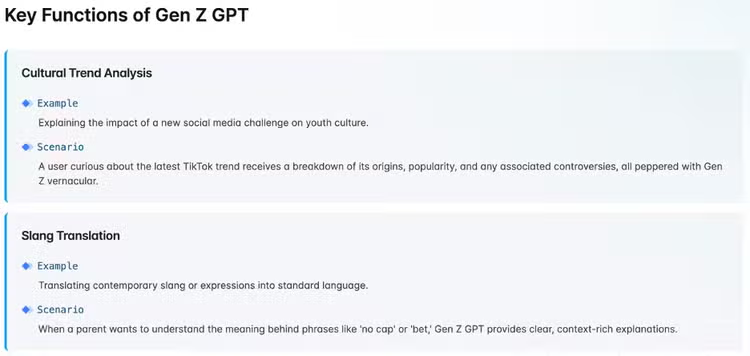
This GPT focuses on using “standard” language alongside Gen Z slang, trends, and culture. (Source.)
The primary purpose of a machine learning model is to map these relationships accurately, such that this mapping could be generally applicable to all input-output data combinations. In the case of generative AI (such as LLMs), the models would learn the distribution of the input data domain and the corresponding features.
Real-world relationships are dynamic
Now, that theory makes sense: when data changes, the patterns from the model may change. But what if you don’t know the data is changing?
in a real-world setting, this relationship can change without warning. The changes may be:
- Uncontrollable
- Unpredictable
- Hidden.
A new data point may have different characteristics regarding the relationship between its corresponding features and the true target variable (output) it belongs to.
For example, an email spam detection system relies on keywords such as ‘won’ and ‘lottery’ to classify an email as spam. An email that closely resembles natural human conversation may not be flagged as spam or fraudulent—especially if it’s not using ‘won’ or ‘lottery’ in it.
If the email contains language that is more relevant to the target, for example, a spam email to a student about school supplies instead of winning a lottery, the model might fail to classify the email text as fraudulent. This is because the feature of email subject: school supplies appears legitimate and relevant, but in reality belongs to the spam category.
In this case, the model drift fails to recognize this change in pattern of relationship between the feature and a target variable for an input-output combination during inference.
Best practices to detect and deter model drift
So as an AI practitioner, consider the following best practices to help detect model drift and develop models that are less prone to data drift or concept drift:
Drift detection
You can detect model drift by monitoring the changes in data and the feature-output variable relationships at inference. You can harness both statistical analysis testing and non-parametric testing.
Statistical analysis tests can evaluate parametric data distributions, where some statistical assumptions holds, such as normal distribution. These tests include:
- Chi-squared test is suitable for categorical data to compare observed and expected frequencies.
- ANOVA and T-tests are best used for comparing means across groups in continuous data, assuming normal distribution and equal variances.
Non-parametric tests can be used for data that are assumed to be normally distributed or parametric to a known distribution. These tests include:
- Kolmogorov-Smirnov (K-S)
- Wasserstein distance
- Population Stability Index (PSI)
Learning
Continual learning schemes can be used to update and adapt the model to learn on new data continuously as it arrives. The learning algorithms can train the models such that their previous knowledge is retained, not forgotten.
This is important because classical machine learning models are prone to the phenomenon of “catastrophic forgetting”, where the model tends to forget its previous knowledge when trained on new data distribution. Certain techniques can help address catastrophic forgetting in continual learning scenarios, including:
- Elastic weight consolidation
- Rehearsal strategies
Model architecture
Modern LLMs are large enough to generalize complex data distributions but they may fail to generalize well during inference if trained with bias toward some distributions.
To handle the changing data distributions (data drift), model architectures that handle sequential learning can be used, such as:
- Recurrent neural networks (RNNs)
- Long short-term memory networks (LSTMs)
FAQs about Model Drift
Related Articles

What is Penetration Testing (Pen Testing)?

What Is Computer Vision & How Does It Work?