Federated Data Explained: Empowering Privacy, Innovation & Efficiency
Data is like the oxygen that fuels the digital revolution. While critical and readily available, data becomes dangerous when misused. Leaders and users alike are becoming concerned with how organizations can protect data, especially personal information. It’s a complex and dynamic challenge, making it harder than ever to share data to the extent needed to facilitate innovation and research.
To meet these challenges, many organizations are leveraging federated data systems. While not necessarily new, many organizations use federated data to enhance innovation and improve privacy.
Here is what you need to know about federated data, how it differs from traditional systems, its benefits, and solutions to common challenges when implementing it.
Federated data v.s. traditional data: what’s the difference?
To understand what makes federated data different, let’s first discuss traditional data collection systems.
Traditional data systems operate under a centralized model. In this instance, various sources collect data and then send it to a centralized database or data warehouse, where it is processed and stored. These systems are either:
- Structured, such as relational databases with defined data types and tables
- Unstructured, like data lakes that store raw data of various types.
(Read our comparison of data structures.)
Shortcomings of traditional data methods
Despite their widespread use, these traditional systems have several shortcomings that continue to grow as data and technology evolve:
Privacy & security concerns. A centralized database creates a single place of failure. If cybercriminals compromise the central database, all the data is at risk. Plus, data is vulnerable during transmission and is liable to interception.
Scalability issues. Data continues to grow exponentially, and traditional systems struggle to keep up with demand leading to increasing costs and decreasing performance.
Data latency. Transmitting data to a central location leads to critical latency for certain industries. This latency is especially apparent when dealing with large volumes of data or geographically distributed data sources.
Regulatory compliance. As leaders and citizens become concerned with data privacy, laws like CCPA and GDPR place strict regulations on collecting, using, and storing data. Centralized data systems make it challenging to ensure compliance, especially when it’s collected from users in different jurisdictions.
With these challenges, many organizations look for ways to improve their data collection and storage processes.
How federated data works
To overcome these challenges, companies are turning to federated data systems, which scatter data across multiple devices and servers instead of a centralized database.
In contrast to traditional systems, federated data stays at its original location. It is often used in the context of federated learning, where models train on the local data, and the learned updates (rather than the data itself) go to the central server. The system then aggregates these updates to update the entire global model
Federated data is becoming increasingly important with the rise of edge devices, such as smartphones and IoT devices, which generate large amounts of data that can be sensitive and challenging to centralize due to bandwidth issues.
(Learn how federated search connects siloed data.)
Common use cases for federated data
Federated data systems are valuable across industries and use cases. Some of the greatest implications are in the IoT, healthcare and finance:
Internet of Things (IoT)
IoT devices like wearables, smart home appliances and industrial sensors amass large amounts of data that can be challenging to centralize. The data is often private (like personal health metrics from an Apple Watch) and voluminous, making it complex and costly to transmit to a centralized server.
With federated data and federated learning, these devices learn and adapt without sharing raw data. For example, a smart thermostat could learn a user’s preferences and adjust to them without transmitting specific data to the central server.
Healthcare
Patient privacy is a significant concern when it comes to healthcare data. Regulations like HIPAA require strict data security, making it challenging to centralize all data. Federated data can create systems that preserve data privacy while facilitating predictive modeling and crucial patient insights.
For example, clinics or hospitals can utilize patient data gathered at each location to train a machine-learning model for predicting disease outcomes. The model then shares updates with a central server and does not share the patient data. Providers and researchers can gain valuable insights without potentially exposing private information.
Finance
Like healthcare, the financial sector often has sensitive data they can’t or won’t share due to regulatory and privacy concerns. PCI DSS has strict regulations over how organizations use and share private information. Federated learning allows financial companies to collaborate on building models, such as credit risk modeling or fraud detection, without sharing specific customer data. Individual institutions can train models on their data and only share the model’s updates with others. They reap the benefits of collaborative learning without compromising data privacy and security.
The benefits of federated data
In each of these cases, federated data provides machine learning capabilities and data-driven insights while avoiding a traditional centralized data system's privacy, security, and regulatory concerns. Some of the key benefits of federated data systems include:
Improved privacy
The most significant advantage is that it helps maintain the privacy and security of sensitive data. Keeping data on local servers and devices instead of centralized ones significantly reduces the risk of breaches and misuse.
Regulatory compliance
With strict data privacy laws, securely handling data is more vital than ever. Federated data helps keep organizations compliant because they do not move or share data, protecting user privacy.
Reduced data transmission
Federated data minimizes the bandwidth and costs associated with data transmission — sharing small model updates instead of transmitting large amounts of data is much more efficient.
Real-time learning and adaptation
Machine learning models are updated and improved in real-time as the data is generated. It’s critical for applications like IoT devices, where timing is crucial.
Utilizing edge computing
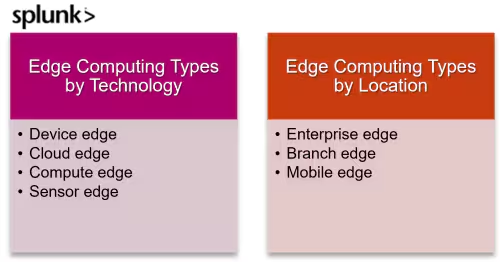
Edge computing has exploded in popularity as it improves speed and security. Federated data is critical because computations occur on the device rather than on a central server. The data is readily available on the computing device, enabling faster responses and reducing the dependence on continuous network connectivity.
Revolutionizing data privacy and efficiency
How we use data continues to evolve, so how we collect and store it also needs to transform. Federated data is a significant shift in leveraging data collection, storage, and processing. Bypassing centralized data addresses many privacy and efficiency issues inherent in the traditional data system.
Federated data can revolutionize many different industries when used with federated learning. It helps devices learn and adjust in real time, efficiently uses edge computing capabilities, and even helps organizations maintain regulatory compliance.
While some challenges remain in implementing federated data, it offers incredible possibilities for the future of data management and machine learning. As data and technology continue to grow and evolve, federated data will play a growing role in generating insights while maintaining privacy and security.
FAQs about Federated Data
Related Articles

How to Use LLMs for Log File Analysis: Examples, Workflows, and Best Practices

Beyond Deepfakes: Why Digital Provenance is Critical Now

The Best IT/Tech Conferences & Events of 2026

The Best Artificial Intelligence Conferences & Events of 2026

The Best Blockchain & Crypto Conferences in 2026

Log Analytics: How To Turn Log Data into Actionable Insights

The Best Security Conferences & Events 2026

Top Ransomware Attack Types in 2026 and How to Defend