Deployment Frequency (DF) Explained
Learn Blessing OnyegbulaTechnical teams use various metrics and indicators to track performance and success. For DevOps teams, among the most important metrics is deployment frequency.
Deployment frequency can help you evaluate the software delivery performance of teams that develop software and apps.
In this article, I’ll look at using this metric to calculate deployment rate, the importance and best practices for improving your deployment rate and setting your DevOps team up for success.
What is deployment frequency?
Deployment frequency (DF) is a measure of how often you deploy changes to production. Production here means your production environment — what’s live to end users. It refers to things including:
- Bug fixes
- The latest software version
- Product updates
DORA metrics
Deployment frequency is one of four DORA metrics. These metrics aim to evaluate the performance of DevOps teams based on their speed, effectiveness and cohesiveness, as well as the overall strength of the delivery process. The other DORA metrics are:
- Mean lead time for changes: the time a code commit requires to become production-ready after passing all the necessary tests in the pre-production environment.
- Change failure rate: the percentage of deployments causing a failure in production that requires an immediate fix, such as service degradation or an outage.
- Time to restore service: the time it takes to recover from a total failure or partial service interruption in a production environment.
While this article focuses on DF, all four DORA metrics are connected: a high score in one of the metrics can reduce or decrease the score of others. For example, a shorter mean lead time for changes will lead to increased deployments.
(Related reading: The State of DevOps Today & DPE: Developer Productivity Engineering.)
Deployment frequency vs. deployment time
Deployment frequency should not be confused with “deployment time”, though they are similar:
- Deployment frequency refers to the total number of deployments made over some span of time.
- Deployment time refers to time spent making deployment happen, measured in hours, minutes or seconds.
Deployment time can be a useful metric, but we won’t be expanding on that topic here.
How to calculate deployment frequency
Deployment frequency can be calculated manually by counting the number of deployments done over a period, whether daily, weekly or monthly. There are no strict rules or formulas for calculating it. However, the DORA team has a form known as Quick Check, which companies can use to evaluate their DORA metrics and compare them to the general benchmark set for DevOps teams. These benchmarks are:
- Elite: Multiple deployments per day
- High: One deployment per week to one per month
- Medium: One deployment per month to one every six months
- Low: Fewer than one deployment every six months
There are also analytics tools from Linearab.io, hatica, Jenkins and Gitlab’s CI/CD platform for measuring DF.
Based on these benchmarks, a high-performing team should be able to make several code deployments within a day. However, organisations differ on what their benchmarks are based on their operational goals and the complexity of projects they work on.
Importance of deployment frequency
Calculating your team’s DF is not for the bragging rights of hitting an elite performance level. It reflects the overall functionality of your engineering team in the following ways:
DF indicates team strength
Here, team strength means overall agility and responsiveness to feedback. Plus, it signals a work culture where work done is prioritised over perfection.
DF ensures continuous delivery
DF enforces a result-oriented mindset that keeps your engineering team active enough to frequent deployments. It also shows your customers you want to deliver good service — things you show in how quickly you take feedback and implement changes, like product features that contribute to their overall user experience.
DF improves existing systems
Your DF score indicates the strength of the internal systems and processes your engineering team has to deal with on a workday. Because apart from their expertise, their output also depends on those factors. Hence, a low DF can mean failing systems or inefficient DevOps personnel, while a high DF signals a highly functional work environment.
Factors affecting deployment frequency
Despite your team’s best efforts, they may still record low deployments due to different factors. One of such factors is the complexity of the project. Projects in specific fields like finance and medicine require extra time and longer processes before code can be shipped to production. This is to minimize risk, especially around regulatory compliance, and guarantee a great customer experience when users interact with the software.
Also, the people within your organisation determine the efficacy of your processes and the quality of output. So, hiring incompetent people, losing a senior engineer or having a new technical team lead join the company can slow down workflow and impact the rate of deployments.
How to improve your deployment frequency
The best practices for improving deployment frequency have their roots in release management. These practices include:
Encouraging collaboration
Collaboration is one of the critical principles of DevOps and should be encouraged at all stages of the software development lifecycle. Product managers, QA engineers, IT professionals and Developers should be available to suggest, approve and implement code changes to increase the deployment frequency.
Implementing CI/CD
Continuous integration/continuous delivery ensures engineering teams stay active and make regular deployments. This practice is made possible through DevOps automation. With DevOps automation, you can put processes like testing, production deployment, and monitoring on auto-pilot. The result is an improved operational efficiency that will reflect in:
- Code quality
- Number of deployments
- Troubleshooting tasks
Reviewing your goals
Pushing your team to achieve elite performance levels with code deployments is great — but understand this might take some time. So, consider starting small and scaling it up as your processes improve. That is, you work your way gradually from medium to elite performance level rather than pressuring them to hit multiple daily deployments no matter what.
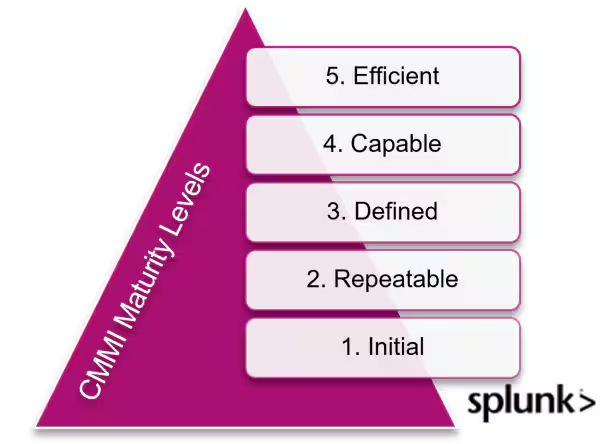
Also, adjust your deployment goal according to the developer or the project at hand. Doing it this way helps you know if the goals are too big, where the lapses are, and if the problem is due to the project.
Deploy in bits
As satisfying as large deployments are, they are usually infrequent and riskier. Hence, rather than waiting for a big rollout to be ready or obsessing over code quality, deploy in small chunks. This allows your team to get more done in a month, receive more feedback, make quicker iterations, and overall ship with fewer risks attached.
Work on your process
The ideal DevOps lifecycle comprises stages which can be shortened to increase deployments. For instance, you can reduce the number of people who need to review the code before it goes live.
Have a reliable production checklist
A production checklist gives room for timely and consistent releases by ensuring the production environment is ready for code to be deployed. Think of it like a repeatable playbook that sets up your deployments for success.
Increase deployment frequency without compromising code quality
The ultimate goal for your DevOps team should be to increase the number of deployments without compromising code quality. After all, It’s of no use releasing software updates ridden with bugs that will generate backlash from customers. Your customers do not just feel the effect of this; your customer support team, sales, and even marketing department will have to deal with it.
FAQs about Deployment Frequency (DF)
Related Articles

Security Compliance Auditor Role: Skills and Responsibilities

What is GitOps: The Beginner's Guide