Control Plane vs. Data Plane: What Are The Differences?
Learn Shanika WickramasingheKey Takeaways
- The control plane acts as the "brain" of a network or cloud infrastructure, managing configurations, policies, and routing decisions, while the data plane is the "muscle" that actually forwards user data according to those instructions.
- Understanding the distinction between control plane and data plane is essential for designing, managing, and securing modern IT infrastructures, as missteps in the control plane can disrupt all data-plane traffic.
- Achieving true cloud network reliability requires end-to-end observability, tracking control-plane events (like API calls and config changes) alongside data-plane performance metrics (such as latency and errors) with tools like Splunk Observability Cloud.
The control plane and the data plane are two key components of a network, each facilitating the flow of network packets, and each with its own set of functions and responsibilities. Understanding the differences between these two planes helps you design and optimize networks for improved performance, scalability, and security.
This article will explore the control and data planes, including their functionalities, fundamental differences and use cases. The article also explains the advantages and drawbacks of decoupling these two components.
What is the control plane?
The control plane is an integral part of a network. It governs everything related to forwarding data packets, or how data is sent from a source to a destination. The control plane is responsible for various functions and processes such as routing table creation, maintenance, forwarding, establishing network policies, managing routing protocols and creating the network topology.
(These functions and processes are all part of the larger concept of managing network configuration.)
The control plane utilizes several protocols such as
- OSPF
- RIP
- BGP
They enable the control plane to exchange routing details and determine the optimal paths for directing network traffic. Usually, the control plane is separated from the data plane, allowing it to become more efficient and scalable. Furthermore, there are distributed and centralized control planes. Those centralized planes are managed by a central controller responsible for making decisions and managing the behavior of network devices.
What is the data plane?
The data plane is the part of networking that forwards network packets between source and destination devices.
As simple analogy to the data and control planes, think of these in a transportation sense:
- The control plane works as the traffic controller that controls and routes traffic.
- Meanwhile, the data plane acts as the vehicle that transports passengers to the correct destination. (Hence why the data plane is also called the ‘forwarding plane.’)
The data plane performs tasks like receiving and inspecting the packets, forwarding them to the correct destination, queuing network packets during network congestion, and ensuring the safe delivery of packets to the correct destination. Similar to the control plane, the data plane also uses protocols such as Internet Protocol (IP) and Ethernet to carry out its functions. The data plane operates at a lower abstraction level than the control plane — forwarding packets based on the routing configured by the control plane.
Control vs. data planes: key differences
Now let’s look at the major differences between these two planes
Focus and functions
The main focus of the control plane is managing and controlling the network and defining how data packets should be transmitted. The following are the core functionalities of a control plane.
- Creating routing tables
- Maintaining routing tables
- Establishing network security policies
- Deciding the optimal routing paths
- Creating and maintaining network topology
- Monitoring network health
On the other hand, the data plane focuses on forwarding the network packets to the correct destination. The following are its core functionalities.
- Receiving and inspecting the data packets
- Forwarding the data packets to their correct destinations
- Verifying the accurate delivery of the data packets
- Queuing data packets during network congestion
- Packet error detection
- Demultiplexing data packets
Operating layer at the OSI model
Considering the 7-layered Open Systems Interconnection (OSI) model, the control plane operates at the network layer (Layer 3). It is responsible for routing and path determination — meaning the control plane operates at a higher level than the data plane. In layer 3, the control plane manages the configuration of network devices, including routing, and decides the best path for forwarding network traffic.
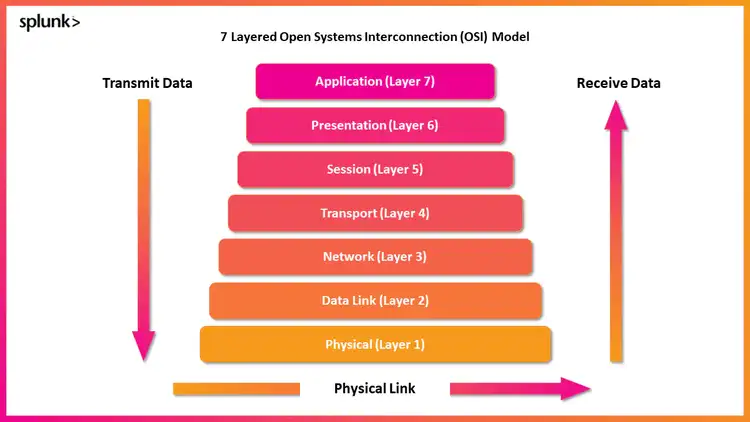
On the other hand, the data plane operates at the Data Link layer of Layer 2 of the OSI model. It is responsible for data transmission between two nodes. In layer 2, the data panel handles core functionalities related to accurate data packet forwarding. The data plane can be implemented using hardware to achieve high performance and minimal latency. It can also be implemented in software, as in software-defined networking (SDN) environments.
Protocols used
The control plane uses different types of protocols supported at layer 3 of the OSI model. The following is a list of protocols commonly used by the control plane.
- Routing Information Protocol (RIP)
- Border Gateway Protocol (BGP)
- Open Shortest Path First (OSPF)
- Enhanced Interior Gateway Routing Protocol (EIGRP)
- Intermediate System to Intermediate System (IS-IS)
- Internet Control Message Protocol (ICMP)
- Multiprotocol Label Switching (MPLS)
In contrast, the data plane uses different types of protocols supported at layer 2 of the OSI model. The following is a list of protocols commonly used by the data plane.
- Internet Protocol (IP)
- Transmission Control Protocol (TCP)
- Ethernet
- User Datagram Protocol (UDP)
- Address Resolution Protocol (ARP)
Centralization and distribution
Both control and data planes can be implemented in a centralized or distributed manner:
- In a centralized architecture, the control plane relies on a central controller for decision-making. This architecture can be typically seen in software-defined networking (SDN).
- In a distributed architecture, the control plane is expanded across multiple devices. It distributes decision-making among various network elements.
Similarly, a centralized data plane is governed by a central device that performs forwarding decisions for all the network traffic. In contrast, a distributed data plane distributes the forwarding functions across multiple devices. Each device handles the forwarding decisions independently based on its routing tables or forwarding information.
Control plane vs. data plane: use cases
Besides larger enterprise networks, control and data planes can be found in SDNs and cloud computing.
Software-defined networking (SDN)
A SDN consists of control, data, and management planes. The control plane performs forwarding decisions and other functions, like quality of service (QoS). In contrast, the data plane is the network that switches or forwards devices handling the data packets and taking inputs from the control plane.
Cloud computing
In cloud computing, the control plane is the layer that handles tasks like creating and distributing routing policies. For instance, in Amazon Web Services (AWS), the control plane supplies administrative APIs for CRUD operations. A few examples of control plane tasks include creating S3 buckets and launching EC2 instances.
The data plane provides the core functionalities of AWS services, such as creating S3 objects, executing EC2 instances, and performing EBS read and write operations.
Control plane vs. data plane: Advantages of separation
Decoupling the control and data planes provides many benefits for building efficient and resilient networks. Following are some key advantages of this separation.
Improves scalability
Separation of the control and data planes allows both planes to operate independently without depending on one another. This independence enables the data plane to scale easily without impacting the control plane. This scalability ensures that a network architecture can seamlessly accommodate growth and increased data demands.
Optimizes performance
Both planes perform distinct functionalities independently. The separation of layers enables each plane to concentrate on optimizing its specific tasks. For instance, the control plane can prioritize efficient routing and decision-making. Meanwhile, the data plane can focus on swift and effective packet forwarding and enhancing network performance.
Improves security
The control plane is much more important than the data plane. Therefore, a security breach in the data plane can expose the control plane if they depend on each other.
Decoupling the planes makes it difficult for attackers to compromise the control plane. Thus, such security breaches on the data plane have less impact on the control plane. Additionally, decoupling makes it easier to introduce optimized security mechanisms separately for each plane.
Makes troubleshooting easier
The control plane is more complex than the data plane. Decoupling allows easy troubleshooting for any issues in the control plane. Additionally, this separation facilitates easy configuration upgrades for both planes without affecting each other. It makes them more adaptable and flexible for changes.
Improves resilience
Separated planes help isolate issues easily, ensuring that faults in one plane have no impact on the other. This feature helps build a more resilient network architecture by eliminating single points of failure.
Eliminates vendor-lock-in
Decoupling allows you to use software from different vendors for each plane. Thus, you do not have to depend on a single vendor. This flexibility lets networking professionals choose the best option, considering important factors like cost, features, and performance.
Ultimately, this separation eliminates vendor lock-in and promotes adaptable network architectures.
Control plane vs. data plane: drawbacks of separation
While decoupling control and data planes provides many benefits, it also introduces some significant challenges and drawbacks.
Increased latency. While the decoupled planes work independently from one another, they still need to communicate with each other to take instructions and perform their tasks. It can lead to increased latency, especially in distributed architectures, introducing delays for packet transmission through the networks.
Increased complexity. Decoupling control and data planes can also introduce additional management configuration and overhead. It requires significant skills and expertise to operate such two separate planes. Finding such expertise can be challenging and costly.
Interoperability challenges. Separating these two planes eliminates vendor lock-in, allowing users to employ different vendor technologies. However, there can be complexities when trying to interoperate different vendor technologies.
Summarizing control vs. data plane
The control and data planes are two integral components of a network that collaborate to ensure efficient data transmission. The control plane focuses on managing and controlling the network, while the data plane focuses on forwarding network packets to the right destination. Each plane differs in its focus and functionalities, operating layer, protocols, and the way centralization and distribution happen. Apart from enterprise networks, these planes primarily focus on cloud computing and SDNs.
Their separation provides several advantages, including improved scalability, performance optimization, enhanced security, and eliminating vendor lock-in.
However, there are also a few drawbacks, like increased latency, complexity, and challenges in interoperability.
FAQs
Related Articles

How GSLB Improves Reliability and Performance Across Multi-Cloud Environments

SOC 1, 2, 3 Compliance: Understanding & Achieving SOC Compliance