What is Continuous Improvement?
IT service providers face a never-ending battle to prove their value to business colleagues as their operating environment evolves at an increasingly rapid pace. This challenges IT leaders, forcing CIOs and CTOs to demonstrate their role as core business functions while securing investments for projects and operations.
Changes in technology, customer needs, market dynamics, and regulatory requirements mean that improvement is no longer viewed as a low priority activity, but a never-ending series of initiatives carried out to generate value across the entire organization.
In this article, we will look at continuous improvement principles, techniques, and how they can be applied to the technology sector.
Continuous improvement defined
Continuous improvement is defined by the Lean Enterprise Institute as a philosophy and set of principles that focuses on making small, incremental changes to continuously improve:
- Processes
- Systems
- Activities
Also known as Kaizen, this is a Japanese business philosophy whose goal is to eliminate waste and increase efficiency, quality, and customer satisfaction. This was first developed by Toyota in the fifties, but has since been adopted beyond manufacturing to service sectors including IT.
Continuous improvement principles
One of the core principles of continuous improvement is rooted in Lean principles, which focus on the philosophy of flow efficiency — how smoothly workflows operate in a system. Good flow allows work to move steadily and predictably, while bad flow creates queues and bottlenecks. Achieving business objectives and satisfying customers through effective service delivery depends on maintaining good flow.
To continuously improve the flow of work, there are five principles within Lean based on the customer’s perspective:
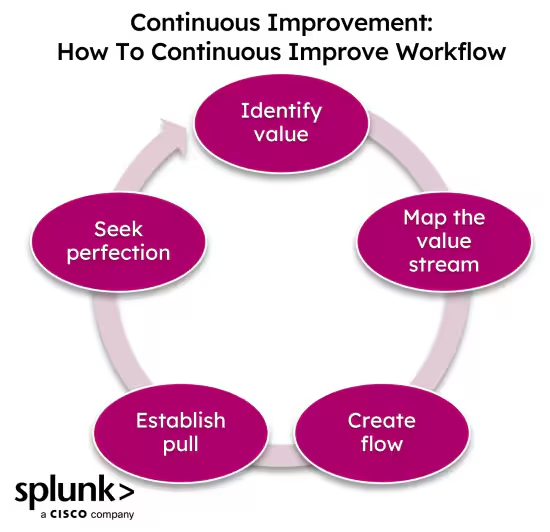
- Identify value: Value is identified from the customer or end consumer. What are the outcomes they are trying to achieve, and the associated benefits? How do our services and related processes generate this value? By asking these questions, the organization can align its continuous improvement activities towards meeting this value proposition.
- Map the value stream: The value stream defines the flow of work units across all the business functions that result in the generation of the identified value. By mapping the value stream, the organization can visualize the steps taken from demand/opportunity through service creation and delivery that result in value.
- Create flow: The flow of work units may be hampered by bottlenecks resulting in waste. To create flow, this waste must be addressed through continuous improvement activities. For example, large work units may be broken down to smaller batches sizes that are optimal for processing.
- Establish pull: Once flow is created, then the value stream is optimized to pull work units rather than push them. Each business function along the value stream has to be allocated the work that they can comfortably handle to prevent backlog build up.
- Seek perfection: The organization measures the flow of work along the value stream and identifies more opportunities for improvement. This informs the continuous improvement aspect as it is a never-ending cycle of enhancing value creation and delivery in every aspect of the organization’s capabilities and environment.
These principles drive stakeholder value by focusing on supporting an efficient and continuous flow of creating and delivering products and services.
Continuous improvement techniques
To apply continuous improvement in a service management system and generate value, some of the techniques that can be harnessed include:
Agile
This software development approach uses continuous cycles to iteratively develop valuable features, adapting to changing customer needs and evolving technology. Agile principles focus on leveraging change to give customers a competitive advantage while maintaining technical excellence and prioritizing good design to enhance agility.
Scrum
This framework for developing and sustaining complex products relies on a continuous cycle. Teams organize work in a backlog, transform selected work into an increment of value, and present the results to stakeholders for inspection. Based on their feedback, teams adjust for the next iteration. Scrum is founded on the principles of empiricism and lean thinking.
Kanban
The Kanban strategy for optimizing the flow of value involves three practices:
- Defining and visualizing the workflow
- Actively managing items within the workflow
- Continuously improving the workflow
Kanban system members take responsibility for continuously improving the workflow to achieve a better balance of effectiveness, efficiency, and predictability.
Six Sigma
This methodology involves improving quality and eliminating defects in every organization-wide process. Six Sigma deploys the DMAIC (Define, Measure, Analyze, Improve, and Control) framework to seek to achieve 3.4 defects per million opportunities through continuous process improvement, reduction of variation, and data-driven decision-making.
Automation for continuous improvement
Continuous improvement requires that organizations closely inspect the flow of work across a value stream to identify bottlenecks and measure the efficiency and effectiveness in delivering value. Technology plays a vital role by providing automated visibility into the entire value stream and taking it further by implementing improvements. It can automatically adjust the service delivery system to address deviations and enhance performance.
Automation is essential in helping achieve operational efficiency and improve customer experiences according to the Camunda 2024 State of Process Orchestration Report. Some of the automation opportunities include continuous monitoring and continuous optimization.
Continuous monitoring
Monitoring and alerting enables a system to tell us when it’s broken, or perhaps to tell us what’s about to break. As per Google SRE, a monitoring system should address two questions: What’s broken, and why.
By continuously monitoring workflow signals — such as latency, traffic, errors, and saturation — and setting practical alerts through observability systems, organizations can ensure the value stream's elements operate effectively. This approach enables quick and accurate identification of deviations, allowing for a quick response.
Continuous optimization
The organization invests in high availability systems and processes that are designed to operate at a high level, continuously, without intervention, for a given time period. These systems automatically deploy capacity optimization, self-healing, or failover to distributed clusters ensuring workflow stability and reliability in all circumstances.
(Related reading: What is availability?)
To wrap up
Continuous improvement is a critical strategy for organizations seeking to adapt and thrive in dynamic environments. By applying proven principles and leveraging techniques, organizations can enhance efficiency, eliminate waste, and consistently deliver greater value to customers.
FAQs
Related Articles

How to Use LLMs for Log File Analysis: Examples, Workflows, and Best Practices

Beyond Deepfakes: Why Digital Provenance is Critical Now

The Best IT/Tech Conferences & Events of 2026

The Best Artificial Intelligence Conferences & Events of 2026

The Best Blockchain & Crypto Conferences in 2026

Log Analytics: How To Turn Log Data into Actionable Insights

The Best Security Conferences & Events 2026

Top Ransomware Attack Types in 2026 and How to Defend