Call Center Analytics & Metrics for Success
Learn Austin ChiaData can speak volumes about your customers’ experiences, especially data that comes from your call centers. But what are we really listening for?
Without the right metrics, it's like navigating a complex maze with no exit in sight. With 9 out of 10 consumers wanting an omnichannel experience, looking into your call center analytics can potentially boost consumer experience.
In this comprehensive guide, we'll explore some key metrics to have for your call center analytics, as well as when and why they should be used. Let's take a look.
(Know the difference: metrics, KPIs, and OKRs.)
Must-have call center metrics
First off, let's begin with some basic metrics that all call centers should be tracking.
In call center operations, certain metrics stand out as fundamental indicators of performance. Here are some of them:
Call volume
Call volume is the number of incoming and outgoing calls handled by agents in a call center. Tracking this metric helps managers determine staffing needs and overall demand for their services. A sudden increase in call volume could indicate a potential issue that needs to be addressed.
You can use this metric to discern peak hours and seasonality in call volume, as this informs staffing decisions and helps maintain customer satisfaction.
Here are some ways where call volume is useful:
- Determining staffing levels and scheduling.
- Identifying trends in customer behavior and preferences.
- Evaluating the overall performance of the call center.
Such metrics can be visualized using bar charts or line graphs. These will help management to identify trends in call volume better and make informed decisions.
Average handling time
Average Handling Time (AHT) is the average length of time an agent spends on a call. This metric includes both:
- The time spent talking to the customer
- Any follow-up tasks such (as data entry or documentation)
AHT can help managers assess the efficiency of their agents and identify areas for improvement.
This metric might hide a lot of details, so you'll have to drill down using these steps to have better tracking:
- Identify the components: Break down AHT into its elemental parts—talk time, hold time, and after-call work.
- Evaluate benchmarks: Compare current AHT metrics to industry standards or historical performance data.
- Monitor for trends: Look for patterns over time to pinpoint efficiency gains or areas for improvement.
- Examine outliers: Investigate calls that significantly deviate from the average to understand the cause of variations.
- Implement training: Provide targeted coaching to agents struggling with extended handling times.
Average Handling Time (AHT) can be a crucial efficiency metric for gauging the effectiveness of call center transactions. Indeed, reducing the AHT can lead to increased call capacity and overall customer satisfaction.
A word of caution: though a low AHT may indicate speedy service, it could also mean that agents are rushing through calls and not providing quality service. So, try to strike a balance between efficiency and customer satisfaction to have an optimal AHT.
First contact resolution
First Contact Resolution (FCR) is the percentage of calls or inquiries that are resolved in a single contact with the customer. It's a pivotal metric because it indicates both customer satisfaction and operational efficiency. It also reduces costs for the call center by avoiding unnecessary follow-up calls and transfers.
High FCR rates correlate to efficient and effective problem-solving by agents, leading to higher customer satisfaction. To calculate FCR, track the issues resolved without follow-up. Agents should record this into the caller system during the call or through post-call surveys.
Continuous monitoring of FCR rates serves as an essential feedback loop for training and process improvements, enabling more issues to be resolved upon first contact. Through the right training of agent staff and technology, it's possible to improve FCR rates and enhance overall customer experience.
Performance drivers for boosting operations
Next, to improve the overall performance of your call center, here are some key metrics to monitor.
Agent occupancy rates
Agent occupancy rate measures the percentage of time agents are actively engaged with customers or performing work-related tasks.
Agent occupancy rates are critical metrics in call center operations, serving as indicators of workforce efficiency. This rate measures the percentage of time agents spend on live calls and their time dedicated to completing work associated with the calls.
- High occupancy rates indicate that agents are busy and productive, but if not managed effectively, they can also lead to burnout and decreased performance.
- Conversely, low occupancy rates can signal a lack of demand or inefficiency in operations, underutilization, wasteful labor spending, or a need for better workload distribution.
Balancing high agent occupancy rates without overburdening staff is crucial for maintaining optimal productivity levels. To ensure a good balance, consider these actions:
- Implementing workload distribution software.
- Conducting regular training and coaching sessions.
- Offering incentives for high performance.
Service level & response time
The service level and response time are telltale indicators of customer experience and operational efficiency in a call center setting.
- Service level measures the percentage of calls answered within a specific timeframe.
- Response time, on the other hand, is the average amount of time it takes for an agent to answer a call.
High service levels and fast response times are essential for maintaining customer satisfaction and reducing wait times. These metrics can also help identify areas where operational improvements are needed.
To improve service levels and response times, try these best practices:
- Implementing call routing technology and providing additional training to agents.
- Regularly reviewing and adjusting service level goals can also help maintain high standards of performance.
(Service levels apply in other areas of your business, too: SLAs, SLIs, and SLOs.)
Agent utilization rate
Agent utilization rate measures the percentage of time an agent spends on active work tasks during their shift. It's a key measure of individual productivity and performance, helping managers identify opportunities for improvement in workload management and scheduling.
- High utilization rates may point to an overworked staff or understaffed team.
- Low utilization rates can signal inefficiencies or underperformance.
Enhancing customer experience
Now, if your goal is hyper-focused on enhancing the customer experience, these are the metrics to track and improve.
Net promoter score (NPS)
The Net Promoter Score (NPS) is a measure of customer loyalty and satisfaction. It asks customers how likely they are to recommend a company, product, or service on a scale from 0-10. NPS is an essential metric because it not only measures customer satisfaction but also predicts future growth and profitability.
NPS scores are incredibly popular — you have probably been asked to fill one out. You know it because of it’s 0-10 scoring:
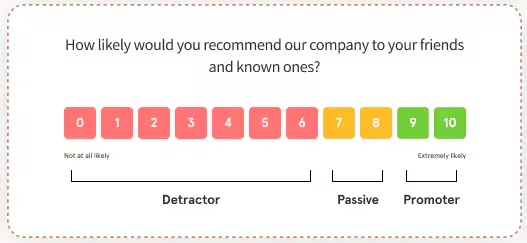
To calculate NPS, subtract the percentage of detractors (customers who gave a score of 6 or below) from the percentage of promoters (customers who gave a score of 9 or 10). Here's the formula:
NPS = % promoters - % detractors
A numerical score between -100 and 100 is generated, indicating the degree of customer loyalty towards the company:
- The higher the NPS, the stronger the customer loyalty and potential for organic growth through positive word-of-mouth.
- A low NPS may indicate areas for improvement in customer service.
NPS is also integral to strategic decision-making. As a performance indicator, NPS is valued for its sensitivity to changes in customer perception.
Average time in queue
Average Time in Queue measures how long customers wait to speak with an agent, typically ranging from seconds to minutes.
Long waiting times can lead to customer dissatisfaction and frustration. Streamlining processes, increasing staffing, or shifting resources can reduce these waiting times, enhancing overall customer experience.
Customer effort score (CES)
The Customer Effort Score (CES) measures the ease of customer interaction and resolution efficiency. It's often overlooked but is crucial in plotting customer journey improvements. Here's how you can calculate it:
(Total sum of responses) ÷ (Number of responses) = Customer effort score
Once you’ve calculated the score, we can say this:
- A low CES indicates smooth, effortless experiences. Effortlessness is a good sign of customer satisfaction and loyalty.
- A high CES may suggest friction and complexity. It denotes areas where action is needed to streamline processes or enhance support training.
Here are some examples where CES can be used:
- Post-service surveys to measure customer effort.
- During a network outage, the CES can help identify roadblocks, such as channel availability or self-help options that could have minimized customer frustration and churn.
- A CES survey after an agent interaction provides instant feedback on the quality of service provided. It's integral in gauging problem resolution efficacy and identifying opportunities for improvement.
Final thoughts
Monitoring these key metrics can provide valuable insights into your call center's performance and help identify areas for improvement.
These metrics should be reviewed regularly through data visualization dashboards to drive continuous improvement. This list of metrics is by no means exhaustive, and other metrics may be more relevant to your specific call center operations.
Try to adapt and adjust these metrics according to your call center needs and as your call center evolves.
Related Articles

SAST vs. DAST vs. RASP: Comparing Application Security Testing Methods

IT Strategic Planning: A How-To Guide