The AI Engineer Role in 2026: What Do AI Engineers Do?
Learn Austin ChiaSince the start of 2023, AI has made many advancements and leaps. This also means that the humans who manage the AI have also evolved. One of the most in-demand roles in today's AI landscape is the AI engineer.
To help you understand what being an AI engineer entails, this guide will provide and overview of the role, its responsibilities and skills required.
What is an AI Engineer?
AI engineers are responsible for developing, implementing, and maintaining artificial intelligence systems. They work closely with data scientists and software engineers to design, build, and deploy AI-powered solutions that can perform human-like tasks.
Their main focus is on creating algorithms and models that enable machines to:
- Learn from data.
- Make predictions and decisions.
- Ultimately improve their performance, and that over other AI systems, over time.
AI engineers typically have a background in computer science, mathematics or engineering, with a strong understanding of machine learning algorithms and programming languages such as Python, Java and C++.
Core responsibilities
AI Engineers are instrumental in developing the algorithms that empower AI systems. They are tasked with crafting code that is robust, efficient, and easily maintainable.
They architect scalable, secure AI infrastructures that can handle large-scale data processing.
Balancing technical prowess with ethical considerations, AI Engineers ensure systems are designed with fairness, privacy, and security in mind, often serving as stewards of responsible AI deployment.
This includes:
- Developing and training machine learning models.
- Optimizing AI algorithms for performance and efficiency.
- Designing and implementing data pipelines.
- Integrating AI systems with other software applications.
- Ensuring ethical considerations are taken into account in development and deployment processes.
AI Engineers must also be versed in continuous iteration and integration practices, as the field of AI is one of rapid evolution and innovation.
Skills to have
To excel in the dynamic field of AI engineering, one must possess a multifaceted skillset.
- Programming proficiency: Command of languages such as Python, Java, and Scala.
- Machine learning techniques: Familiarity with supervised, unsupervised, reinforcement learning.
- Deep learning concepts: Understanding architectures like CNNs, RNNs, and Transformers.
- Data management: Proficiency in data preprocessing, cleaning, and visualization.
- Software development: Knowledge of full-stack development, APIs, and version control systems.
- Mathematical acumen: Strong grasp of statistics, probability, linear algebra, and calculus.
- System design: Ability to design and implement scalable and robust AI systems.
- Cloud computing: Experience with platforms like AWS, Azure, and GCP.
- Collaboration tools: Proficiency with tools that facilitate teamwork, such as Git and JIRA.
Strong analytical thinking and problem-solving capabilities are core to navigating complex AI problems.
Common tools used by AI Engineers
AI Engineers frequently leverage a suite of software and frameworks tailored to the complexities of artificial intelligence and machine learning tasks. Here are some tools commonly used:
LangChain
LangChain is a framework developed for creating language models. Here's what it does:
- Facilitates complex reasoning tasks by breaking them into manageable parts
- Enables the chaining of different AI models to complete a task
- Supports integration with external knowledge sources
- Promotes adaptability and flexibility in AI-driven solutions
- Empowers developers to create more sophisticated AI applications
At its core, LangChain enhances how AI understands and processes language. It represents a significant step forward in developing conversational AI and tools that mimic human-like thinking patterns.
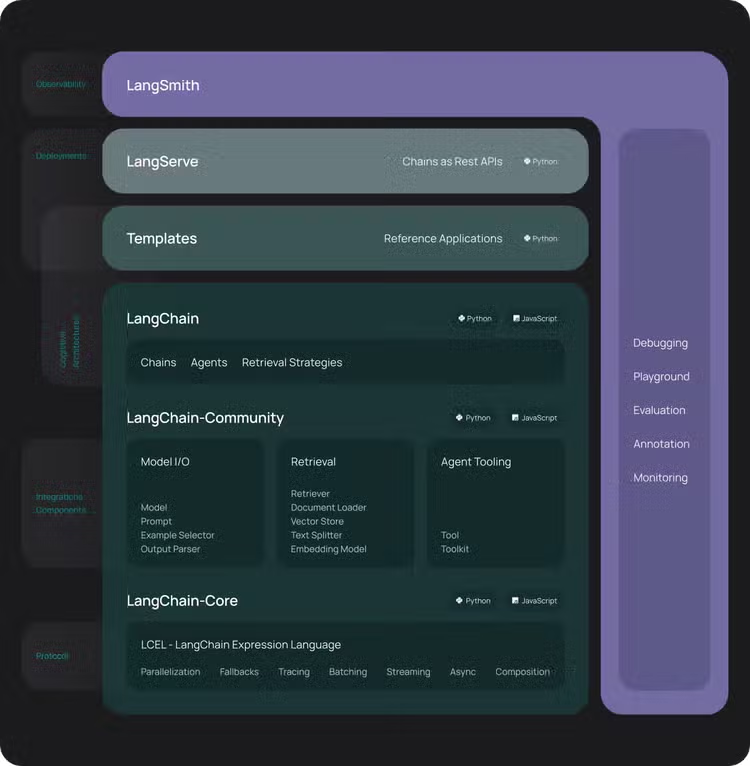
It contains libraries and templates that allow developers to efficiently create language models with less coding from scratch.
PyTorch
PyTorch is an open-source machine learning library widely acclaimed for its flexibility and ease of use. Here are some of its features:
- Intuitive and straightforward syntax that accelerates development time
- Dynamic computational graph that allows for flexible model architectures
- Robust ecosystem with tools for model serving, mobile deployment, and more
- Active community that contributes comprehensive documentation and resources
- GPU acceleration for efficient training of complex neural networks
Developers favor PyTorch for prototyping and research due to its dynamic graph paradigm. Moreover, PyTorch is seamlessly integrated with Python, which allows leveraging the rich Python ecosystem for data science tasks.
Hugging Face
Hugging Face is also a common tool used in democratizing AI through its accessible tools and libraries.
It has made cutting-edge natural language processing (NLP) models available to a wide audience, greatly simplifying the process of integrating AI into applications.
Docker
Dockers has made it easier for AI engineers to deploy their models and algorithms in production. Docker containers provide an isolated, portable environment that packages all the dependencies and configurations needed to run AI applications consistently across different systems.
Now, AI models can be encapsulated within containers, making them portable and easy to deploy across various environments. This allows for seamless deployment of AI solutions on a variety of platforms, from local machines to cloud servers.
Moreover, Docker ensures consistency, eliminating the "it works on my machine" problem that plagues so many development projects. It also enhances collaboration across teams, promotes rapid prototyping, and provides a robust framework for deploying and scaling AI applications in the real world.
OpenCV
OpenCV is a popular library used for computer vision applications. It offers pre-trained models, algorithms, and modules to help developers develop robust object detection, recognition, and tracking systems.
Since AI often involves processing large amounts of visual data, OpenCV is a valuable tool in an AI Engineer's toolkit.
AI engineers use OpenCV for a wide range of tasks, from image preprocessing to training and implementing deep learning models.
Furthermore, it has bindings for various programming languages like Python, Java, C++, and more, making it widely accessible to developers with different language preferences.
Apache Spark
Apache Spark is a powerful, distributed computing framework used in big data and AI applications. It has gained widespread adoption for its ability to handle massive datasets with ease.
Here's what distinguishes Apache Spark from other big data frameworks:
- Resilient Distributed Datasets (RDDs) that enable parallel processing of large datasets
- Extensive support for different programming languages such as Python, Java, and R
- Native integration with Hadoop to leverage distributed storage for significant performance gains
- Libraries like SparkSQL enable developers to perform complex SQL queries on distributed data.
Furthermore, Spark has a rich ecosystem of tools that facilitate building scalable AI solutions. This includes MLlib, a machine learning library within Spark, and GraphX, a graph processing library for building graph-based data applications.
The future: AI Engineers
The career growth trajectory for AI engineers is enormously promising, making it one of the most sought-after and future-proof careers today. With AI's increasing omnipresence across various sectors, from healthcare to finance, the demand for skilled AI professionals is expected to increase, too.
As industries adopt AI, they seek talent capable of delivering sophisticated solutions that integrate seamlessly within their operations. This trend presents AI engineers with plentiful opportunities for work.
AI development engines and frameworks are also constantly advancing. As AI technologies evolve, so must AI engineers. AI started becoming popular with text-generation chatbots and has quickly moved on to AI image generation and even AI video generation.
The tools that AI engineers use will also be continuously evolving, and staying updated with the latest advancements will be key for AI engineers to stay at the forefront of their field.
How to become an AI Engineer
The path to becoming an AI engineer is a combination of formal education, practical experience, and continuous learning.
Firstly, some of the essential skills for AI engineers include programming languages like Python and Java, knowledge of machine learning algorithms and deep learning frameworks, proficiency with big data tools like Hadoop and Spark, and expertise in mathematics and statistics.
Secondly, aspiring AI engineers can pursue degrees in computer science, mathematics, or statistics. However, with the increasing popularity of AI and its versatile applications, many universities now offer specialized programs in artificial intelligence and machine learning.
Next, to gain practical experience, aspiring AI engineers can participate in hackathons, coding competitions, and open-source projects. These opportunities not only provide hands-on experience but also allow for networking and collaboration with fellow developers.
Lastly, AI engineers must also adopt continuous learning to stay relevant in this fast-paced field. This can include taking online courses, attending workshops and conferences, reading industry research papers, and experimenting with new tools and technologies.
Final thoughts
AI engineers play a crucial role in driving the development and adoption of artificial intelligence. An AI engineer's responsibilities include designing and implementing AI solutions, optimizing algorithms for efficiency, and deploying these solutions across various environments.
The continuous advancement of AI technologies and the increasing demand for skilled AI professionals make this an exciting field to pursue.
Their skills, knowledge, and expertise are instrumental in creating smart solutions that improve efficiency and enhance user experiences.
Video: Learn more about The AI Engineer Role Today
Related Articles

The Best Artificial Intelligence Conferences & Events of 2026

What is the Pareto Principle? The 80/20 Rule, Explained