What Is Adaptive AI? Definition & Use Cases
Learn Kayly LangeKey Takeaways
- Adaptive AI continuously learns and evolves from new data and experiences, enabling organizations to dynamically adjust to changing environments, emerging threats, and business disruptions.
- Unlike traditional, static AI models, adaptive AI closes the loop between data ingestion, model monitoring, and automated retraining, ensuring ongoing accuracy and relevance as conditions evolve.
- Implementing adaptive AI enhances operational resilience, decision-making, and efficiency, while enabling proactive anomaly detection, predictive analytics, and real-time decision support across IT, security, and business domains.
A significant part of artificial intelligence's future is adaptive AI. The uniqueness of adaptive AI lies in the fact that it can adjust code, for example, anticipating real-world changes or information. That adaptability is possible even when devs or coders didn't know or assume the changes.
As AI becomes essential to running a business, it is no longer a differentiating factor. In fact, researchers have found that by 2025, around 97% of companies will be actively using or planning to expand their AI initiatives. To get ahead of the competition, leaders need to:
- Advance their AI capabilities.
- Get more from their investments.
Adaptive artificial intelligence is the next generation of AI systems. It can adjust its code for real-world changes, even when the coders didn’t know or anticipate these changes when they wrote the code.
Innovations in machine learning and deep learning have advanced AI technology by leaps and bounds. AI algorithms can ingest and interpret data more accurately and effectively than ever. As a result, adaptive AI generates staggering insights and better predictions to help organizations make better decisions, become more resilient, and work more efficiently.
As businesses shift away from the fixed, historical data of traditional AI and embrace adaptive frameworks, technology will evolve even more to fit into an increasingly digital world. That is why Gartner proclaimed adaptive AI among the top strategic technology trends of 2024. Indeed, Gartner experts predict that organizations embracing adaptive AI will outperform competitors by 25% by 2026.
In a rapidly evolving digital world, adaptive AI is a critical tool to meet the needs of today’s customers and continue to create crucial innovations. But what is it, and how is adaptive AI transforming the future? Let’s dive into the basics of adaptive AI and why it’s crucial for businesses today.
What is adaptive AI?
Adaptive AI is a form of artificial intelligence that learns, adapts, and improves as it encounters changes, both in data and the environment.
While more traditional forms of AI follow set rules and algorithms and tend to fall apart when faced with obstacles, adaptive AI systems can modify their behavior based on their experiences. It adjusts its own code without input from a person, providing a level of adaptability and business resilience not seen before. This enables AI to deliver better outcomes faster. On that note, let's discuss some key characteristics of adaptive AI.
Characteristics of adaptive AI
Some key characteristics that distinguish adaptive AI systems are:
- Ability to learn. Machine learning algorithms allow the technology to process and analyze new information. As a result, adaptive AI can acquire knowledge, identify patterns, and make predictions.
- Adaptability. Adaptive AI systems adjust their algorithms and decision-making processes when they encounter changes in input data or the context in which they operate. This flexibility makes them practical and relevant even in dynamic and unpredictable situations.
- Self-improvement. Systems improve their capabilities over time by analyzing their own performance, identifying weak or inefficient areas, and refining their algorithms in response.
- Problem-solving capabilities. Adaptive AI systems develop sophisticated and nuanced approaches to problems by learning from experience and adapting to new information. These enhanced problem-solving capabilities often surpass traditional AI systems, leading to more innovative solutions to even the most challenging issues.
Traditional vs. adaptive AI
While traditional AI lets companies work faster and become more productive, the technology is limited in its real-world application.
The development of adaptive AI lets organizations become more flexible, resilient, and effective when faced with complex challenges in daily business.
How does adaptive AI work?
Adaptive artificial intelligence has critical components that help it learn, adapt, and improve over time. These are the most critical components…
Machine learning algorithms
These algorithms allow AI systems to learn from data and make predictions or decisions based on their learning. Machine learning is categorized into three main types:
- Supervised learning. This is where the system receives labeled data and learns to map input data to known outputs.
- Unsupervised learning. The system learns patterns and structures in unlabeled, often identifying hidden relationships or clustering similar data points.
- Reinforcement learning. Through trial and error, the system adjusts its actions based on feedback in the form of rewards or penalties.
Neural networks and deep learning
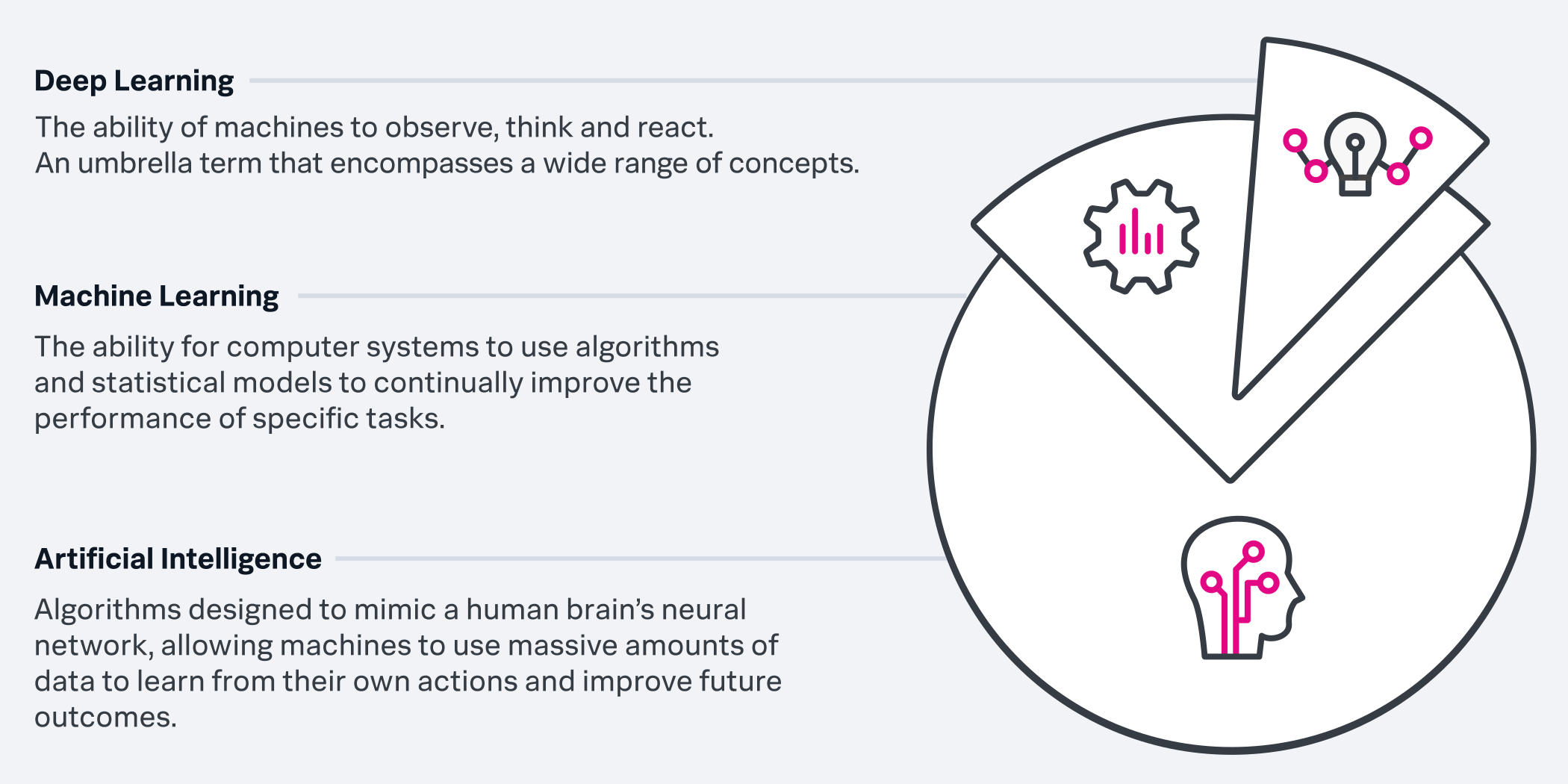
The structure of the human brain inspired the creation of neural networks, which have interconnected layers of nodes or neurons. Deep learning involves using large neural networks with multiple layers to learn complex patterns and representations in data.
AI systems learn hierarchical features with these techniques and perform tasks such as image and speech recognition, natural language processing, and more.
(Follow our recurrent neural network tutorial.)
Transfer learning and meta-learning
AI systems leverage the knowledge it learns from one task or domain and apply it to another related one with transfer learning. This significantly reduces the required training to speed up the learning process.
Meta-learning, sometimes called learning to learn, trains AI systems to optimize their learning algorithms, improving their ability to learn new tasks or adapt to changing environments.
(Related reading: continual learning in AI.)
Evolutionary algorithms
These algorithms use natural selection and involve optimization through successive generations of candidate solutions. Adaptive AI uses evolutionary algorithms to:
- Optimize AI models.
- Select features.
- Tune hyperparameters.
All this enhances the system’s adaptability and performance.
Working together, these components enable adaptive AI systems to learn from experience, adjust based on new information, and continually improve performance over time.
Adaptive AI use cases
The implications of adaptive artificial intelligence and its capabilities on the world are vast and revolutionary. It can potentially transform nearly every aspect of business, bringing innovation and resilience.
The healthcare industry
Adaptive AI is proven to be lifesaving and has improved how the healthcare industry functions.
- AI systems accuratelyanalyze X-rays and MRIs, thereby helping to detect conditions like fractures and tumors in the early stage. Research has proven the capability of certain AI tools to identify abnormal x-rays with more than 99% sensitivity.
- There are AI models that personalize treatment plans and predict patient outcomes.
- AI also accelerates the discovery of drugs by predicting the interaction between different components, thus speeding up the development of new medicines.
Finance
As finance becomes more digital, adaptive artificial intelligence has the potential to transform how the financial industry runs. For example, Equifax uses it to assess customer risk with deep learning of customer behavior. By studying each customer’s financial decisions over the past 24 months, it approved 92,000 more loans — without any more losses.
In addition to risk management, adaptive AI offers more effective fraud detection by learning customer patterns and identifying anomalies. It can alert institutions faster than ever without inconveniencing customers.
(Consider what emerging AIs mean for cybersecurity.)
Manufacturing
Organizations can optimize their supply chain using adaptive AI. Algorithms analyze market trends and sales data to predict demand and give manufacturers and leaders deeper insights into production, inventory, and distribution. With optimized inventory, companies can avoid shortages and overstocking their warehouses. For example, UPS's AI tool ORION is helping to reduce fuel costs by calculating the most efficient route.
Adaptive AI also predicts when equipment will fail, minimizing failures and enabling proactive maintenance. It also predicts other potential risks by analyzing:
- Delivery times
- Supplier performance
- Economic indicators
This way, leaders can proactively tackle threats and minimize disruption to the supply chain.
(Related reading: Splunk AI.)
Environmental sustainability
By analyzing complex climate data, adaptive AI can create more accurate models to predict climate change impacts. With these advanced models, policymakers make informed decisions about mitigation and adaptation strategies, such as:
- Setting emissions reduction targets. Google's DeepMind project has successfully reduced fuel consumption by analyzing traffic data and reducing commuting times.
- Planning for sea-level rise. Royal HaskoningDHV. a Dutch company is utilizing AI to optimize and design infrastructure projects that can deal with the impact of rising sea levels.
Adaptive AI also can optimize farming practices to reduce waste. Cameras, drones and sensors use AI to scan fields and detect areas over- or under-irrigated, pests, crop diseases, and vital soil health to eliminate the need for helicopters and enhance food security. These tools help farms improve resource management while reducing the environmental impact of waste.
(Related reading: sustainable technology.)
Ethical considerations & challenges
While adaptive AI has incredible potential, it's vital to recognize and account for its challenges. Some common challenges are:
Data dependency
Access to more data does not guarantee improved performance. Indeed, feeding incorrect information can negatively impact organizations and users, especially around decision-making. This negative impact can be severe.
Bias
Bias is one of the most significant problems of adaptive artificial intelligence.
- Gender bias:Amazon had to abandon its recruitment engine that was supposed to select the best applicants with AI since it was heavily biased against women. The technology was trained with resumes submitted over the ten years prior. However, since tech has long been male-dominated, the tool accidentally picked up and continued this bias. It penalized resumes that mentioned anything to do with women, such as “woman’s chess club,” and downgraded any applicants from two all-women universities.
- Racial bias: AI has mistagged photos based on racist tropes and failed to recognize Black and Brown faces because the images the algorithms were trained with were mostly white.
Need for controls
Understanding and rectifying potential biases is critical to avoid harm and more fully utilize adaptive AI. That's why some controls are needed. To this end, ISO 42001 was released in December 2023, the world's first body of standards to apply to AI management systems (AIMS).
To learn more about this topic, explore our free guide on developing a organizational-wide AI philosophy and approach.
(Related reading: ethics of AI & using inclusive language in the technology sector.)
Embracing the potential of adaptive AI
Adaptive artificial intelligence innovates a more resilient, effective, and faster framework by adapting to real-world circumstances. It continues to adapt and problem-solve, improving its capabilities over time, making it ideal across numerous industries, including healthcare, finance, manufacturing, and environmental sustainability. These applications demonstrate the transformative potential of adaptive AI in:
- Addressing complex, real-world challenges.
- Promoting more sustainable practices.
As the development of adaptive AI continues, it is essential to address some of the critical ethical challenges it raises, such as bias, for responsible AI development and usage. By embracing the potential of adaptive AI and addressing its challenges, we can harness its power to drive innovation, enhance efficiency, and create a more sustainable and prosperous future for all.
Video: Learn more about Adaptive AI
Related Articles

Data Lifecycle Management: A Complete Guide

Log Management: Introduction & Best Practices