What is ABAC? Attribute Based Access Controls, Explained
Learn Muhammad RazaKey Takeaways
- ABAC enables dynamic, fine-grained access control by evaluating user, resource, and environmental attributes, providing greater flexibility than traditional models like RBAC.
- Organizations can improve security and compliance by quickly adapting ABAC policies to evolving business needs and regulatory requirements.
- While ABAC offers significant benefits, it also introduces complexity in policy management and requires accurate, up-to-date attribute data for effective implementation.
Securing sensitive data and critical systems is more challenging than ever. Traditional access control methods, while foundational, often struggle to keep up with the dynamic and diverse requirements of modern organizations.
This is where attribute-based access control (ABAC) come into play. ABAC provides a flexible and scalable approach to managing access, ensuring that only authorized users can reach specific resources under the right conditions.
In this article, we'll explore how ABAC works, how it differs from other access control models, and why it's becoming increasingly essential for organizations of all sizes.
What are attribute based access controls?
ABAC is one type of access control. In ABAC, authorization for a given user to access resources is determined by evaluating a range of attributes associated with:
- The requesting user (subject).
- The target resource (object).
- The sequence of computing operations.
- Environment condition variables.
Instead of relying on static user profiles and role assignments, a combination of dynamic attribute parameters is evaluated to grant or restrict user or machine access in real-time. In practice, this approach enables both fine-grained security access controls and dynamic decision-making capabilities.
For example, ABAC allows organizations to define access policies that automatically adapt to contextual changes, such as a user’s location, device security posture, or time of access, reducing the risk of unauthorized data exposure.
ABAC is suitable for use cases where security policies evolve continuously, across a large and complicated hierarchical structure in the organization that shares overlapping access privileges.
Other access control approaches vs. ABAC
A simple access control system may support logical access based on the user identity. Every user may carry a unique set of privileges based on the security policies.
This primitive approach guarantees security, however, it is not enforceable in any large organization, given the scale of the user base and complex security policies.
Role-based access control (RBAC)
In order to make security policies easier to manage among large users, groups on the same hierarchical levels and job functions may be assigned access privileges based on their roles and profiles — this is called role-based access controls (RBAC).
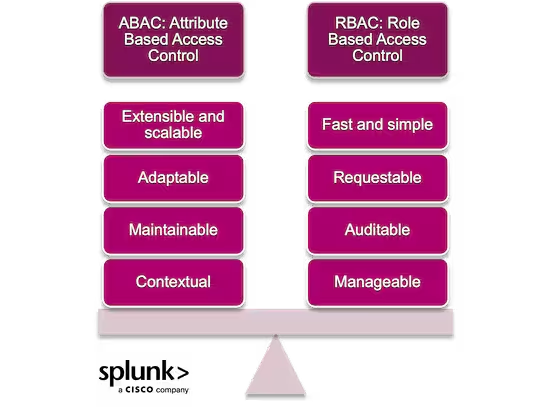
The challenge with this simplification emerges when users from the same group are not subject to the same security policies but are granted excessive access privileges by virtue of their role assignment.
The least privilege access assigned to one user may already provide unnecessary access rights to other users within the same group. This happens when users within the same group are assigned different projects that fall under different levels of security clearance.
RBAC is therefore limited in two ways:
- Users within the same group must also be subject to the same security policies.
- Customizing access controls for some individuals within a group violates the least privilege access principle for other users.
Because of these drawbacks, organizations seeking to implement more adaptive and context-aware access policies are increasingly looking towards ABAC. With ABAC, individual access can be tailored to precise business needs without disrupting the overall security framework.
(Related reading: RBAC vs. ABAC.)
How does ABAC work?
So, how does the attribute-based access control (ABAC) allow organizations to enforce the principle of least privilege across a large-scale organization with complicated and overlapping permissions structure?
ABAC provides least privilege access rights based on the attributes possessed by the user within a known environment state. Since the individual user or group can have varying security attributes, large organizations can customize how individuals and teams operate across different job functions while maintaining the organizational hierarchical structure and security policies.
This means, for instance, that two users in the same department might have different access levels based on their project involvement, employment status, or even the device from which they are accessing company resources. This flexibility dramatically enhances both security and operational efficiency.
Similarly, the ABAC approach can account for dynamic parameters that evolve continuously, such as:
- The nature of service request.
- The sequence of computing operations leading to the service request.
- The future state of the IT security.
ABAC also allows organizations to establish a well-defined policy for Separation of Duties: enforcing multiple permission levels and a different set of security policies to different parts of the process workflow. This limits the scope of permission approvals in a complicated process pipeline.
For example, one user may require escalated permissions that do not pose security risk to the organization at that stage of the workflow. Once completed, the next stage of the process workflow exposes sensitive business information and resources, but the job function itself may not require higher access privileges. ABAC can enforce a custom set of rules to enforce separation of duties and protect sensitive business information as the environment conditions change.
ABAC components and use cases
Consider the following definitions and a simple example where a user attempts to download a business-sensitive financial report:
-
Attributes are the characteristics of the subject, object or the environment parameters. For example: department = "Finance", job_title = "Manager", employment_status = "Full-Time".
-
A subject is the user, device or a system that may request an IT service. For example: type = "financial_report", classification = "confidential", fiscal_year = "2024"
-
An object is the computing resource. The security policy enforcement on the object is managed by an access control system. For example: current_time between 08:00-18:00, network_security_level = "internal_corporate"
-
An operation is the execution of the computing function performed by the subject on the object. For example: download (download the financial report)
-
Environmental conditions refer to the operational context of the system. It is measured by a variety of parameters such as time, location, security levels and risk score.
-
Policy is a set of security rules and relationships enforced by the organization. The policy determines how requests are granted or denied. This decision is enforced by evaluating the attributes assigned to the subject given the present environment state. For example:
Allow download of a financial_report if:- subject.department == "Finance"
- subject.employment_status == "Full-Time"
- object.classification == "confidential"
- current_time is within business hours (8AM–6PM)
- network_security_level == "internal_corporate" (must be inside the company's secure network)
With ABAC, organizations can quickly adapt their policies when new regulations are introduced, or when business processes change, without having to overhaul their entire access management infrastructure. This adaptability is key to maintaining compliance and competitiveness in fast-paced industries.
In this example, we can see how considerations for the attributes reduce the security risk and narrow down the access privileges not only around the user profile but also the circumstances during which an access request is made.
This flexibility allows ABAC to overcome situations when a network infringement may allow malicious actors to escalate access privileges for a low security-level account from a different department.
Benefits of ABAC
ABAC offers several significant benefits:
- Fine-grained control: Access decisions can be based on an unlimited combination of user, resource, and environmental attributes.
- Dynamic policy enforcement: Policies can change in real-time as attributes change, supporting agile business operations.
- Improved compliance: Organizations can respond quickly to regulatory changes by updating attribute-based policies.
- Separation of duties: Supports complex workflows with precise control over each stage.
Challenges of ABAC
However, ABAC also introduces some challenges:
- Complexity: Policy definition and management can become complex, especially as the number of attributes grows.
- Performance considerations: Real-time evaluation of multiple attributes can impact system performance if not properly optimized.
- Attribute management: Ensuring the accuracy and timeliness of attribute data is critical to the effectiveness of ABAC.
Final thoughts
Attribute based access control stands out as a powerful solution for modern organizations seeking flexibility, scalability, and robust security. By leveraging a rich set of attributes about users, resources, and the environment, ABAC enables highly customized and context-aware access decisions.
While the model does introduce additional complexity in policy management and attribute handling, the security and compliance benefits often outweigh these challenges. As organizations continue to evolve and adapt to new threats and business requirements, ABAC will play an increasingly central role in safeguarding sensitive information and supporting dynamic business operations.
Related Articles

What Are SLMs? Small Language Models, Explained

What Is Financial Crime Risk Management (FCRM)?