Entity Posture: Find Security Control Gaps, Before They Become Incidents
Security Milena Chen , Paul JohnsonEnterprise Security (ES) 8.8 introduces new proactive security features to the Exposure Analytics capability. These features build upon Entity Discovery, previously released with ES 8.5, to help you shift from reactive response to proactive assurance.
These three new features are as follows:
- Entity posture - Continuously measure security control coverage, gaps, and progress
- Entity profile - Use context to identify the highest priority gaps and to elevate finding risk
- Entity actions - Trigger actions to operationalize follow-up and remediation
Over the next three weeks, we will explore each of these new features in detail and demonstrate the value each feature brings to the security teams.
Continuous Security Posture Assessment
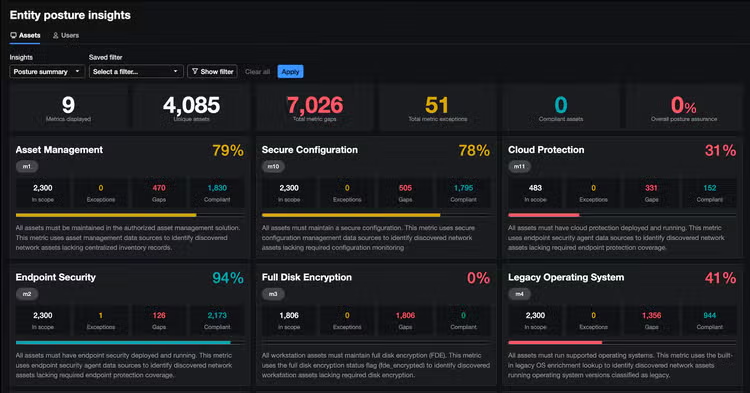
Entity Posture in Exposure Analytics uses metrics to proactively identify security control gaps across assets and users on a continuous basis. These metrics help organizations monitor and strengthen their overall security posture. For example, metrics can reveal gaps in asset management or vulnerability scanning, as well as show whether users have completed required security tasks, such as awareness training.
Each entity posture metric assesses a defined group of assets or users using data from selected sources or specified logic. It identifies the entities in scope, those that do not meet the metric requirements and are therefore considered gaps, and those that meet the requirements and are compliant.
Examples of entity posture metrics might include:
- Asset management: Identify the assets that are not managed.
- Vulnerability scanning: Identify the assets that have not been vulnerability scanned.
- Security awareness: Identify the users that have not completed security awareness training.
Exposure Analytics includes predefined entity posture metrics that can be quickly added and cover common security controls.
In addition, Entity posture provides comprehensive reporting and analytics, including executive summary posture insights across all metrics, full drill-down and trending for individual metrics and a posture metric matrix report, showing individual entity compliance across multiple metrics.
Posture metrics and an overall posture assurance percentage, along with a dedicated exposures tab, have been added to the Entity analysis view to provide visibility and context into exposures and security control gaps during investigations.
See It in Action:
A Proactive Foundation for the Agentic SOC
The Agentic SOC depends on trustworthy information about the environment. Without it, neither analysts nor AI-assisted workflows can keep pace with modern threats.
Exposure Analytics provides that foundation. Entity Discovery continuously finds every asset and user, and Entity Posture identifies their security gaps. When a finding is tied to an asset, teams immediately see which gaps exist on it and on related entities, so they know what to investigate first and AI-assisted workflows have the context to act with confidence.
Entity Posture is part of a broader set of proactive capabilities in Exposure Analytics in Splunk Enterprise Security 8.8. Once teams understand their posture, Entity Profile adds contextual risk to guide targeted remediation and prioritization. The next blog in this series covers Entity Profile.
Related Articles

Staff Picks for Splunk Security Reading February 2022

Sharing is Not Caring: Hunting for Network Share Discovery