Entity Actions: Connect Exposure Insights to Remediation
Security Milena Chen , Paul JohnsonEntity actions let you automate actions based on the output of Exposure analytics discovery filters, posture metrics, and profile rules. They help proactively address security issues and contextual risks, remediate security gaps, and reduce the entity attack surface.
Examples of entity actions include:
- Pushing unmanaged assets to ServiceNow for onboarding and management.
- Creating tickets to address vulnerability scanning gaps on critical servers.
- Sending workstations without endpoint security to SOAR for automated remediation.
Entity actions are triggered by conditions. Each condition returns a set of entities that can be acted on. For example, a posture metric condition returns entities with a gap in that metric, while a profile rule condition returns entities that triggered the rule.
Each entity action has one condition and can include multiple actions. Available actions are based on Splunk alert actions. Splunk includes several alert actions by default, and additional actions are available on Splunkbase.
Push Unmanaged Assets to ServiceNow
Exposure Analytics has a built-in alert action for pushing asset records to ServiceNow. This action is useful for updating existing ServiceNow assets with accurate, complete asset data or adding unmanaged assets to ServiceNow so you can manage them appropriately.
For example, an Asset management Entity posture metric may use the data from Entity discovery to identify active servers that are not in the ServiceNow asset management solution. An Entity action can then be configured to automatically push these unmanaged servers to ServiceNow. Once configured, any new unmanaged servers will be automatically pushed on an ongoing basis, ensuring that assets are managed and secured appropriately.
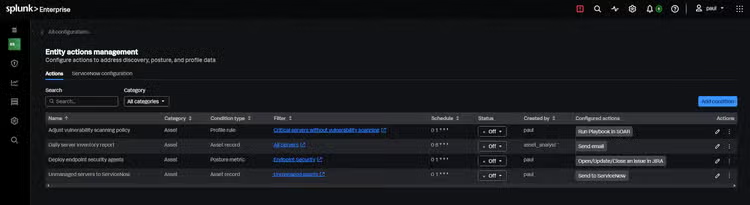
Turning Proactive Insights Into Proactive Action
Entity actions rounds out the new proactive security features in Exposure analytics introduced in Enterprise Security 8.8. Entity Discovery continuously discovers all assets and users; Entity Posture identifies security control gaps affecting these entities; Entity Profile adds contextual risk to prioritize remediation and focus investigations; and Entity Actions connect exposures to remediation workflows.
See It in Action:
The additional context provided by Exposure analytics also supports the Agentic SOC. When security teams and AI-assisted workflows can work from a clearer view of entities, exposure, and contextual risk, they make better, more informed and faster decisions.
Related Articles

Deep Learning in Security: Text-based Phishing Email Detection with BERT Model

Boss of the SOC (BOTS) Advanced APT Hunting Companion App: Now Available on Splunkbase