Enhancing SOC Efficiency with OCSF & Splunk Enterprise Security
What is OCSF? The Open Cybersecurity Schema Framework is an open-source, vendor-agnostic standard designed to simplify and unify the way security telemetry is structured and consumed. By providing a consistent schema for common event types across security products, OCSF enables faster data normalization, streamlined correlation, and more effective threat detection across diverse environments. It was built to reduce complexity and enhance interoperability across the modern security stack.
For a SOC Analyst, the Open Cybersecurity Schema Framework (OCSF) is a game-changer. By providing a common, vendor-agnostic data schema, OCSF helps streamline the normalization of security telemetry across tools–reducing the noise, accelerating detection and investigation workflows, and ultimately allowing analysts to focus on what matters most: identifying and responding to real threats.
Unified Data, Sharper Detections
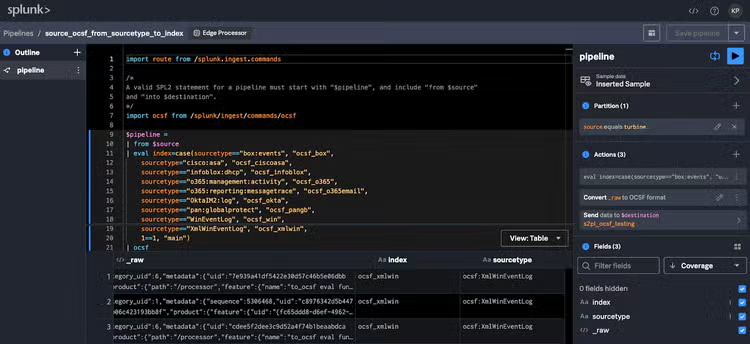
Within Splunk Enterprise Security (ES), a SOC Analyst can leverage OCSF-aligned data during normalization and correlation workflows, particularly through the use of the Common Information Model (CIM). OCSF-mapped data sources can be ingested into Splunk and aligned to CIM-compliant data models using props and transforms, enabling consistent field extraction, tagging, and acceleration of field lookups.
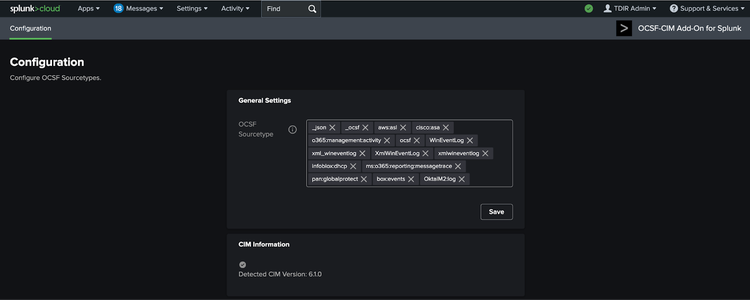
This alignment enhances the fidelity of correlation searches, risk-based alerting (RBA), findings, and events generation by ensuring uniform field semantics across disparate log sources. For example, disparate fields like src_ip, source_ip_address, and client_ip from different technologies are standardized under src_endpoint.ip through OCSF mapping, allowing detections to operate independently of vendor-specific schemas.
OCSF’s structured event classes — such as Authentication, ProcessActivity, or FileActivity — also streamline the development of correlation logic by providing predictable, semantically rich context around each event. This allows SOC Analysts to build precise, scalable, and reusable detections that operate reliably across hybrid environments (on-prem, Cloud, OT). Additionally, this reduces the need for custom SPL per source, minimizes false positives due to inconsistent field naming, and allows for more modular and portable detection content.
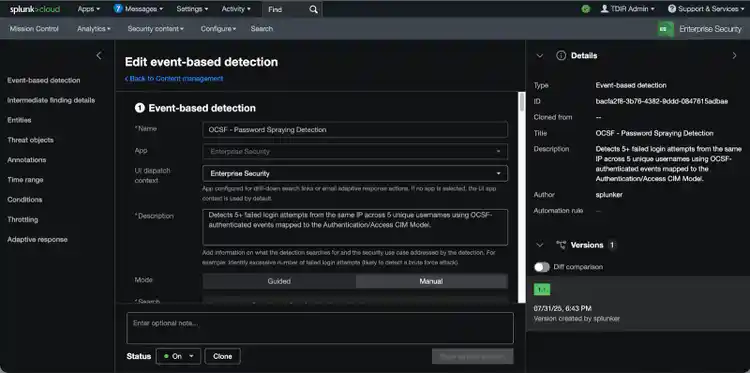
Alert to Action: Streamlining SOC Triage with OCSF & Splunk ES
Once OCSF-aligned data has been mapped and custom detections are in place, a triggered alert within Splunk ES flows directly into the Analyst Queue for triage as a finding. Thanks to the standardized field structure provided by OCSF and its alignment to Splunk’s CIM, SOC analysts can quickly interpret key context–such as event_class, actor.user.name, target.asset.hostname, security_result.outcome, and severity–regardless of the originating data source or vendor.
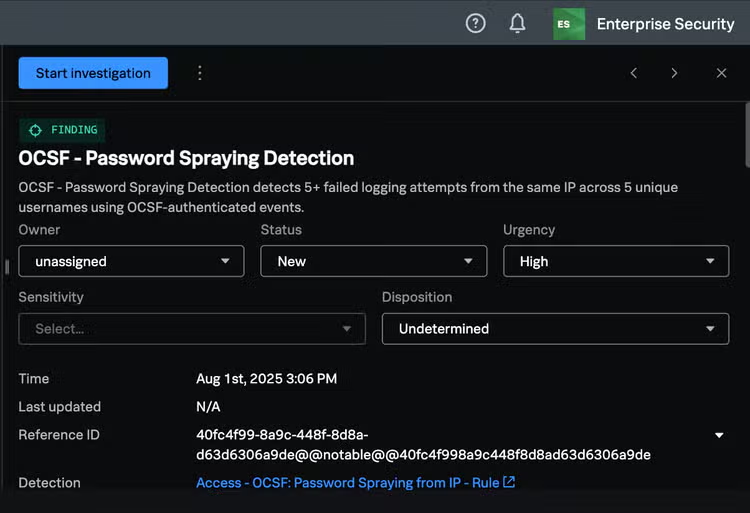
This schema consistency reduces cognitive load and enables faster analysis by allowing analysts to recognize and respond to familiar field structure across diverse telemetry. From the Mission Control/Analyst Queue, analysts can pivot into raw or contextual data using a wide range of Splunk’s ESinvestigative capabilities, explore upstream and downstream activity within the Investigation Workbench, and validate risk modifiers if the alert is part of the RBA chain.
For complex cases, SOC Analysts can review prior findings tied to the same entity (via risk_object) or investigate asset context through integration with the Asset & Identity Framework. OCSF-enriched events can also trigger mapped adaptive response actions–such as account lockdown, host isolation, ticket generation in ServiceNow or other ticketing platform, or enrichment via threat intelligence lookups–based on detection logic severity and playbook integration.
Enhance Your Detections with OCSF
This standardized triage workflow, powered by OCSF and Splunk ES, improves mean time to detect (MTTD) and mean time to respond (MTTR), while reducing errors in high-pressure decision-making. It also lays the groundwork for tiered analyst workflows and automation-ready processes that align with the MITRE ATT&CK framework and modern SOC best practices.
There is no better time to adopt OCSF than now. As threat volumes grow and environments become more complex, standardized, high-fidelity telemetry is no longer a luxury–it’s a necessity. SOC teams leveraging Splunk ES can immediately benefit from integrating OCSF-aligned data into their detection and response workflows. Start mapping your data sources, enhance your correlation logic, and empower your analysts to move faster with greater confidence. The future of streamlined, scalable operations begins with OCSF and Splunk ES.
To see a quick demo of this in action, click here, or contact our sales team to begin exploring how Splunk ES and OCSF can streamline your SOC team
Related Articles
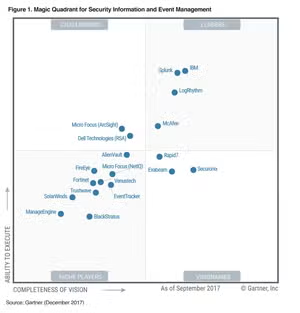
Splunk Named a Leader in Gartner SIEM Magic Quadrant for the Fifth Straight Year

Staff Picks for Splunk Security Reading June 2024