Why Observability Is Becoming Critical to Digital Trust in Healthcare
Partners Christine LowIn 2025, one theme keeps coming up in conversations with customers. Digital issues rarely start as major outages. They start quietly. A transaction takes longer than expected. An error pops up and disappears. Something that normally works just fine suddenly doesn’t – at least not every time.
At first, it’s easy to brush off. Nothing is technically broken. Alerts haven’t fired. But customers notice. They try again. They abandon the task altogether. They pick up the phone. By the time complaints start coming in or call-centre volumes spike, the experience has already suffered – and teams are left trying to catch up.
That gap between what systems say is happening and what customers are actually experiencing is what’s pushing many organisations to rethink how they manage digital performance.
This is where observability is increasingly changing the conversation. Instead of just showing whether systems are up or down, observability helps teams understand how performance issues emerge, where friction starts, and how quickly they can respond before small problems turn into bigger ones.
Splunk’s 2025 State of Observability report found organisations classified as observability leaders generate an average annual ROI of 125%, driven by reduced downtime, faster detection and resolution, improved productivity and stronger customer experience. Simply put, teams that can see what’s happening earlier tend to respond better.
That difference becomes even more obvious in industries where digital experience and trust are closely linked. Health insurance is one of them.
When Digital Performance Becomes a Trust Issue
For health insurers, digital channels are now the main way people interact with essential services — lodging claims, checking coverage, managing policies. When those experiences slow down or behave inconsistently, frustration builds quickly and trust is tested.
This is something we see regularly in Australia. Health insurers are operating under rising healthcare costs and increased regulatory scrutiny, while industry consumer watchdogs continue to rank the sector among the most complained-about financial services. In that environment, digital resilience directly shapes how members perceive reliability and care.
Bringing Observability Into Practice at HCF
One organisation navigating this shift is HCF, Australia’s largest not-for-profit health fund and a Splunk customer in Australia.
As digital engagement increased, HCF recognised that keeping systems online wasn’t enough. Teams needed clearer insight into how digital services were performing for members — and earlier signals when experience started to degrade.
Like many large organisations, HCF’s teams were working across multiple monitoring tools, each offering a partial view of the environment. That made it difficult to connect the dots between systems, or to see when a technical issue was starting to affect members.
To address this, HCF has moved to consolidate operational data from across its environment, using Splunk, AppDynamics and ThousandEyes, with all data consolidated in the Splunk Cloud Platform. This approach enabled HCF to gain a more complete, real-time view of performance. That context made it easier to spot patterns, prioritise issues and focus on what mattered most to members.
Claims quickly became a key focus. Speaking at Cisco Live in Melbourne last year, HCF’s Head of Networks and Reliability Engineering, Anton Eksteen, described how teams can now see claims activity as it happens — from transaction volumes to approvals, declines and where errors or timeouts begin to appear. Issues that once took hours to identify can now be surfaced within minutes, reducing the impact on members.
That visibility has also reduced the need for manual firefighting. When teams already understand the cause of a recurring issue, responses such as restarting systems or services can be automated, resolving problems faster and with less disruption. Engineering teams also use the same data to quickly see the user-facing impact of backend changes, helping confirm whether improvements are working as expected.
Digital Resilience as a Business Catalyst
Observability is no longer just about troubleshooting. It’s becoming part of how organisations manage risk and resilience.
Our report found that nearly two-thirds (64%) of leaders say closer collaboration between observability and security has reduced incidents that affect customers. More than three-quarters (76%) also say the ability to detect application security vulnerabilities is important to overall business outcomes.
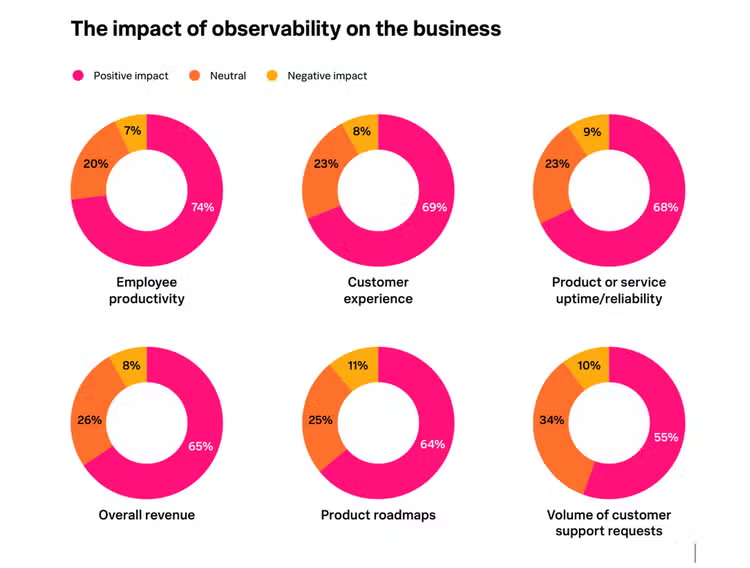
Together, those insights help explain why observability is increasingly seen as a business catalyst. When teams can see issues earlier, understand their impact and respond faster, they’re better equipped to protect trust — no matter the industry.
As digital expectations rise, some sectors are already ahead. Financial services and manufacturing have been early adopters of mature observability practices, driven by clear impact on revenue protection, product performance and supply-chain resilience. Splunk customers such as Repay and Bosch have embedded deep operational visibility to detect issues early and limit downstream impact.
Healthcare now faces a similar opportunity. By applying the same level of end-to-end visibility across member-facing, clinical and administrative systems, organisations can strengthen digital trust at the moments that matter most.
Related Articles

Threat Update: AwfulShred Script Wiper

regreSSHion: Uncovering CVE-2024-6387 in OpenSSH - A Critical Vulnerability