What the North Pole Can Teach Us About Digital Resilience
Observability Ben LovleyLast year I wrote about Santa tracking as a way of thinking about operations, visibility, and scale. At the time it was deliberately light-hearted, but the point underneath it was serious. Large systems fail in familiar ways, and we tend to underestimate how early those failures start.
This year I revisited the North Pole operations Centre (everyone loves a rename), and focussed on building a more complete view of arguably the biggest global operation there is. Not because the dashboard needed more decoration, but because the operational story was incomplete.
What became clear, very quickly, is that Christmas is not a delivery problem. Delivery is simply the outcome of a much longer chain of decisions, constraints, and trade-offs. If anything goes wrong in the business process, delivery just happens to be typically where it becomes visible.
That may feel familiar.
Operations Before Outcomes
Most Santa trackers start the moment the jolly fellow leaves the North Pole. They show location, progress, and totals delivered. That is reassuring, but it is also misleading. By the time those numbers move in the wrong direction, there is very little left to do about it. You can ask Arthur Christmas to confirm.
Resilient operations may focus on outcomes, but they consist of capacity, flow, balance and metrics.
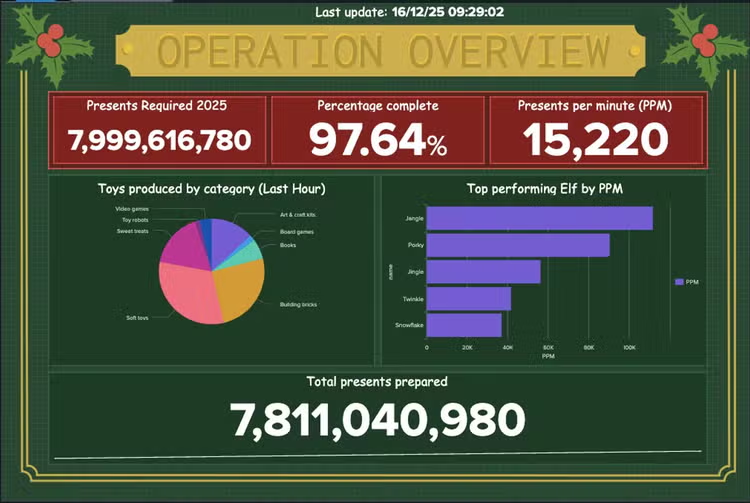
In the North Pole, that means understanding how many presents are required, how many are prepared, and how quickly the gap between the two is closing. It means knowing whether production is accelerating, plateauing, or quietly falling behind. It also means seeing whether the mix of what is being produced matches what is required based on demand.
Stress Is the Normal State
One of the traps we can fall into when talking about resilience is treating stress or load as an anomaly. Something that arrives unexpectedly and should be eliminated.
The North Pole does not have that luxury. It operates under sustained, predictable stress every single year. The deadline does not move, demand does not soften and variability is guaranteed.
Resilience, in that context, is not about coping when something goes wrong. It is about functioning when things are permanently close to their limits.
This is where Splunk’s definition of resilience matters. The ability to anticipate, withstand, recover, and adapt is not sequential. In high pressure operations, all four are happening at once.
The dashboard is really a reflection of that idea. It is less about detecting incidents and more about understanding how close the system is to its edges.
People Are Not Separate From the System
There is a tendency, particularly in technical organisations, to draw a neat boundary around “the system” and leave people outside it. The classic people, technology and data problem.
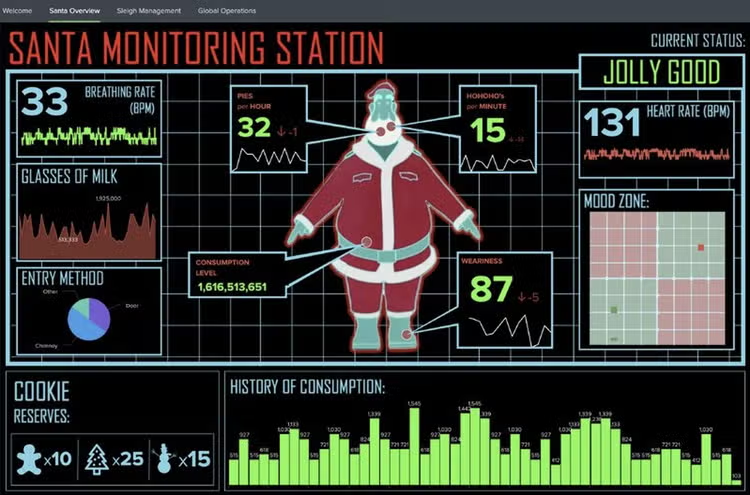
Santa is not a symbolic figure in operational terms. He is a critical dependency. His health, energy levels, alertness, and fatigue all have direct consequences for the success of the operation.
Monitoring that is not a joke. It is no different from monitoring the health of any other constrained resource in a complex system.If your operation relies on sustained human performance, then ignoring human signals is not kind or pragmatic. It is negligent.
Resilient organisations do not design systems that only work when people are superhuman. They design systems that adapt when people are tired, stressed, or overloaded.
Decision Making, Not Decoration
As Christmas Eve approaches, the nature of the problem changes. Preparation gives way to execution. The questions stop being about capacity and start being about choice.
Routes. Weather. Regional risk. Timing. Trade-offs.At this point, resilience is no longer an abstract quality. It is expressed through decisions. Do you push on, slow down, reroute, or accept risk in one place to protect another?
This is why observability matters, but it is also why observability alone is insufficient. Visibility only creates value when it supports deliberate, informed decision making.
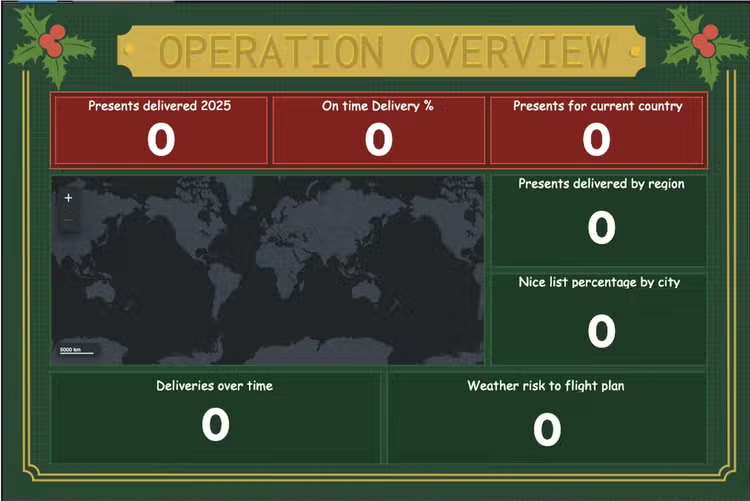
The delivery view of the dashboard exists for that reason. Not to reassure, but to inform.
Why This Still Matters
It would be easy to dismiss all of this as seasonal theatre. A festive dashboard. A technical curiosity.
But the reason Santa tracking continues to resonate is because it strips away complexity without removing reality. No one debates the scale. No one questions the deadline. No one argues that failure is acceptable.
Most real organisations face the same structural challenges. They just hide them behind language, process, and optimism.
Resilience is not about dashboards, tools, or slogans. It is about whether an organisation understands how it actually works when it is under pressure.
The North Pole just happens to make that visible.
Call to Action
If you would like to track the preparation to the big day and see if everything is on schedule live; or if you would like to track Santa on the big day to see where he is and when your due to have a visit, please visit our live Splunk dashboards!
Live Splunk Dashboards: https://santa.splunk.engineer/
Related Articles

The Five Tenets of Observability

Intro to Python Frameworks Part 2 – Full-Stack vs. Micro Framework