It’s time to rethink your approach to SAP monitoring
SAP, the world’s leading enterprise resource planning (ERP) system, is widely used by organizations across the globe. Since its inception in the 1970s, SAP has become the top choice for supporting the most critical and deeply integrated enterprise applications.
In fact, IDC notes that SAP is a market share leader in analytics and business intelligence, ERP and supply chain management. Ninety-nine of the 100 largest companies worldwide are SAP customers, generating 87% of total global commerce ($46 trillion). There are more than 425,000 SAP customers and 300+ applications, including ERP, customer relationship management (CRM) and business warehouse (BW).
In short, SAP is everywhere, defining the foundational processes that support business operations for a vast swath of global enterprises.
And yet SAP observability has many challenges
IT organizations today are monitoring and measuring increasingly complex environments, resulting in an intricate mix of difficult systems to manage, maintain and secure. As tech stacks become more distributed and dynamic, SAP observability strategies must evolve to gain the critical insights needed to align SAP with the business.
The bad news? Today it’s both time-consuming and expensive to observe and troubleshoot SAP and its respective applications — as well as third-party applications. The rise of cloud, microservices, continuous delivery — and, of course, SAP environments — has generated ever-growing volumes of data with no end in sight.
Traditional SAP monitoring tools — including the vendor’s own Solution Manager (or SolMan, which by design is a lifecycle management tool) — fall short of providing the full visibility that customers need. SolMan, for instance, can only make sense of data generated by SAP environments, missing the complete production environment and leading to slow root cause analysis and difficulty correlating issues to the end user’s experience or the business. Nor can it provide a direct link to the line of code, including ABAP (SAP’s proprietary programming language), or offer visibility into applications integrated with SAP, potentially leading to problems during an upgrade or migration.
SolMan’s limited visibility into complex SAP and integrated environments can lead to additional headaches as well, including unhelpful alert storms where the lack of intelligent baselining for problem identification creates unnecessary noise and slow remediation, resulting in costly and time-wasting war room finger-pointing. In addition, SolMan provides only basic performance metrics for non-SAP systems and lacks the ability to follow a business process beyond an SAP environment, making it impossible to talk to external systems.
Other monitoring solutions also fail to provide effective SAP observability. Cepheid, a leading molecular diagnostics company, was manually monitoring its SAP applications in each shift — spending roughly six hours a day observing the environment to make sure nothing went down. Cepheid adopted AppDynamics for SAP as its go-to observability solution, providing proactive, real-time monitoring of all its SAP resources and applications. Cepheid now receives automated alerts when it needs to fix issues before they become problems.
Similarly, premium clothing manufacturer Carhartt has a sprawling business footprint. Its front-end systems, including customer-facing e-commerce and retail partner sites, connect to an order management system that communicates with SAP for ERP and inventory and warehouse management systems. AppDynamics Business iQ, for industry-leading real-time business performance monitoring, made it possible to watch each e-commerce application and retail location closely for excessive log-ins and other potential security vulnerabilities. Carhartt also monitors the end-to-end flow of traffic to instantly understand when channels aren’t flowing properly.
The company is also undertaking a major digital transformation to replace conventional on-prem IT systems with more flexible and scalable cloud systems. Carhartt’s limited insight into its complex, sprawling IT environment was impacting its bottom line — where an hour of downtime could cost millions of dollars in lost revenue. The answer was to adopt an AppDynamics for SAP-optimized observability solution that enabled the company to unify previously disparate application and network monitoring efforts, gain greater operational insights and help ensure the long-term success of its digital transformation initiative.
Simply put, observability shortcomings are clearly a problem when SAP is at the heart of how your digital business operates. Therefore, building resiliency into your SAP landscape is critically important.
SAP and digital transformation
Many organizations undergoing digital transformation are moving their on-prem workloads and applications to the cloud, or their legacy SAP system to S/4HANA®, as SAP support for ECC (ERP Central Component) will end in 2027. So, SAP environments still need a next-gen performance management solution that can monitor ABAP and provide real-time visibility into application performance before, during and after an upgrade or migration.
Of course, SAP migrations are complex and costly — often multi-year, multi-million dollar initiatives. Multinational conglomerate 3M, for instance, began its migration to S/4HANA and AWS in 2018 and estimates its journey is still about two years from completion. This intricate process has impacted a large number of the company’s business-critical applications, many of which experienced various errors when moving to the cloud. By implementing an observability solution early — one that enables IT teams to monitor and compare the full results of the ongoing migration before, during and after — 3M has gained critical insights to know with certainty when cloud applications are ready to launch.
SAP observability done right
An effective observability solution should empower SAP and IT teams in several critical areas of operational improvement. SAP monitoring must be a proactive — not reactive — process that happens in real time. When migrating to S/4HANA or the cloud, teams need to understand their applications’ health throughout the difficult journey. Empowered with continuous insights into how end users use the system and how new releases impact their experience, companies can not only de-risk a migration project but accelerate it as well.
In general, observability essentials include:
- Real-time visibility into application performance before, during and after a migration or upgrade.
Custom dashboards that enable IT teams to develop a comparative analysis — contrasting side-by-side production and canary deployments. - The ability to quickly mitigate risks and address impacts before users transition to the new deployment, or before teams make changes to the production environment.
- Leveraging artificial intelligence and machine learning (AI/ML) to understand “normal” behavior and help teams set baselines to detect anomalies.
- Enable IT staff to spend more time focused and aligned on achieving business outcomes rather than on resolving issues.
Modern SAP observability is all about gaining the insight you need to better align SAP with the business. No matter how complex tech stacks become, your business goals remain the same: Serve your customers and protect the bottom line.
An effective SAP observability strategy must evolve to do exactly that. Learn how Cisco AppDynamics can enable you to monitor your SAP environments with a solution that not only minimizes risk but also builds a strategic and cost-effective approach to digital transformation. Learn more with a live demo from one of our performance experts.
Related Articles
New Splunk Synthetic Monitoring Features Help Integrate Uptime and Performance Across the Entire Splunk Platform
Start Your Engines, Data Drivers
How Splunk Is Parsing Machine Logs With Machine Learning On NVIDIA’s Triton and Morpheus
Splunk IT Essentials Work: A Centralized App for All Things ITOps
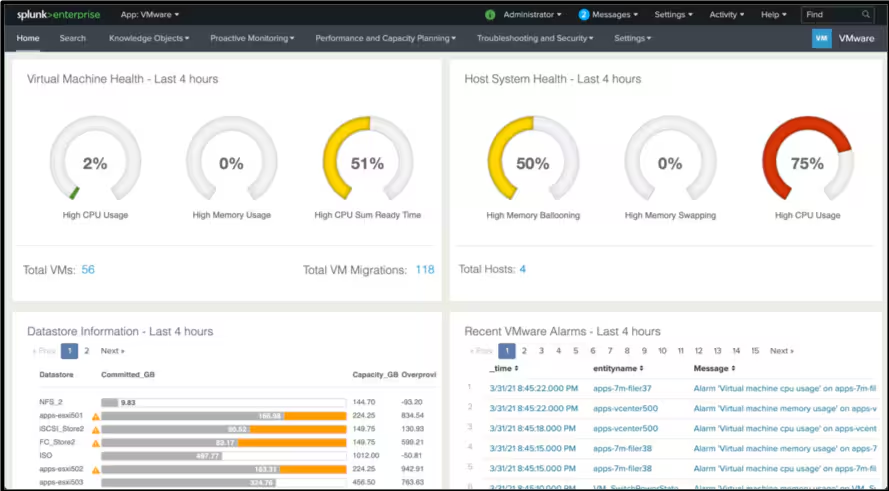
Monitor and Troubleshoot VMware Infrastructure with Splunk
Splunk Developer Spring 2021 Update

Getting Started with OpenTelemetry Python v1.0.0
Low Latency Observability Into AWS Services With Splunk