What is Multicloud? An Introduction
Simply defined, multicloud (or multi-cloud) describes a computing environment that relies on multiple SaaS or cloud services for different workloads within a single architecture.
In a multicloud approach, organizations may use public cloud providers such as Amazon Web Services (AWS) for infrastructure, Microsoft Azure for platform, and Google Cloud Platform for development. While multicloud architecture provides critical benefits, it’s also more complex than a single-vendor environment, underscoring a growing need for unified management capabilities.
A multicloud deployment can help businesses realize a significant return on their investment by distributing workloads across multiple providers. These benefits include cost savings, increased reliability and performance, more flexible operations to avoid vendor lock-in and even security enhancements. At the same time, multicloud can present challenges, adding complexity and introducing new privacy-related considerations to already challenging cloud computing environments.
Multicloud management systems are a key solution to these concerns, offering organizations end-to-end visibility and insights into the entirety of their cloud environment. In this blog post, we’ll examine the risks and opportunities created by multicloud environments, including best practices on how to make these environments more manageable.
Multicloud vs Hybrid Cloud: What's The Difference?
Multicloud and hybrid cloud are often confused, or used interchangeably, but the difference is that multicloud environments are built around multiple public cloud services, while hybrid cloud includes private cloud services alongside public cloud services. Both environments can coexist in organizations that operate some form of a private data center while also utilizing public cloud services.
Hybrid cloud, however, presents a more complex manageability problem than multicloud, as it involves two distinctly different infrastructure designs — cloud and on-premises. It’s generally easier to collectively manage services in a pure multicloud environment because they’re available on the public internet. A hybrid cloud environment includes management of both public services and private ones, which will involve overseeing multiple security protocols — particularly if data on the organization’s private cloud services need to be excluded from use on public cloud services.
Hybrid clouds are very common today, especially as many organizations are cautious in their migration to public cloud services involving sensitive data.
(Related reading: hybrid computing.)
Creating a Multicloud Strategy
Many — and arguably, most — IT teams don’t set out to create a multicloud strategy, but rather find themselves with one after years of slowly and organically piecing together public cloud systems as needed. Over time, organizations often find themselves with a messy collection of services and an archaic cloud management strategy — typically because they have limited visibility into how data flows among these services, the data center and client devices. Security is also a natural concern.
In getting started with a successful multicloud strategy, here are some key considerations:
- Audit your existing services and clarify the purpose for each. Many organizations fully democratize cloud services, giving numerous stakeholders the ability to source and operate their own cloud services as needed. While this gives the organization agility, it can also lead to duplicated effort, increased expenses and added complexity. When executing on your multicloud strategy, step one should be to determine every cloud deployment currently in operation at your organization, as well as its purpose and efficiencies.
- Consolidate clouds where possible. Organizations shouldn’t rely on a half-dozen different cloud-based data storage systems, as this can leave them vulnerable to unnecessary risk. Be judicious about your cloud migration strategy, and consolidate different tools and solutions where possible. This way, you can bring the total number of cloud deployments under control.
- Understand data flows among clouds. How do various cloud services interact? What type of interaction is acceptable in the future? Establish rules regarding the types of data allowed to reside on each service and rules for how this data must be treated when it’s in motion (e.g., encryption level, privacy, etc.).
- Consider workload distribution among cloud services. With cloud adoption, determine which service is best suited for each required purpose or application. This can be done by benchmarking the same operation on various services and determining the fully loaded cost for running that operation. This data can then be compared and analyzed to determine which service is best suited for each workload, helping to further consolidate your cloud environment.
- Interconnect and manage multiple cloud services. Be sure to test cloud management platforms that offer multicloud manageability and are compatible with all the systems on your curated list of cloud services, as well as any systems you might consider adopting down the road. What is the dashboard or user interface like? How steep is the learning curve? And do these tools offer automation systems that can also provide easier methods of managing your multicloud environment?
- Develop a long-term plan. Develop strategies for keeping costs and vendor sprawl in line, and develop ways to determine whether cloud services are fulfilling a real business need in your organization. Set metrics that will help you determine when it’s time to sunset a certain cloud computing service — or when to give it greater workloads.
Common Benefits & Opportunities of Multicloud
A multicloud environment offers some key potential benefits, including:
- Cost savings: Multicloud lets you pick and choose service providers based on how effectively, and affordably, they can do a certain job.
- Better flexibility: If you’re not locked into a single provider, you’re better able to pair a given workload with the most capable service that can scale with your organization.
- Better reliability: If one service experiences latency or goes down, you can more easily migrate your workloads to competing services, ensuring better uptime.
- Better performance: Distributing workloads across multiple clouds can lead to workflow optimization and boost performance, especially in times where demand is high, such as the holiday shopping season.
- Improved security: If one cloud service provider is the victim of a distributed denial of service (DDoS) attack, you can quickly move your services to a different cloud system and avoid significant damage.
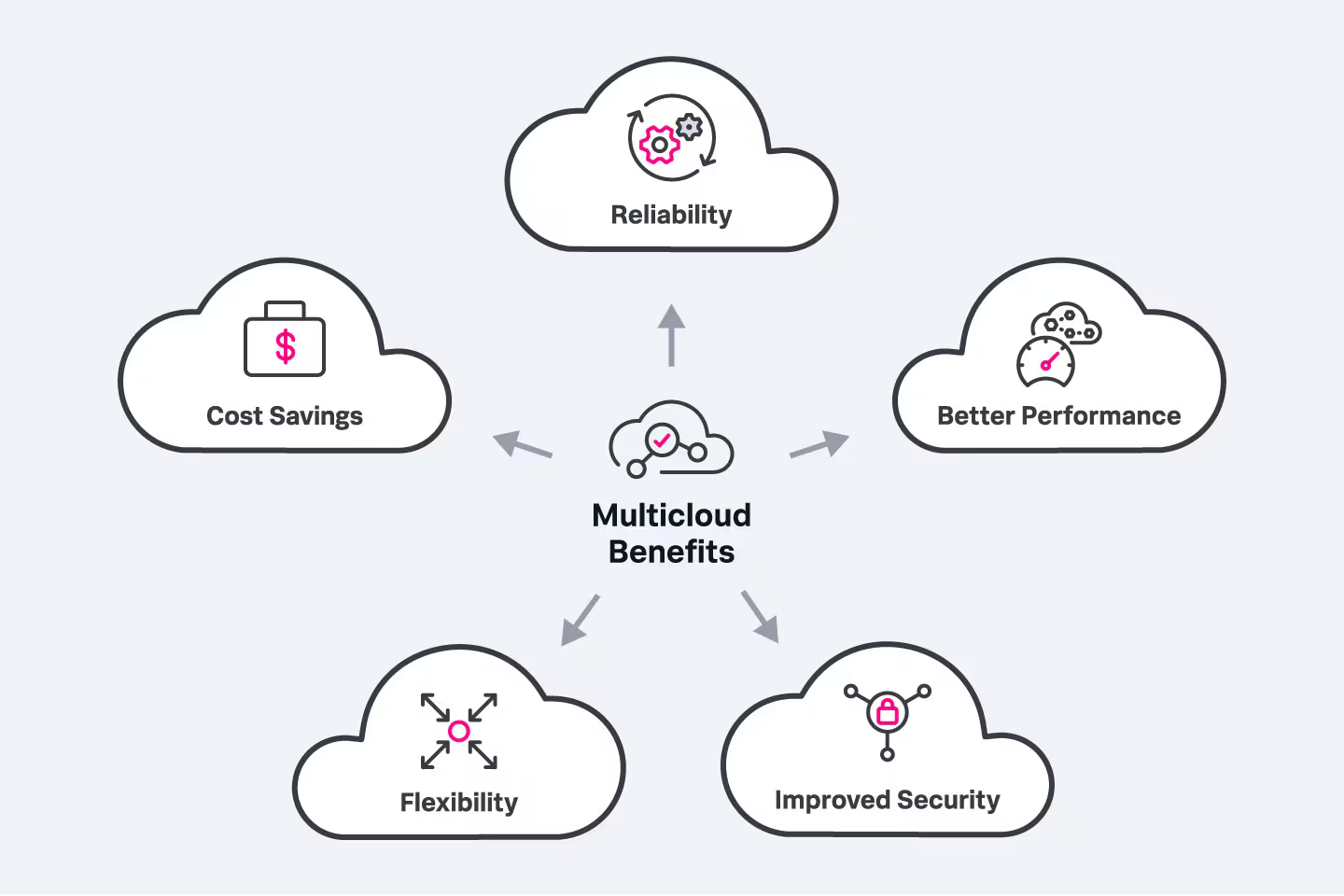
The primary values of multicloud are flexibility, resilience and agility. And with the ability to shift workloads from one cloud platform to another, the organization is able to draw from a much broader pool of services and a wider array of cloud offerings. Drawing from multiple cloud services allows an enterprise to build a robust solution that is tailored specifically to its needs.
Multicloud also prevents vendor lock-in. With all your organization’s proverbial eggs in a single basket, a cloud provider may be reluctant to provide the highest quality service, knowing that you have no other choice but to continue using its services. Locked-in customers may find costs rising more quickly as well; at the very least, it puts the organization at a distinct disadvantage when negotiating pricing.
Ultimately, multicloud helps to improve your organization’s ability to execute on these innovations, giving you the ability to pair every workload with the most suitable cloud platform.
Common Challenges of a Multicloud Environment
While multicloud environments offer many benefits, numerous challenges are innate with this strategy, including the following:
- Multicloud is naturally more complicated: It stands to reason that managing multiple workloads on a single cloud provider will be simpler than if they’re spread across multiple service providers. More than any other factor, an environment with different vendors and different providers has led directly to the need for multicloud management systems. In general, cloud vendors prefer you to use their services for all of your workloads, as well as their own proprietary management tools, making it difficult to integrate multiple vendors’ offerings together.
- Multicloud can create security and privacy headaches: The more cloud services that you operate, the more you will need to concern yourself with the specific security protocols of each. This becomes even more complex when data moves between one or more cloud services, creating privacy issues that violate regulations such as the General Data Protection Regulation (GDPR), the Health Insurance Portability and Accountability Act (HIPAA) and others.
- Identifying the right cloud services is time-consuming: It’s no easy task to benchmark the same workload on multiple services to determine which is fastest or best suited for the job. Configuring each service identically isn’t always possible and network conditions may vary, which can make comparing services something of an “apples vs. oranges” situation.
- Managing costs is more complex: With multicloud, the enterprise has to manage multiple bills, requiring increased diligence to ensure costs don’t spiral out of control as usage increases.
- Qualified workers are scarce: Multicloud management is not a common skill in the current marketplace, and finding staff can be difficult (and costly).
Pros and Cons of Multicloud Storage
Multicloud storage — specifically the storage of data on multiple cloud services — presents a particularly challenging use case for the enterprise.
On the upside, multicloud storage provides a seamless way to back up data for disaster recovery efforts. Data can be mirrored to multiple services so that if one cloud provider suffers an outage or data corruption issue, the data can still be retrieved from the second cloud provider, offering better reliability, stronger functionality and potentially increased uptime.
On the downside, managing data that lives in more than one place is complicated. What happens if a change is made on one service, but that change isn’t reflected on the other due to an outage, error or other cause of unexpected downtime? Without a single source of truth, replicated data can create messy redundancies, lead to inconsistencies and, ultimately, business mistakes.
Security Risks of a Multicloud Environment
Even the new cloud security challenges and risks shouldn’t stand in the way of your migration to a multicloud environment. Here are some of the biggest risks to consider:
- Coordination and orchestration of multiple security protocols is difficult: Every cloud environment is different, which means each one will need to be managed individually. That requires understanding each system’s unique security protocols, particularly when data moves through multiple platforms, in addition to data governance or privacy issues.
- Security threats multiply: Your attack surface expands with each cloud service you spin up. Attackers who are unable to break into one cloud service or system can then redirect their efforts to another, all in the hopes of eventually finding an exploitable weak link.
- Democratizing cloud services creates an authentication risk: When workers pick and choose their own cloud services, you implicitly allow them to determine who has access to those services. Many organizations don’t have a centralized framework for authentication and access control, creating uncoordinated user management problems.
- Centralized security monitoring is complex: How will your organization keep tabs on security breaches, ensure code is properly patched and updated, and keep configurations secure? Doing all of this on one cloud service is difficult — and even more complex on multiple cloud platforms.

There is no magic bullet that can address all the risks associated with multicloud security, but adopting a multicloud management platform is the first step toward creating an integrated, cohesive security strategy. These tools help you manage and monitor security conditions, provide multi-platform analytics and otherwise simplify administration. These tools can also be useful in synchronizing your security policies from one vendor to another while improving your overall visibility into each cloud platform.
How to Get Started with Multicloud
As noted earlier, most businesses end up with a multicloud environment by accident, due to a natural proliferation of cloud services over time. As such, organizations will have to determine the best use of their existing multicloud environment, essentially answering the question: How do you take a haphazardly created multicloud environment and turn it into something more robust and manageable?
As a first step, it’s important to understand that multicloud does not mean every cloud. With each additional cloud service, management becomes more complex — even with a multicloud management tool in place. It’s a good idea to audit all of your cloud services at the start. Weed out duplicate, unused and overpriced platforms; consolidate services where it makes sense. Hiring experienced multicloud professionals is also essential early on, as having the necessary expertise on hand to guide you through this process will be crucial down the line. If your existing team is experienced only in AWS, you may want to hire staff with expertise in Azure or Google Cloud, depending on where your multicloud future lies.
From there, you’ll need to begin building a data management strategy that focuses on interoperability and security. Standardize policies and adopt common data storage formats that make it easier to move workloads from one cloud to the next. Finally, investigate centralized multicloud management tools. These can be essential in gaining control over complex multicloud environments, giving you a single dashboard on which you can view and interact with the entirety of your cloud environment from a central location.
The Bottom Line: Multicloud pairs the right service with the right need
Managing and monitoring workloads across multiple clouds is still not a simple process: siloed tools, inconsistent policies and incompatible management tools add a lot of complexity. However, the added operational flexibility and potential for significant cost savings more than compensate for these concerns. By using a multicloud management tool (and having a skilled team to operate it), you can more easily navigate these sometimes confusing waters and gain comprehensive, real-time visibility into your cloud operations no matter how many different platforms you’re working with.
FAQs about Multicloud
Related Articles

Maximum Acceptable Outage (MAO) Explained

SRE vs. DevOps vs. Platform Engineering: Differences Explained

What Is Threat Hunting?

Data Pipelines & Optimizing Pipeline Efficiency

Snort Rules 101: Examples & Use Cases for Snort Network Defense

Information vs. Operational Technology: IT vs. OT Explained

What Is Lateral Movement?

What’s Chaos Monkey? Its Role in Modern Testing